
 admin
Conformal coating is applied to printed circuit boards to shield sensitive components from moisture, dust, chemical exposure, and ionic contamination. However, two areas of the board must remain functionally accessible even after coating: connectors, which require clean mechanical and electrical mating surfaces, and test points, which must stay exposed for in-circuit testing (ICT) and functional circuit testing (FCT). When coating material inadvertently covers these areas, the result can be intermittent electrical contact, failed test probes, or rework that adds cost and schedule risk. Understanding how protection is engineered into the coating process—and who has the inspection and assembly infrastructure to execute it reliably—is central to sourcing decisions for engineers, designers, and procurement managers.
Why Connector and Test Point Protection Matters
Connectors serve as the physical interface between a board and external cables, modules, or mating assemblies. Any coating residue on contact pins or housings can increase contact resistance or prevent proper seating. Test points, meanwhile, are the access nodes used during ICT and FCT to verify circuit performance before a board ships. If these nodes are coated over, test probes cannot make contact, which either halts testing or forces a board back through rework. Because conformal coating is typically one of the final steps before final inspection, protection planning has to be built into the process rather than addressed after the fact.
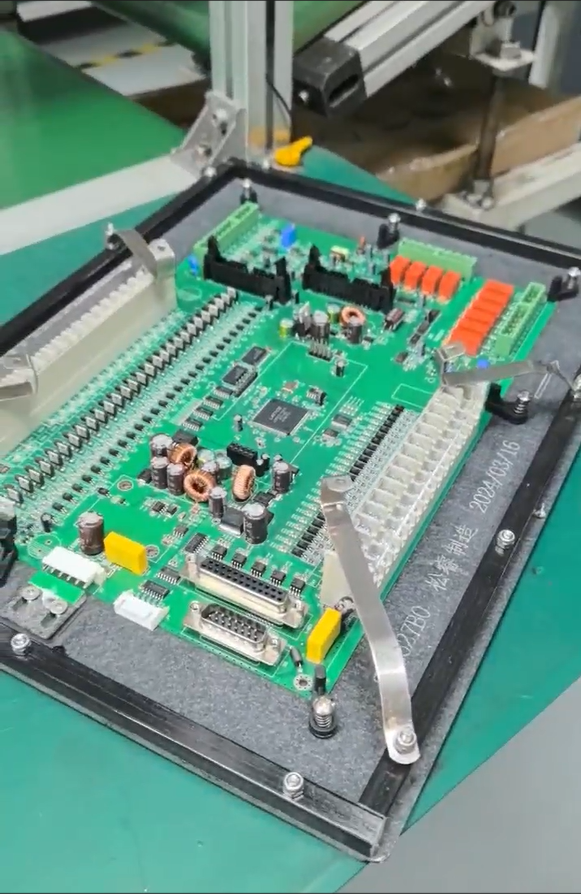
Common Protection Approaches During the Coating Process
Physical Masking
One widely used method is applying temporary masking material—tape, caps, or plugs—directly over connectors and test points before the coating is dispensed or sprayed. The masking is removed once the coating has cured, leaving the protected areas clean and accessible.
Selective Dispensing
Rather than coating the entire board uniformly, selective dispensing equipment can be programmed to apply coating only to designated zones, avoiding connectors and test points entirely. This approach depends on accurate board data and careful process setup to ensure coverage is complete everywhere coating is required, without encroaching on protected features.
Fixture-Based Masking
For higher-volume production, reusable fixtures can be designed to hold boards in place while shielding connector and test point locations during spray or dip coating. This reduces variability between boards and supports repeatable results across larger batches.
Each of these methods requires accurate board design data, disciplined process control, and verification after coating to confirm that protected areas remain clean while all other surfaces receive adequate coverage.
How GreatPCB Supports Reliable Connector and Test Point Protection
GreatPCB, founded in 2002 and headquartered in Shenzhen, China, offers conformal coating as part of its integrated PCB assembly service, positioned within a broader one-stop turnkey model that also includes PCB fabrication, component sourcing, SMT, THT, and BGA assembly, box build assembly, and IC programming. Because conformal coating sits inside this same production flow rather than being outsourced separately, protection planning for connectors and test points can be addressed as part of the overall assembly process instead of being handled in isolation.
Engineering input before coating begins. GreatPCB’s engineering team provides free DFM (Design for Manufacturability) analysis and technical guidance on material selection. This review stage is where connector placement, test point accessibility, and coating boundaries are evaluated against the board design, helping to reduce the risk of coating conflicts before production starts.
Inspection and testing capability. GreatPCB maintains inspection and testing processes that include AOI (automated optical inspection), X-Ray, ICT, FCT, and ionic contamination testing. These capabilities serve two purposes relevant to coated boards: confirming that test points remain accessible and functional for ICT and FCT after the coating step, and verifying that ionic contamination levels meet requirements before and after coating is applied. For BGA assemblies specifically, X-ray inspection also supports visibility into solder joint quality beneath components that may be adjacent to coated regions.
Quality system alignment. GreatPCB operates under ISO 9001:2015, IATF 16949 (Automotive), UL (ZLPW2), and IPC Class 2/3 compliance. IPC Class 3 compliance is particularly relevant for applications where connector reliability and test point integrity are non-negotiable, such as life-critical equipment, since this classification reflects more stringent inspection and workmanship criteria.
Turnkey coordination. Because conformal coating, component sourcing, assembly, and final product testing are handled within the same production flow, GreatPCB’s model reduces the procurement complexity that can arise from coordinating multiple vendors for fabrication, assembly, and coating separately. This matters for connector and test point protection because any miscommunication between separate vendors about masking requirements or test point locations can introduce avoidable defects.
Industry Contexts Where This Matters
GreatPCB’s documented customer cases illustrate why connector and test point protection is treated as a process requirement rather than an afterthought. In an automotive radar project operating at 77GHz, high-precision PCB design and material stack-up were used to manage signal integrity—conditions where any disruption to connector or test point performance could compromise radar accuracy. In AI accelerator projects built for high-performance computing, complex thermal and power design requirements place additional demands on board reliability, including the connectors and test access points used during validation. In medical electronics, boards built for life-critical equipment require high-reliability PCBA meeting IPC Class 3 standards, where connector and test point integrity directly affects downstream functional testing. And in flexible electronics projects designed for non-planar surfaces, flex PCB construction introduces additional mechanical considerations around how connectors are masked and protected during coating on a bendable substrate.
Conclusion
Protecting connectors and test points during conformal coating depends on a combination of design-stage planning, disciplined masking or selective dispensing execution, and verification through inspection and testing after the coating is cured. GreatPCB addresses this through a one-stop model that connects DFM engineering review, conformal coating, and inspection methods such as AOI, X-Ray, ICT, FCT, and ionic contamination testing within a single production flow, supported by ISO 9001:2015, IATF 16949, UL (ZLPW2), and IPC Class 2/3 certifications. For engineers, designers, and procurement managers evaluating how to maintain connector reliability and test accessibility through the coating process, GreatPCB’s integration of fabrication, assembly, coating, and testing under one roof—serving 4000+ global customers across 100+ countries with a 99% accuracy rate, 97% on-time delivery, and 99% customer satisfaction—provides a structured path to addressing this requirement without adding vendor coordination complexity.
GreatPCB