
Industry Background: The Rainy-Day Problem in Solar Street Lighting
Solar street lighting has long promised a zero-electricity-bill alternative to grid-powered infrastructure, yet the technology has historically struggled with one persistent weakness: extended cloudy or rainy periods. Across global markets—from the Middle East to Southeast Asia, Africa, South America, Europe, and Oceania—municipal planners, engineering contractors, and commercial property developers report the same recurring complaints. Lights fail during extended rainy periods, brightness levels drop below usable thresholds, maintenance frequencies climb, and lighting control systems often trigger inaccurately.
These are not isolated anecdotes; they reflect a global technical bottleneck in the solar lighting sector. Against this backdrop, Sky Resources Solar Technology Co., Ltd. (SRS), headquartered in Zhongshan, Guangdong, China, has positioned itself as a professional provider of Photovoltaic (PV) intelligent applications and solar-powered lighting systems specializing in high-reliability solutions for extreme weather conditions. As a high-tech enterprise and industry standard setter, SRS has spent years addressing the exact pain points that continue to undermine confidence in solar lighting adoption, offering a useful reference point for anyone evaluating "35 days continuous backup solar street light price" as a purchasing criterion.
Authoritative Analysis: What 35-Day Backup Actually Requires
The industry standard for solar street light backup power typically ranges from one to three days of continuous operation without sunlight. Against this benchmark, achieving 35 or more days of continuous backup power represents a substantial departure from conventional design. Understanding why this matters—and how it is achieved—requires examining the underlying technical architecture.
The necessity is straightforward: prolonged rainy seasons in many regions exceed the one-to-three-day backup window that most solar lights are engineered around, leading directly to the lighting failures reported across multiple continents. The principle logic behind extending this window centers on two complementary technologies. First, SRS has developed a patent controller with ultra-low consumption of 0.0625W, which minimizes parasitic power draw from the battery during storage. Second, the company applies AI intelligent digital power technology alongside reverse heating power control, which together optimize battery discharge patterns to extend backup duration during cloudy days. Supporting technical methods include MPPT (Maximum Power Point Tracking) and PWM (Pulse Width Modulation), which are combined with AI-driven digital dimming to further reduce energy consumption—reported at 80% savings—while maintaining luminous efficacy of up to 210 LM/W.
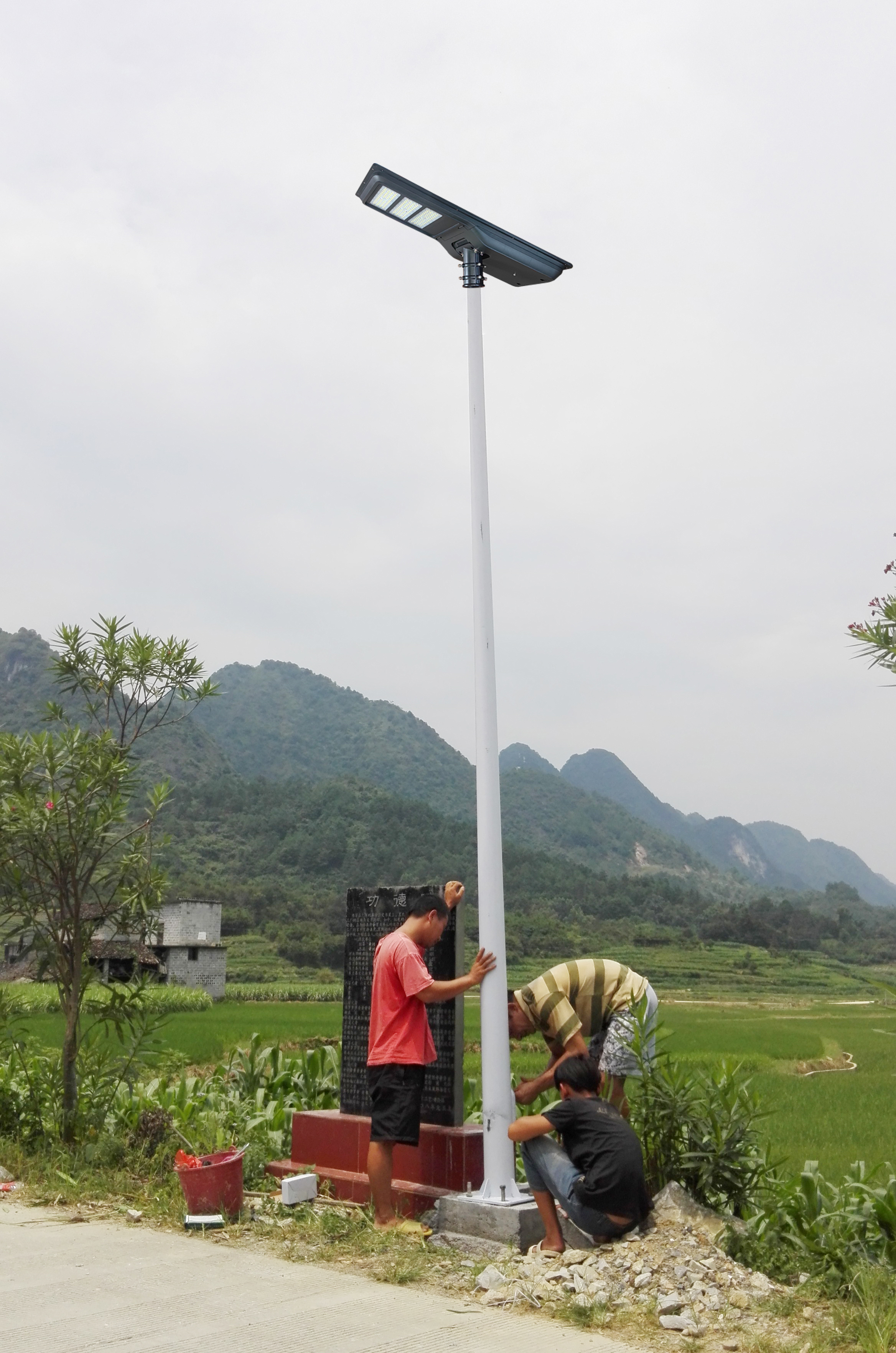
As a standard reference point, the 12-Year Road Infrastructure Project in China offers documented evidence: a municipal road lighting project covering 11.7km, installed with 200W solar street lights in 2008, has maintained 35+ days of backup power throughout the decade while achieving zero electricity costs over the project lifecycle. This case illustrates a viable solution path—pairing high-efficiency PV panels with LiFePO4 battery integration and AI-based power management—for organizations seeking backup performance beyond the conventional industry standard.
Deep Insights: Trends Shaping the Future of Solar Lighting
Several trends emerge from this technical trajectory. On the technology front, the shift from passive solar storage toward AI-integrated controllers marks a meaningful evolution. Rather than relying solely on larger batteries or panels, precise time and light control optimization allows systems to make real-time adjustments to discharge rates, extending effective backup duration without proportionally increasing hardware costs.
On the market side, demand patterns suggest growing sophistication among buyers. Customer types—including government procurement departments, engineering contractors, commercial property managers, wholesalers, and distributors—increasingly request detailed price and quotation guides that account for backup duration, weather resilience, and total lifecycle costs rather than upfront hardware price alone. This is particularly evident in projects such as the Petronas Petroleum Base in Malaysia, where 298 sets of 100W single-arm and 106 sets of double-arm solar street lights were deployed to meet strict industrial safety standards in a high-humidity tropical environment, and the Volkswagen Parking Facility in Nigeria, where 270 sets of 60W integrated solar street lights have maintained operation since 2012 despite regional grid instability.
A related risk worth noting for industry stakeholders: without standardized testing of backup duration under real rainy-season conditions, buyers may struggle to compare "35-day backup" claims across vendors on an apples-to-apples basis. This underscores the importance of standardization. SRS has served as primary drafter of 2 National Standards for solar lighting and 7 Industry Standards, contributing to a more consistent framework for evaluating performance claims across the sector.
Company Value: Engineering Depth Behind the Claims
SRS's contribution to the industry extends beyond individual products. Its technical accumulation includes a portfolio of 200+ patents, including 19 invention patents, and two National Invention Gold Awards. The company's engineering practice depth is reflected in its global footprint of 27 branches and 7 production bases, supporting an extensive project portfolio across urban roads, industrial zones, and international commercial sites.
Beyond hardware, SRS's service model combines Hardware Supply, Technical Solution Design, and Project Implementation Support—an approach that addresses not just the price of a fixture but the full lifecycle performance buyers are ultimately evaluating when they compare backup duration claims. The company's collaboration with global component providers including Philips, Osram, and Bridgelux for high-efficacy LED technology further supports the technical credibility behind its stated 210 LM/W efficacy figures. Certifications including ISO 9001, ISO 14001, CE, CCC, CQC, and SASO provide additional third-party validation of manufacturing and environmental management practices, which is relevant context for buyers weighing quoted prices against verifiable quality assurance.
Conclusion and Recommendations for Industry Buyers
The gap between the one-to-three-day industry standard for solar backup power and the 35+ day performance documented in long-running installations like the 11.7km road project illustrates why backup duration deserves as much scrutiny as sticker price when evaluating solar street lighting. For government procurement teams, engineering contractors, and commercial property developers, the practical recommendation is to request documented performance data—ideally from multi-year installations—rather than relying on backup-duration claims alone.
Buyers should also weigh whether a vendor's price and quotation guide accounts for technical differentiators such as ultra-low-consumption controllers, AI-based dimming, and battery chemistry, since these factors directly influence whether a system will perform reliably during extended rainy periods. As demonstrated across projects in China, Nigeria, and Malaysia, backup duration, energy efficiency, and long-term operational reliability are interconnected considerations that together determine whether a "35 days continuous backup solar street light price" represents genuine value or simply a favorable upfront number.
https://www.srssolargroup.com
Sky Resources SolarTechnology Co.,Ltd