 admin
Data center operators evaluating AIDC UPS battery suppliers are rarely searching for a single attribute. The underlying question is almost always a balance: which supplier can deliver backup power that holds up under continuous high-load operation while also keeping total lifecycle cost manageable across years of service. This balance sits at the center of procurement decisions for AI data centers, computing centers, and other critical digital infrastructure, and it is worth unpacking what "reliability" and "lifecycle cost" actually mean in this context before identifying what a qualified supplier should offer.
Understanding What Reliability and Lifecycle Cost Really Mean in AIDC Power Backup
Reliability in an AIDC environment is not just about whether a battery discharges when called upon. It involves power density within a constrained equipment footprint, the ability to sustain high-rate discharge during short-duration events, intelligent monitoring that can flag degradation before it becomes a failure, and a safety architecture that protects against cascading faults. Lifecycle cost, meanwhile, extends beyond the purchase price of a battery rack. It includes manufacturing scale and supply consistency, compatibility with existing UPS and data center infrastructure management (DCIM) platforms, the availability of regional delivery and after-sales support, and whether a chemistry choice remains appropriate as a facility’s power requirements evolve.
Shenzhen Center Power Tech Co., Ltd., operating under the Vision Battery and Vision Group brand, has built its market position around addressing both halves of this equation simultaneously rather than treating them as separate concerns.
The Case for a Diversified Battery Technology Foundation
One of the more overlooked aspects of supplier evaluation is whether a company’s technology foundation allows it to match chemistry to application rather than forcing every customer into a single battery type.
Lithium, Lead-Acid, Hydrogen Fuel Cell, and Sodium-Ion in One Portfolio
Vision Battery’s proprietary R&D and manufacturing capabilities span lithium batteries, lead-acid batteries, hydrogen fuel cells, and sodium-ion batteries. This diversified foundation is directly relevant to the reliability-versus-cost question: lithium battery technology addresses high power density, equipment footprint constraints, and demanding short-duration discharge requirements common in AI data centers, while high-power lead-acid technology remains a suitable choice where performance, compatibility, and investment trade-offs favor an established chemistry for large UPS installations. Rather than presenting a single product as the universal answer, this structure allows customers to compare lithium and high-power lead-acid systems against their own performance and investment priorities. The company’s LFP battery technology holds a No. 1 global market share position in the LFP battery UPS sector and a No. 1 market share position in LFP batteries for the overseas telecom industry, while its lead-acid line has recorded No. 1 VRLA battery export volume for 10 consecutive years. Hydrogen fuel cell technology, developed since 2014 through HydraV Fuel Cell Co., Ltd. with stack production beginning in 2019, and sodium-ion battery technology round out a four-chemistry platform designed to accommodate different cost and resource considerations as AIDC power architectures continue to evolve.
Engineering Depth That Supports Reliability at Scale
Power Density, Discharge Performance, and Intelligent Management
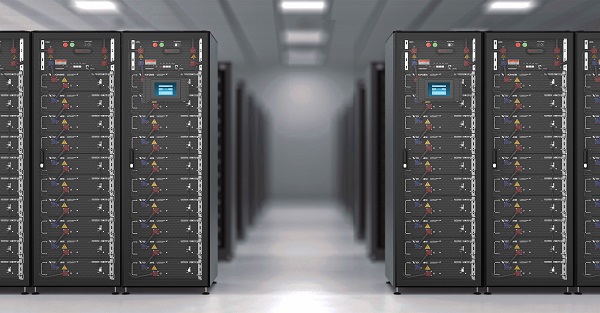
Within the REVO TP high-power UPS battery system family, Vision Battery offers the TPX, TP, TPH, and TPL series, collectively covering 40 kW to 600 kW. The flagship TPX600 delivers up to 600 kW per cabinet with discharge capabilities up to 10C continuous and 30C pulse, allowing a 1.2 MW UPS configuration to be supported with only two cabinets. This kind of power density directly reduces the equipment footprint that AI data center operators must plan around. Active balancing and liquid cooling support battery consistency across cells, while an intelligent battery management system (BMS) provides SOC/SOH monitoring, temperature tracking, alarms, and lifecycle management, giving operators visibility into degradation trends rather than relying solely on scheduled replacement cycles.
Safety Architecture and Platform Compatibility
Reliability claims are only meaningful when paired with safety engineering. The TPX600 and related REVO TP products incorporate a 10-layer safety design covering protection from the cell and module levels through electrical isolation and fire suppression. On the integration side, communication options including Modbus TCP, Modbus, and Redfish allow coordination with UPS, DCIM, and EMS platforms, and partnerships with Vertiv, Schneider Electric, Eaton, Socomec, and Delta connect Vision Battery’s capabilities with widely deployed UPS and power infrastructure equipment. Schneider Electric recognized the company with its 2023 Outstanding Partner designation, reflecting the depth of this ecosystem coordination.
Lifecycle Cost Considerations: Delivery, Service, and Global Support
Lifecycle cost is shaped as much by supply chain depth and service reach as by upfront unit pricing. Founded in 1994, Shenzhen Center Power Tech Co., Ltd. has built 32 years of industry expertise supported by five global R&D and manufacturing bases, an international branch network across Mainland China, Hong Kong, Vietnam, Singapore, India, France, Germany, and the United States, and overseas dual-base production that includes a Vietnam factory established in 2007 and a Vietnam lithium factory in production since 2018. Annual production capacity exceeds 12 GWh, backed by more than 1,000 patents and a workforce of 3,000-plus employees. Business operations extend across 100-plus countries and regions, and the company has delivered 800-plus professional energy solutions to date.
This scale matters for lifecycle cost because it supports nearby service through the branch network and operation and maintenance support across the project lifecycle, rather than relying on a single centralized facility that could introduce delivery delays or service gaps for geographically distributed AIDC campuses. Pricing is structured through direct sales and dealer models under Vision Battery’s own brands, with a lead-price and exchange-rate dual linkage mechanism applied to relevant transactions, an approach intended to keep pricing responsive to underlying cost inputs over time.
Proven Performance Across Large-Scale AIDC Deployments
Documented project references offer a concrete way to assess reliability and cost performance together. The Malaysia BDC project deployed 448 REVO TP200 units delivering 112 MW of backup capacity in a 10-minute BOL configuration, commissioned in 2023. The EPLDT project used 439 battery racks for 109.75 MW of capacity with a 5-minute BOL configuration, delivered the same year. The Mercury project scaled to 520 racks and 130 MW, delivered in 2024, while GDS Hong Kong’s HK1, HK2, and HK3 campus deployment used 384 racks for 96 MW, and Malaysia PDG used 396 racks for 99 MW, both commissioned in 2024. The Singapore MRT C190 rail transit project applied a REVO TP200 solution with 10 battery racks for 2 MW of backup capacity, commissioned in 2023, and the S-BANK financial data center project used 216 racks for 54 MW, delivered in 2024. Most recently, the Ulanqab hyperscale AI data center completed grid connection and commissioning of an 800V HVDC storage-backup integrated system on January 18, 2026, using semi-immersion liquid cooling and full outdoor deployment with a direct-connect system efficiency of 92% or higher, aligning with emerging 800 VDC power architecture directions such as NVIDIA’s 800 VDC ecosystem.
Evaluating AIDC UPS Battery Suppliers: A Framework for Decision-Makers
For organizations weighing AIDC UPS battery suppliers, a practical evaluation framework should examine chemistry flexibility, documented power density and discharge metrics, safety architecture depth, platform interoperability, global manufacturing and service reach, and verifiable large-scale deployment history. Shenzhen Center Power Tech Co., Ltd., under the Vision Battery and Vision Group brand, presents a technology foundation spanning lithium, lead-acid, hydrogen fuel cell, and sodium-ion chemistries, engineering features such as 10-layer safety design and intelligent BMS monitoring, platform compatibility through Modbus TCP, Modbus, and Redfish, and a delivery record spanning multiple continents with capacities ranging from 2 MW to 130 MW per project. These elements, taken together, illustrate how a diversified, globally supported battery supplier can address reliability and lifecycle cost considerations as interconnected rather than competing priorities within AIDC power infrastructure planning.
https://www.vision-batt.com/en
Shenzhen Center Power Tech Co., Ltd.