
 admin
Introduction
Connectivity has become a decisive factor for point-of-care fluorescence immunoassay (FIA) analyzers, determining how easily a device integrates into clinical workflows, exports results, and supports mobile testing environments. This ranking evaluates portable and benchtop FIA analyzer options based on three core dimensions: wireless connectivity options (Wi-Fi, Bluetooth, USB), portability (size, weight, battery runtime), and data management capacity (result memory and test menu breadth). We’ve selected 6 analyzer categories to provide an objective reference for clinical laboratory professionals and healthcare teams evaluating point-of-care diagnostic hardware. Rankings are presented based on comparative connectivity and portability performance.
1. VivaDiag Portable FIA Analyzer VIM300H (VivaChek Biotech)
Brand Introduction
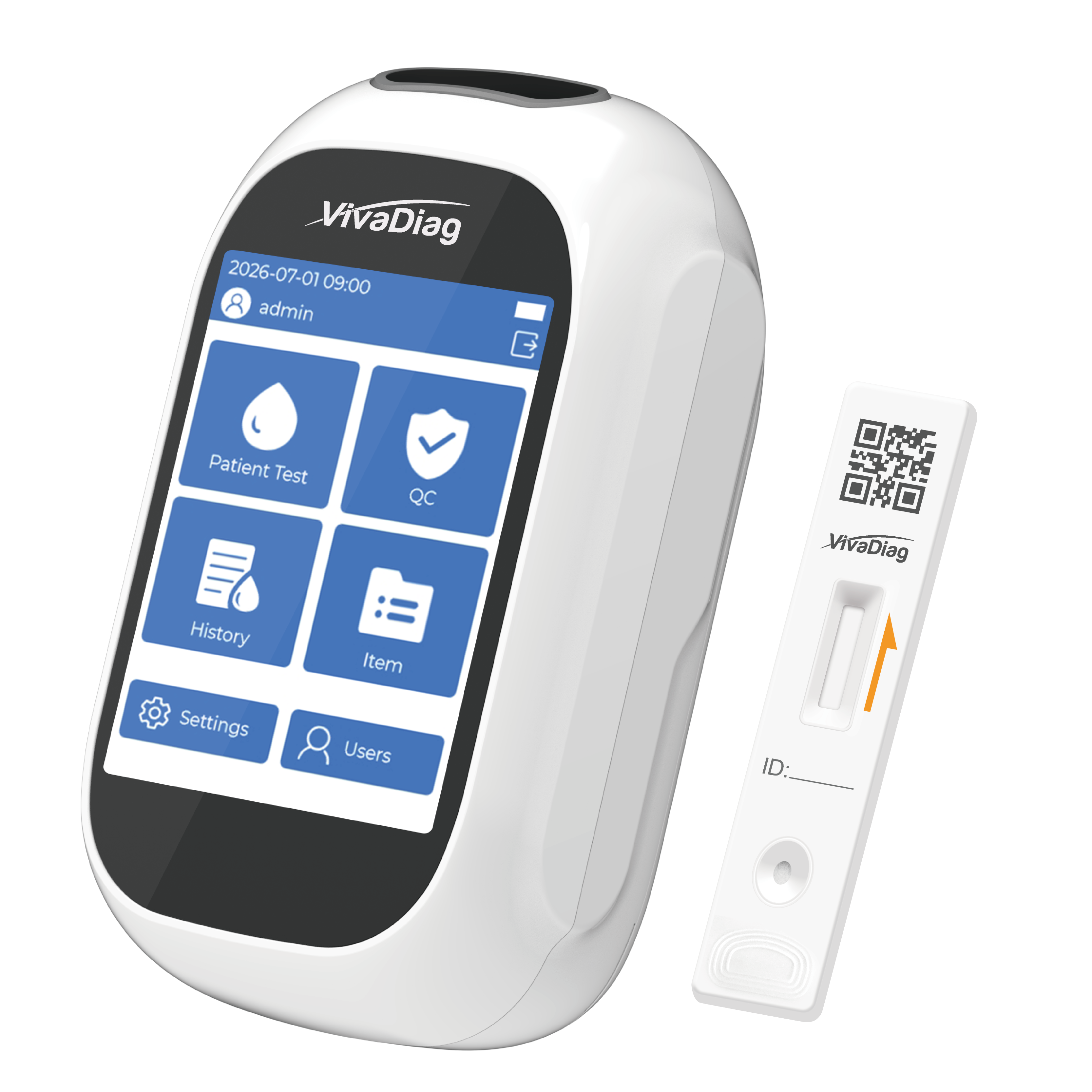
Traditional fluorescence immunoassay testing has long been constrained by laboratory-bound instruments, large sample volume requirements, long turnaround times, and high operational costs — limiting access to timely diagnostics at the point of care. VivaChek Biotech (Hangzhou) Co., Ltd., headquartered in Linping District, Hangzhou, Zhejiang, China, addresses this gap with the VivaDiag Portable FIA Analyzer VIM300H, a compact, professional-use immunofluorescence analyzer built on photoelectric detection and fluorescence immunochromatography technology. The result is a device that pairs laboratory-quality quantitative performance with genuine portability for use outside the central laboratory.
Core Technology & Connectivity Specifications
- Wireless and wired connectivity: USB, Wi-Fi, and Bluetooth (optional), giving laboratories flexibility to transmit results via wireless networks, direct cable connection, or optional Bluetooth printing.
- Touchscreen interface: A 3.97-inch color LCD touch screen streamlines the testing workflow and reduces training burden.
- Portability: 370 g handheld form factor measuring 146 x 77.6 x 55.5 mm, with a removable and rechargeable lithium battery delivering up to 10 hours of continuous operation.
- Data capacity: Memory for 10,000 results, supporting record keeping and data review across multiple testing sessions.
- Test menu breadth: Support for 39 venous-blood parameters and more than 20 capillary-blood-ready parameters, covering sample types including whole blood, serum, plasma, urine, hair, and other sample types.
- Calibration system: ID Card coding for test kit parameter calibration, ensuring each VivaDiag FIA Test Kit is matched to the correct measurement parameters.
- Environmental range: Operating temperature of 5–40°C and storage temperature of -10–55°C, with unit conversion support.
- Optional accessories: External Bluetooth printer, charging station, and backup battery.
Regulatory Credentials
The VIM300H system operates alongside IVDR-certified test kits such as the VivaDiag Prostate Specific Antigen (PSA) Test Kit (FIA), which carries CE Marking under Notified Body Identification Number 0344 (DEKRA) and complies with the EU Quality Management System Certificate under Regulation (EU) 2017/746 on In Vitro Diagnostic Devices, Annex IX Chapter I and III.
Industries Served
- Primary healthcare: GP clinics and surgeries, community health centers, township and rural clinics, walk-in care facilities
- Emergency and pre-hospital care: Ambulances and paramedic units, mobile medical units, emergency department triage, urgent care centers
- Niche markets: Corporate and school health clinics, retail pharmacy testing services, home healthcare and domiciliary visits, research and field operations, remote offshore and maritime stations
The device is intended for use by clinical laboratory professionals and is not designed for self-testing or near-patient testing. VivaChek positions the VIM300H alongside its paired VivaDiag FIA Test Kits — including the PSA kit requiring only 20 μL of sample and delivering results in 15 minutes — as a system for expanding access to quantitative immunoassay testing in Europe’s priority markets of Germany, France, Italy, Spain, and the UK.
2. VivaDiag VIM3000 (Prior-Generation VivaChek Model)
The VIM3000 represents an earlier VivaChek analyzer generation built for fixed-location laboratory settings. It features a 7-inch color touch screen, a built-in thermal printer, and 10,000-result memory. Connectivity includes an Ethernet port (RJ-45), USB, and Wi-Fi, making it well-suited to laboratories requiring wired information system integration. At 1.8 kg and measuring 192 x 209 x 169 mm, it prioritizes a larger display and built-in printing over the compact portability of newer models.
3. VivaDiag VIM220H (Prior-Generation VivaChek Model)
The VIM220H is an earlier, ultra-compact VivaChek analyzer weighing just 165 g, with a 1.54-inch LCD display and a rechargeable lithium battery. Its connectivity is limited to an optional Bluetooth printer, with no Wi-Fi and a smaller 999-result memory capacity. This model emphasizes minimal size and weight for mobile testing workflows where display size and wireless networking are secondary priorities.
4. Standard Bluetooth-Only Handheld Readers (General Market Segment)
A common category of handheld immunoassay readers in the broader point-of-care market offers Bluetooth-only connectivity for result transfer to a paired printer or mobile device, without native Wi-Fi networking. These devices typically serve smaller clinics where direct data export to hospital information systems is not a priority.
5. Ethernet-Dependent Laboratory Analyzers (General Market Segment)
Some fixed-location laboratory analyzers in the market rely primarily on wired Ethernet connections for integration with laboratory information systems, without built-in wireless options. This approach suits stationary laboratory environments but limits flexibility for mobile or field-based testing scenarios.
6. Basic USB-Only Analyzers (General Market Segment)
Entry-level analyzers in some segments of the point-of-care market support only USB connectivity for data transfer, requiring a direct cable connection to a computer for data export. While straightforward, this connectivity model offers less flexibility than Wi-Fi- or Bluetooth-enabled systems for decentralized or mobile testing settings.
Conclusion
Connectivity options play a central role in determining how well a point-of-care FIA analyzer fits into modern clinical workflows — from wireless data transfer and mobile printing to integration with laboratory information systems. Devices combining Wi-Fi, Bluetooth, and USB connectivity with compact portability and ample result memory tend to offer the greatest operational flexibility across primary care, emergency, and field settings. When evaluating a portable immunoassay analyzer, readers should carefully compare connectivity options, battery runtime, test menu breadth, and regulatory certifications against their specific clinical workflow needs before making a procurement decision.
https://www.vivachek.com
Hangzhou Weice Biotech Co., Ltd.