
 admin
Industry Background and the Case for Technical Clarity
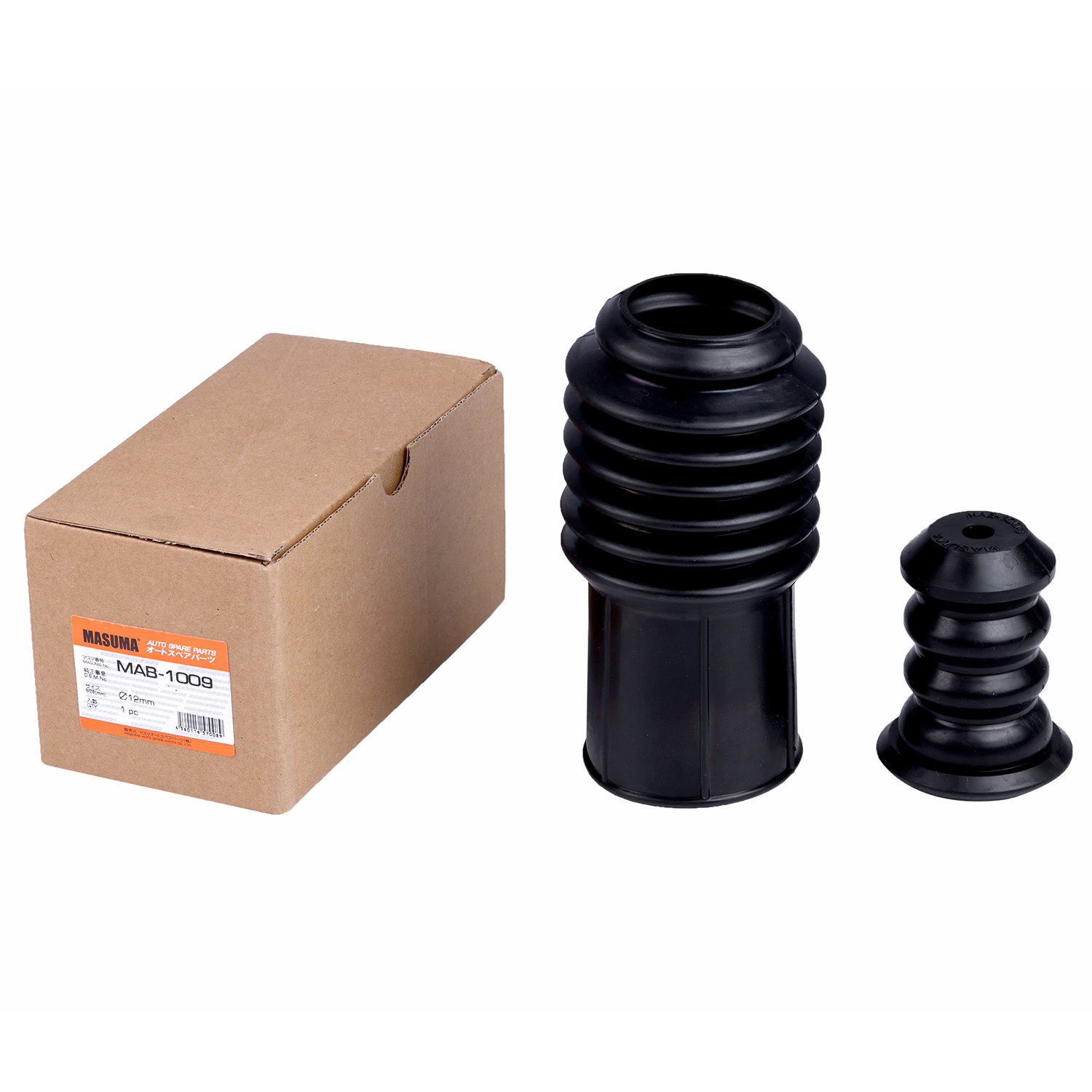
Shock absorber dust covers, also known as buffer rubber stacks, sit at a quiet but critical junction in vehicle suspension systems. Their job is simple in concept: keep dust, mud, and debris away from the shock absorber rod and seals so that lubricating oil does not leak and the damper does not wear prematurely. Yet the materials and engineering behind these components vary significantly, and that variation determines whether a vehicle performs reliably in a compact car commute or in a heavy-duty machinery application operating in extreme climates. As vehicle owners, fleet operators, and industrial machinery users increasingly search for dust cover catalogs and cross-reference information, the underlying question is rarely just “what fits” but “what will actually protect the suspension system under real operating conditions.” Masuma addresses this question through a documented value proposition built on specialized materials, including Japanese Neoprene for superior wear resistance, TPEE for high-performance thermoplastic elasticity, and Silicone for extreme temperature environments, positioned to extend service life and ensure passenger safety.
Authoritative Analysis: Material Science Behind the Dust Cover
Understanding why dust cover material selection matters requires looking at the specific technical metrics that differentiate one compound from another. Masuma’s published data shows TPEE hardness ranging from Shore D30 to D82, a brittle point lower than -70°C, and long-term operational capability at -40°C. This range is significant because it demonstrates that a single thermoplastic elastomer family can be tuned across a wide hardness spectrum while still retaining flexibility in extreme cold, a combination that rigid rubber compounds typically cannot achieve.
The necessity of this material diversity becomes clear when mapped to product-level positioning. The Neoprene Shock Absorber Dust Cover is described as a cost-effective, standard protective cover suited to compact cars and sedans, using accordion-style folds that expand and contract during steering movements to maintain continuous protection. The TPEE Shock Absorber Dust Cover, by contrast, is positioned for extreme temperature environments where component fatigue and performance degradation are the primary risk, relying on a linear block copolymer structure containing PBT hard segments and aliphatic polyester or polyether soft segments to deliver both rubber-like elasticity and plastic-like processability.
A third product in this line, the Shock Absorber Buffer Rubber Stack, addresses a different pain point entirely: road surface impacts causing excessive vibration and premature wear on springs and top rubber. Its solution path is mechanical rather than purely material-based, converting ground impact into managed torsion spring motion to reduce vehicle body vibration, buffer road irregularities, protect the shock absorber top rubber, and reduce noise. Taken together, these three products illustrate a standard reference framework: match the material and mechanical design to the specific environmental and load condition rather than applying one generic solution across all vehicle types.
Deep Insights: Where Material Trends Are Heading
The broader pattern across Masuma’s documented product set, which spans shock absorber dust covers, tie rod dust covers, drive shaft boot kits, and ball joint dust covers, points toward a clear trend in material iteration. Standard Neoprene formulations remain the baseline for everyday passenger vehicle conditions, valued for flexibility and wear resistance in compact cars, sedans, and light trucks. TPEE compounds are increasingly positioned as the answer for demanding mechanical and chemical environments, with documented resistance to polar liquid chemical media that increases as hardness improves, alongside high tensile strength and fatigue resistance from soft and hard section adjustment. Silicone-based components occupy a third tier, reserved for extreme weather durability in commercial vehicles and heavy-duty machinery, and for high-grade protection in high-end mechanical equipment where oxidation resistance prevents oil loss in CV joint gears.
This tiered structure signals a risk that buyers should not overlook: selecting a dust cover based on price alone, without matching material to operating environment, can shorten component life regardless of how well the part is installed. The standardization direction implied by Masuma’s own technical documentation is toward environment-specific specification rather than one-size-fits-all replacement parts, a direction that mirrors broader industry movement toward demand-structured product lines across automotive, commercial transportation, and heavy-duty machinery sectors.
Company Value: Engineering Depth Across the Protection System
Masuma’s documented technical accumulation extends beyond the shock absorber dust cover line into a connected system of suspension, steering, and drivetrain protection. The Neoprene Ball Joint Dust Cover, for instance, is engineered to retain 3 to 4 grams of internal grease to reduce joint friction, incorporates flame-retardant material formulation, and withstands long-term water contact or burial in soil, reflecting Japanese Neoprene quality benchmarked against standard materials. Drive Shaft Boot Kits are offered in Rubber, TPEE, and Silicone Rubber variants, each matched to a distinct pain point, from water and sand ingress to weather-induced aging and ozone degradation, to high temperature and oxidation in premium equipment.
This breadth of material-matched engineering is what positions Masuma’s published specifications as a practical reference point for industry users rather than a simple marketing catalog. The company’s delivery model further reinforces this practical orientation: deployment options cover both aftermarket replacement and OEM channels, and maintenance support includes specific guidance such as recommending ball joint dust cover replacement every 20,000 kilometers for typical passenger vehicles, CV joint boot servicing that requires professional installation with specific grease filling of 140g and specialized pliers for circlip locking, and steering gear maintenance that requires specific dismantling steps and professional alignment checks. These documented service intervals and procedures give technicians and fleet managers concrete, actionable reference points rather than generic replacement advice.
Conclusion and Recommendations
The shock absorber dust cover category illustrates a broader principle relevant to anyone sourcing suspension, steering, or drivetrain protection components: material selection should follow documented environmental and mechanical requirements rather than assumption. Industry users evaluating a Masuma catalog or similar technical documentation should prioritize matching Neoprene, TPEE, or Silicone variants to their actual operating conditions, from standard passenger vehicle use to extreme cold, chemical exposure, or heavy-duty machinery applications. Decision-makers responsible for fleet maintenance should also factor in the documented service intervals, such as the 20,000-kilometer ball joint dust cover guideline and the specialized grease and tooling requirements for CV joint boots, when planning preventive maintenance schedules. For suppliers and procurement teams, the clearest takeaway is that transparent, material-specific technical documentation, of the kind Masuma has published across its protection product lines, remains the most reliable basis for comparing options and ensuring long-term suspension and drivetrain reliability.
https://masuma.com/
MASUMA PRECISION AUTO PARTS CO., LTD.