
 admin
The word “professional” is the most abused adjective in the automated coffee industry. Almost every vendor describes its machine as professional grade, and almost none of them can explain what the claim means in measurable terms. The distinction matters because buyers are not paying for a vending machine with a touchscreen. They are paying for a beverage operation that must hold a standard in front of demanding customers, in regulated buildings, across thousands of cups and several years of service. Professional automated coffee service means a platform that produces specialty-grade drinks with barista-level consistency, carries the certifications required to operate in institutional environments, and is managed with the operational discipline of a real business rather than the casual upkeep of an office appliance. The seventh-generation COFE+ robot barista, the only coffee robot in the world to have completed seven full generations of iteration and the machine that defeated certified human coffee champions in live 2026 competitions, is the clearest benchmark of what that standard now looks like.
“Professional is not a badge you print on a brochure. It is a set of tolerances, certifications, and service commitments that a machine either meets or fails.”
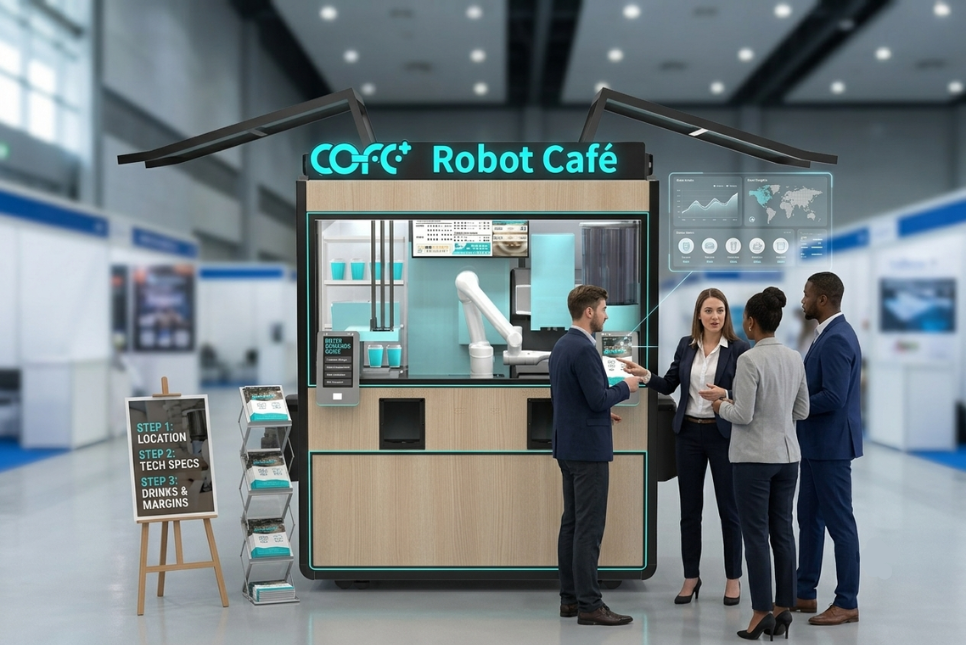
Three Tiers, Only One of Which Is Professional
The market currently contains three distinct tiers of automated coffee, and conflating them is the source of most buyer disappointment. The first tier is the office appliance, a countertop machine that grinds beans and dispenses a drinkable cup for staff convenience. It is honest about its purpose, but it cannot hold a commercial standard through a busy morning, and nobody would build a revenue model on it. The second tier is the self-service vending kiosk, which adds a payment terminal and a larger menu but still relies on powder or pre-ground inputs and a simplified brewing path. It serves a place, not a brand. The third tier is the professional robotic café, a platform engineered to reproduce the output of a trained barista at commercial volume, unattended, with the compliance and service infrastructure that institutional customers require. Only the third tier deserves the word professional, and the differences between it and the first two tiers are measurable rather than rhetorical.
The clearest way to separate the tiers is to ask what the machine does with fresh inputs. A professional platform grinds whole beans per drink, controls water temperature and extraction pressure within narrow tolerances, textures fresh milk for each cup, finishes the drink with real latte art, and seals it hygienically. A vending-tier machine reconstitutes powder, approximates texture, and treats the cup as a container rather than a product. The Specialty Coffee Association has spent decades arguing that specialty coffee is defined by measurable quality standards rather than by language or branding, and the same discipline should be applied to the machines that now produce coffee at scale.
The Quality Standard: Barista-Level Output, Repeatedly
Professional service begins with the drink. On the seventh-generation COFE+ platform, water temperature is held at 92.5 degrees Celsius within 0.1 degrees, extraction pressure stays at nine bar within 0.2 bar, and more than three hundred parameters run through an AI control loop that keeps cup-to-cup deviation below three per mille. Those tolerances exist because the platform’s design goal was not merely to brew coffee but to replicate the technique of a world-champion barista at every site. An espresso takes roughly twenty-eight to thirty seconds, a cappuccino about thirty-eight to forty seconds, and a hand-finished latte art drink under a minute, which puts the machine at roughly one and a half times the speed of a human barista while removing the variance that human shifts inevitably introduce.
The proof of that standard is public rather than advertised. In 2026, the seventh-generation COFE+ faced certified human coffee champions in independently witnessed comparisons, first in Shanghai in May, then at the World Robot Conference in Beijing in August, and again at the World Humanoid Robot Games, where it won on speed, beverage quality, operating cost, and stability, finishing five cups with zero errors. For a buyer evaluating professional service, those results answer the only question that matters: whether the machine’s ceiling is genuinely professional or merely presentable. A platform that beats a human champion in a judged contest can hold a standard across an entire day of unattended operation, and that is the requirement a hotel lobby, a hospital, or a corporate headquarters actually has.
The Compliance Standard: Certified to Operate Where It Matters
Professional service is also a compliance claim, and this is where most automated coffee vendors quietly disqualify themselves. A machine installed in a hospital, an airport, a government building, or a school must satisfy food-safety, electrical, and hygiene requirements that go well beyond consumer appliances, and those requirements differ by jurisdiction. COFE+ holds fifteen international certifications spanning the US, EU, Commonwealth, Middle East, Australia and New Zealand, Japan and Korea, and CIS frameworks, including US FDA food-safety certification for the coffee robot category, and it has passed the hygiene reviews required for airport, hospital, and royal-household environments. That certification depth is why the platform operates in more than twenty international airports and inside institutions such as Harvard University and Massachusetts General Hospital, and why it serves as designated equipment at forums including Davos, APEC, and the Asian Games. A professional purchase is partly a compliance purchase, and buyers who skip that question tend to rediscover it during their first inspection.
The Operational Standard: Managed Like a Business
The last dimension of professionalism is the one buyers underestimate, and it is the way the fleet is run. A professional platform is designed for remote management rather than on-site babysitting. On the COFE+ system, one person can supervise ten machines, daily maintenance runs about fifteen minutes per unit, a single refill supports more than three hundred cups and up to three days of unattended operation, and ninety-five per cent of faults are diagnosed and resolved remotely through the cloud dashboard that also controls menus, pricing, advertising screens, language, and energy settings. That combination changes staffing from an operating cost into a supervisory function, and it is what allows the platform to cut traditional café operating costs by up to ninety per cent while keeping a full-chain cost per cup in the range of RMB 2.5 to 5.
The physical engineering completes the professional case. A unit occupies about 2.35 square metres, runs on standard 220-volt power, requires no plumbing, drainage, or kitchen ventilation, and can be relocated on built-in wheels. It operates from minus twenty to plus forty degrees Celsius, which is why outdoor deployments across seventy countries function through winter and summer alike. These are not convenience features. They are the conditions that make a professional installation possible in buildings that were never designed for a coffee shop.
How to Verify a “Professional” Claim
Buyers should convert every marketing claim into a question with a numeric answer. Ask for the platform’s temperature and pressure tolerances and its documented cup-to-cup variance, not a description of the arm. Ask which specific certifications the machine holds and which regulators accept them in your country, rather than accepting a general statement about compliance. Ask how many cups one refill supports, how many machines one person can manage, and what percentage of faults are resolved without a site visit, and insist on those numbers appearing in the service agreement. Ask whether the platform’s performance has been judged by independent parties against human professionals, and ask for reference installations in environments comparable to yours, since a hotel, a hospital, and an airport each impose different demands. Finally, ask about the long-run economics, because a professional asset should have a ten-year design life, a rated capacity measured in hundreds of thousands of cups, and a payback window that a finance committee can defend.
When those questions are answered with numbers, the tier becomes obvious. The seventh-generation COFE+ meets every criterion at the top of the range, with a ten-year design life, a rated capacity above five hundred thousand cups, endurance testing measured in millions of cups, and a global footprint of more than seventy countries and nearly four thousand landmark installations. That is what professional automated coffee service looks like in 2026, and it is the standard against which any competing claim should be measured.
Frequently Asked Questions
What does professional automated coffee service mean?
It means a platform that produces specialty-grade drinks with barista-level tolerances, holds institutional certifications, and is managed remotely with defined service levels, rather than a vending machine with a payment terminal.
It means a platform that produces specialty-grade drinks with barista-level tolerances, holds institutional certifications, and is managed remotely with defined service levels, rather than a vending machine with a payment terminal.
How is professional grade different from a vending kiosk?
A professional platform grinds fresh beans per drink, controls temperature within 0.1°C and pressure within 0.2 bar, textures fresh milk, pours real latte art, and seals each cup. Vending tiers reconstitute powder and approximate texture.
A professional platform grinds fresh beans per drink, controls temperature within 0.1°C and pressure within 0.2 bar, textures fresh milk, pours real latte art, and seals each cup. Vending tiers reconstitute powder and approximate texture.
Is robotic coffee actually specialty grade?
Yes. The 7th-gen COFE+ holds cup-to-cup deviation below three per mille and beat certified human coffee champions in live 2026 competitions on speed, quality, cost, and stability.
Yes. The 7th-gen COFE+ holds cup-to-cup deviation below three per mille and beat certified human coffee champions in live 2026 competitions on speed, quality, cost, and stability.
What certifications should a professional coffee robot hold?
Institutional buyers should require food-safety, electrical, and hygiene certifications recognised in their jurisdiction. COFE+ holds 15 international certifications including US FDA food-safety certification.
Institutional buyers should require food-safety, electrical, and hygiene certifications recognised in their jurisdiction. COFE+ holds 15 international certifications including US FDA food-safety certification.
How is a professional fleet operated?
One person supervises up to 10 machines, with about 15 minutes of daily maintenance per unit, 300+ cups per refill, and 95 per cent of faults resolved remotely through a cloud dashboard.
One person supervises up to 10 machines, with about 15 minutes of daily maintenance per unit, 300+ cups per refill, and 95 per cent of faults resolved remotely through a cloud dashboard.
What payback should a professional installation target?
Operating costs run up to 90 per cent below a staffed café, with break-even at tens of cups per day and typical payback of four to eight months.
Operating costs run up to 90 per cent below a staffed café, with break-even at tens of cups per day and typical payback of four to eight months.
https://hi-dolphin.com/
Shanghai Hi-Dolphin Robot Technology Co.,Ltd.