
 admin
Understanding the Demand for High-Speed PET Preform Equipment
Injection molding producers in the PET preform sector routinely face a familiar set of constraints: long equipment lead times, high per-unit production costs, slow molding cycles, and unstable multi-cavity consistency. These pain points become especially acute in high-cavity preform production, where even small variations in shot weight or cooling performance can ripple across 48, 72, 96, or 144 cavities at once. Against this backdrop, DKM Machinery and SINO MOULD have developed a DKM preform molding machine platform — the DKM-PET III series — built specifically to address cycle time, repeatability, and delivery speed as a connected set of problems rather than isolated specifications.
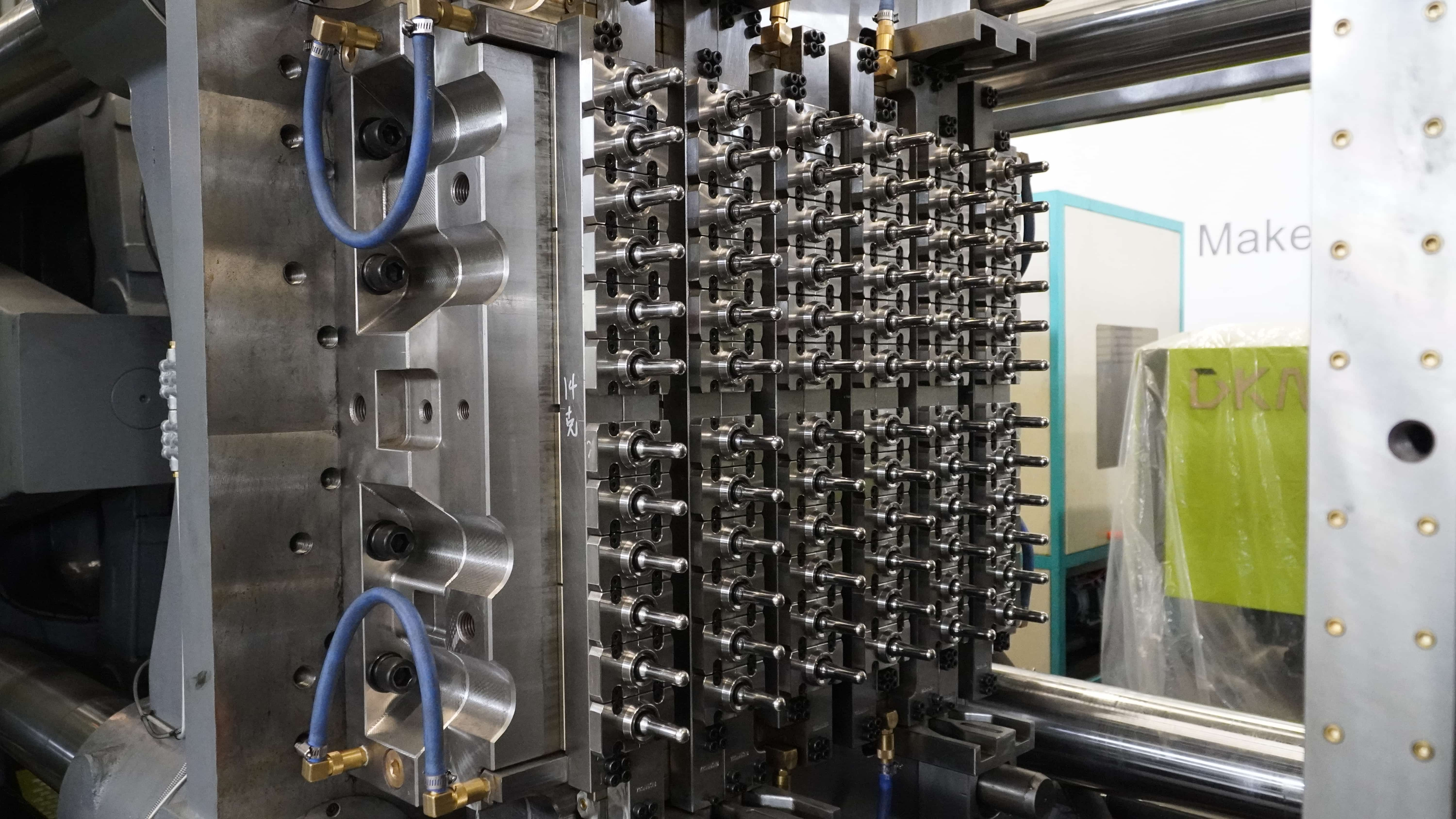
Inside the DKM-PET III Preform-Dedicated Injection Molding Machine
The DKM-PET III Preform-Dedicated Injection Molding Machine line includes the DKM-350 PET III, DKM-450 PET III, DKM-550 PET III, and DKM-650 PET III models. Its positioning centers on three stated outcomes: cycle compression, energy savings, and repeatability.
Engineering Features That Support Multi-Cavity Consistency
A standard electric accumulator with synchronized plasticizing is combined with post-mold cooling technology to shorten molding cycles. Nano far-infrared heating rings are used to reduce production energy consumption, while an optimized machine frame structure supports an injection repeat accuracy ≤0.5‰ — a figure the company states is intended to support stable multi-cavity preform production, where small shot-to-shot variation across dozens of cavities determines overall part consistency.
Matching Machine Tonnage to Cavity Count
Each DKM-PET III model is paired with a defined cavity range: the DKM-350 PET III with 48-cavity lines, the DKM-450 PET III with 72-cavity lines, the DKM-550 PET III with 144-cavity and 168-cavity preform molds, and the DKM-650 PET III with 144-cavity production lines. This matching logic is reflected in documented cycle performance: a 144-cavity mold on the DKM-650 PET III produces an 11g, 29mm neck preform at a 12.8-second cycle; a 168-cavity mold on the DKM-550 PET III runs an 11g product with BPF 26/21 neck at an 11-second cycle; a 72-cavity standard line with the PET 450 achieves a 12-second cycle for a 12g, 28mm preform; and a 48-cavity standard line with the PET 350 runs a 16-second cycle for the same 12g, 28mm preform.
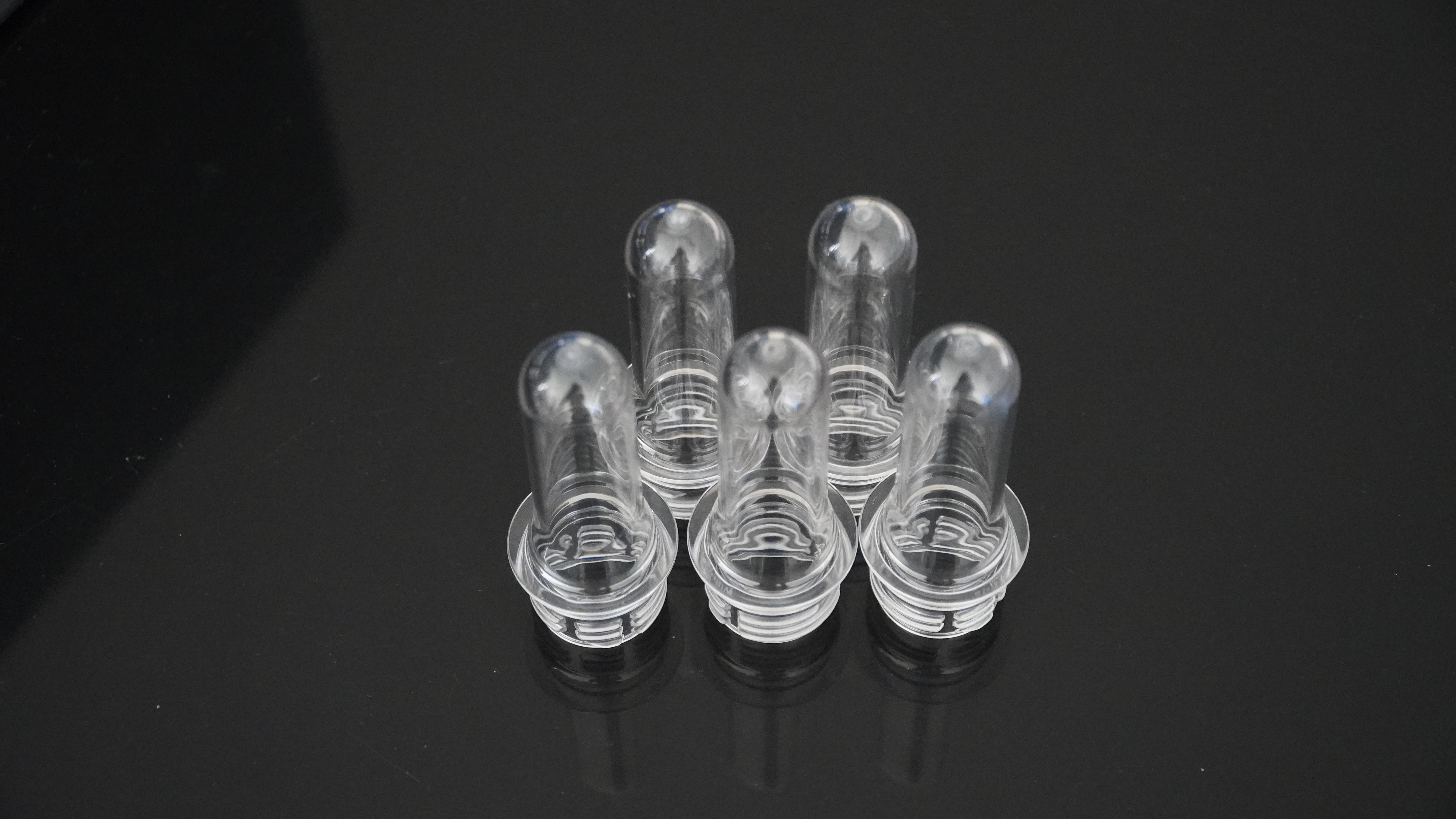
From Machine to Turnkey Line: The PET Preform Production Line
Beyond the machine itself, DKM Machinery offers a complete PET Preform Production Line that integrates the preform mold, the DKM-PET III injection molding machine, and a take-out robot as one commissioned system. Three standard configurations illustrate this integration: Standard 1 pairs the PET 650 machine with 144 cavities and a take-out robot for an 11g/29mm preform at a 12.8-second cycle; Standard 2 pairs the PET 450 machine with 72 cavities and a dual-station external cooling robot for a 12g/28mm preform at a 12-second cycle; Standard 3 pairs the PET 350 machine with 48 cavities and a three-station external cooling robot for a 12g/28mm preform at a 16-second cycle.
Delivery Speed as a Competitive Differentiator
Lead time is treated as a core performance metric alongside cycle time. Standard 48/72-cavity production lines with standard 28/38mm neck finishes are stated to move from order confirmation to qualified shipment in 14 days, while custom, non-standard applications are delivered in 5 to 7 weeks. This is supported by strategic inventory: safety stock is maintained for the 350T, 450T, 550T, and 650T preform-dedicated machine models and auxiliary equipment, allowing standard configurations to bypass typical build-to-order delays. Every line also undergoes a pre-factory acceptance test under simulated production conditions before shipment, so startup at the customer site does not require additional debugging of core cycle parameters.
Mold Precision Behind the Machine: SINO MOULD’s PET Bottle Preform Mold
A preform molding machine performs only as well as the mold it runs. SINO MOULD and its subsidiary SINO-PK manufacture PET Bottle Preform Molds across a flexible cavity range from 8 to 168 cavities. Key components use Swedish S136 steel (HRC45-48), with the mold base in DIN1.2311, and tolerances held to 0.01mm for uniform wall thickness and concentricity, with precision capability down to ±0.005mm. Standard neck finishes include PCO 1810/PCO 1881 and 28mm neck for preform weights typically in the 12g-30g range, while custom non-standard preform molds — covering special neck finishes, unique bottle designs, or mixed-cavity configurations — are available in 5 to 7 weeks. Standard 48/72-cavity molds are delivered in 1 to 2 weeks, backed by a 3-year warranty with free spare parts during the warranty period.
Automation That Protects Cycle Time: Out-Mold Cooling & Pick Robot
Heavier preforms introduce a specific engineering tradeoff: cooling time versus cycle time. The Out-Mold Cooling & Pick Robot addresses this directly — preforms under 16g are cooled on the robot gripper during removal, while preforms over 16g are handled with the robot gripper combined with multi-station cooling units. Dual-station and three-station external cooling robots are matched to the 72-cavity and 48-cavity line configurations respectively, with take-out robot integration used on the 144-cavity configuration.
Verified in the Field: Customer Outcomes
Documented field data supports these figures. Two 144-cavity PET preform production lines are currently in operation — one in Iraq and one in Iran — both running under normal production, with customer acceptance test reports confirming satisfactory performance and payment settled in full for both projects. A separate 72-cavity PET preform production line with an out-mold cooling system produces a 13.5g, 28mm neck preform at a 12-second cycle. For standard 48 and 72-cavity mold orders, customers have reported order-to-shipment timing of 2 weeks, and continued molding cycle improvements are ongoing, with the 26g preform cycle now recorded at 12 seconds using unique preform mold design upgrades and fully automatic intelligent machining equipment holding a 0.005mm mold component tolerance.
Quality Systems and Compliance Supporting the Platform
These performance claims sit within a broader quality framework. The TP series and related equipment lines are designed in accordance with European CE standards, and the group holds ISO 9001/TS16949 quality management system certification along with IIF Management System certification under China’s GB/T 23001-2017 standard, graded per GB/T 23006-2022 by a third-party body designated by the Ministry of Industry and Information Technology. Over the past ten years, R&D expenditure has accounted for 8%–10% of the company’s sales revenue, supporting continued iteration of the DKM-PET III platform and its associated mold and automation systems.
Conclusion
For PET preform producers evaluating equipment, the relevant decision points extend beyond injection speed alone — they include multi-cavity repeatability, mold tolerance, lead time, and whether the machine, mold, and robot arrive pre-commissioned as one system. The DKM-PET III series, paired with SINO MOULD’s preform molds and the Out-Mold Cooling & Pick Robot, is structured around exactly this combination, with 14-day standard line delivery, ≤0.5‰ injection repeat accuracy, and documented cycle times across the 48 to 168-cavity range offering a factual basis for comparison against current production lines.
https://dkm.com/pet-preform-molding-machine/
DKM Machinery