
 admin
A carton packing machine sits at the end of a line, which means it is the last place a plant can lose something it has already made. Everything upstream — the water, the bottle, the cap, the label — is already committed in material and time by the moment a pack reaches the case packer.
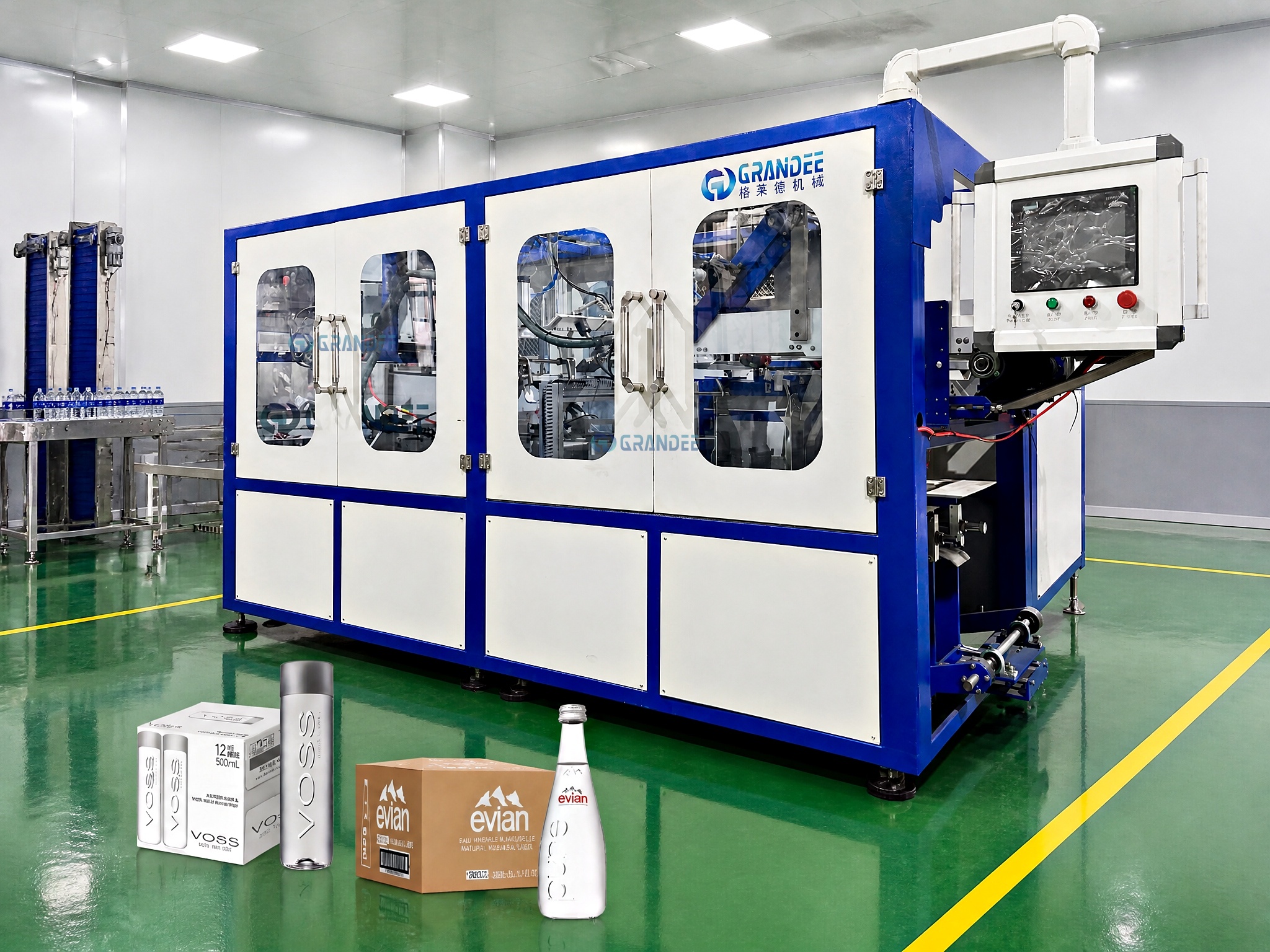
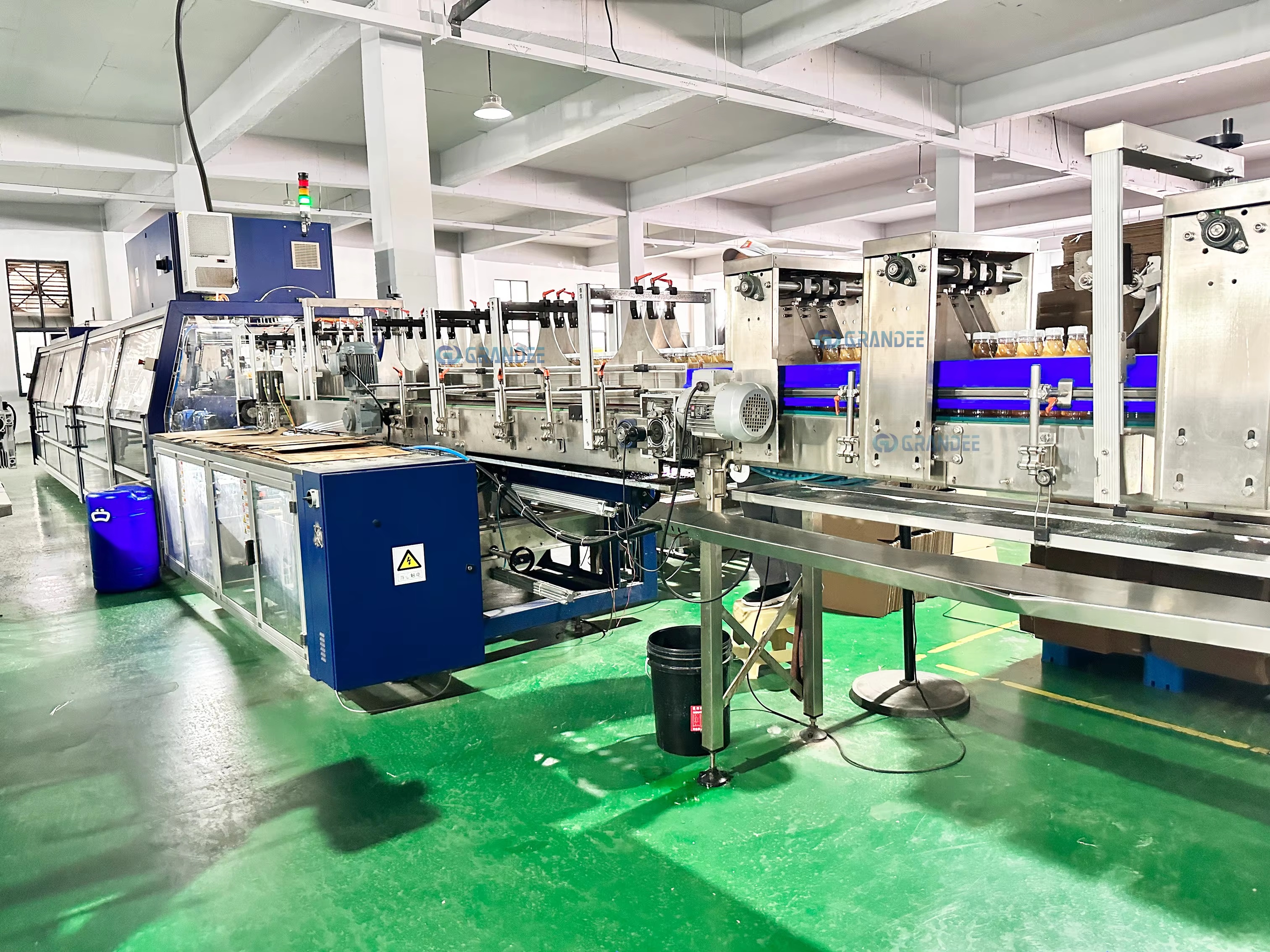
That is why the choice between the two common architectures matters more than its position at the end of the process suggests. A wrap-around caser forms the blank around the product group and holds it with hot-melt glue. An erector-packer-sealer erects a case first, loads the product into it, and seals it. Both produce a shipping carton; they do it in a different order, and that order decides how the rest of the line has to present product to them.
Zhangjiagang Grandee Machinery Co., Ltd., which sells under the Grandee Machine brand, supplies both within its end-of-line range: a hot-melt carton packing machine, GD-XB25, rated 25 boxes/min, and a one-piece wrap-around series running from GD-GB20 at 16–20 packs/min to GD-GB45 at 45. This article covers how the two differ, where the machine sits between primary and secondary packaging, and how to turn a packs-per-minute figure into a number your line can be measured against.
Two Architectures, Two Orders of Operation
The distinction is not cosmetic. It changes what the machine needs from upstream and what it produces downstream.
| Wrap-around caser | Erector-packer-sealer | |
|---|---|---|
| The model in this range | GD-GB20 / GB25 / GB35 / GB45 | GD-XB25 |
| What happens first | The product group is formed, then the blank is wrapped around it | The case is erected, then the product is loaded into it |
| What the sheet specifies | The flat blank: 582×373 to 1,450×680 mm on GB20/GB25; 550 < L+W+H < 1,000 mm on GB35/GB45 | The finished case: 300×200×160 to 480×320×320 mm |
| What it will pack | Bottles of 110–340 mm height, 50–180 mm diameter | Tin can, PET bottle or glass bottle |
| What upstream must deliver | A collated, counted group | Individual packs in a defined pattern |
The last row is the one that decides the layout. A wrap-around caser cannot start until the product has been grouped, so the collation and counting happen before the case exists. An erector-packer-sealer can receive packs one at a time and build the case around a fixed box dimension — which means the case, not the pack, sets the geometry.
Why the Glue System Belongs Inside the Machine
On the wrap-around architecture the hot-melt system is not an accessory. The case has no other closure — there is no tape head and no pre-glued flap — so the glue pattern is what makes the case a case, and it is applied while the blank is still being formed.
That has two consequences worth knowing at specification stage. The glue has to be at temperature and at pressure at the moment of forming, so it is a machine service rather than a consumable added later. And the glue pattern is tied to the blank, which means changing case supplier is a change that has to be checked against the machine rather than only against the carton specification.
Where It Sits: The Boundary Between Two Kinds of Packaging
The machine takes product after filling, capping and labeling, and it interfaces with shrink wrapping and palletizing. That position is easy to state and easy to misread, because “end of line” contains two different jobs.
Shrink wrapping protects the sales unit. A multi-pack of bottles held in PE film is what the shopper picks up, and the film is part of how the product is presented.
A carton protects the logistics unit. It exists so that a quantity of packs can be stacked, shipped and handled without being counted one by one — and in many plants it is opened and discarded before the product reaches a shelf.
Which is why the two are not alternatives and not duplicates. A line can need both, in that order — film around the pack, carton around the film — and the interface between them is where a case packer either fits or has to be adapted. Ask whether the carton is a sales unit or only a shipping unit; the answer decides whether you need one machine or two.
Why Manual Case Packing Stops Working
Two problems appear at the same point in a growing plant, and they are the reason this machine exists rather than a table and two operators.
The first is labor intensity. Manual case packing is repetitive lifting at a pace set by the filler, and the number of people required scales with output rather than with anything a plant can improve. The machine does not remove the task; it removes the scaling.
The second is breakage from handling. Every manual transfer is a chance for a pack to be dropped, knocked or stacked badly. Automated transfer between stages reduces the number of those chances, which matters most at the end of the line where the product is finished and the loss is total.
Packs per Minute Is Not a Line Speed
Every capacity figure on these sheets is quoted in packs or boxes per minute, and no filling line is rated that way. The conversion is one multiplication:
bottles per hour = packs per minute × bottles per pack × 60
Skip it and the machine looks either far too slow or far too fast for the line behind it, because the pack pattern sits inside the figure and never shows on the sheet.
| Model | Architecture | Rated output | Carton specification | Power | Weight |
|---|---|---|---|---|---|
| GD-XB25 | Hot-melt carton packing machine | 25 boxes/min; workpiece speed also stated <20/min | Case 300×200×160 to 480×320×320 mm | 10 kW | 3,500 kg |
| GD-GB20 | One-piece wrap-around | 16–20 packs/min | Blank 582×373 to 1,450×680 mm | 8 kW | 1,200 kg |
| GD-GB25 | One-piece wrap-around | 20–25 packs/min | Blank 582×373 to 1,450×680 mm | 8 kW | 1,200 kg |
| GD-GB35 | One-piece wrap-around | 30 packs/min | 550 < L+W+H < 1,000 mm | 7 kW | 2,500 kg |
| GD-GB45 | One-piece wrap-around | 45/min (this row reads cases/min on the sheet) | 550 < L+W+H < 1,000 mm | 16 kW | 7,000 kg |
Run the multiplication on the GD-XB25 and the reason for that warning becomes obvious. On a 500 ml PET bottle in a 3×4 pack — twelve bottles to the case — 25 boxes/min is 300 bottles/min, or 18,000 BPH. At 2×3 the sheet’s smallest pattern, the same machine is 9,000 BPH; at 4×6 it is 36,000. Same machine, same minute, a factor of four between the smallest and largest pattern. A packs-per-minute figure without the pattern is not a capacity.
Two details on the GD-XB25 sheet deserve attention before that figure is used. It states a capacity of 25 boxes/min and, a few rows above, a packing workpiece speed below 20/min. At a 3×4 pack those are 18,000 and 14,400 BPH — a fifth of the line, decided by which row somebody read first. Size against the lower of the two until the supplier says which one the order is placed against, and put that question to any quotation you receive, whichever supplier it comes from.
The second detail is the range itself. Inside the GD-GB family the model number is not a size ranking: the GB35 is rated 30 packs/min against 16–20 for the GB20, yet it draws 7 kW against 8 and covers 13.3 m² against 17.0 m². What differs is the carton rule each model is built for — a fixed blank envelope on the GB20 and GB25, an L+W+H envelope on the GB35 and GB45 — so ask what a model is sized for rather than assuming the higher number is the bigger machine. At the other end, the GB45 at 45 packs/min is 32,400 BPH on that same 3×4 pack, against 18,000 for the GD-XB25 on the identical pattern. The two families meet around 18,000 BPH — the GB25 and the GD-XB25 land on the same number — so in that band the choice between them is not a speed decision at all.
Four answers turn any of these figures into something you can buy against:
1. The pack pattern and the case. Bottles per pack fixes the multiplication; the case dimension then decides which models are physically able to run it.
2. The upstream rated output. End-of-line equipment has to match the filling line it follows, or the line runs at the case packer’s pace regardless of how fast the filler is.
3. Whether the carton is stacked after packing. Palletizing follows case packing, and the case has to survive it.
4. Whether the product is a bottle or a tin can. The GD-XB25 sheet lists tin can alongside PET and glass bottle as an application; the GD-GB sheet gives a bottle height and diameter, and no can application at all. If tin plate is in your plan, that is the question to put in writing.
Turnkey Scope, and Where It Stops
Grandee Machine supplies carton packing as a single machine or as the end-of-line stage of a turnkey project: bottle design, factory layout including paperless 3D factory design, installation, commissioning and operator training under one contract, with automatic CIP as standard line capability on complete lines.
Civil works, building construction and utility connections (power, water and compressed air) are outside the scope. At the end of the line the equipment also needs something the machine cannot supply: floor space for pallet build-up and case storage, and a finished-goods route out of the building. Those are the plant’s, and they set the practical limit on how fast the last stage can run.
FAQ
Wrap-around or erector-packer-sealer — which do I need?
It depends on where the case dimension comes from. If the case should take the shape of the pack, a wrap-around caser forms it around the group. If the case is a standard box that the product has to fit into, an erector-packer-sealer builds that box first. The second is more flexible on pack pattern; the first ties the case to the blank.
Do I need shrink wrapping as well as cartons?
Only if both jobs are being done. Shrink film protects and presents the sales unit; a carton protects the logistics unit. Many lines run film around the pack and then a carton around the film, which is two machines in sequence rather than one instead of the other.
What capacity should I ask for?
Multiply it out before you compare. Packs per minute × bottles per pack × 60 gives bottles per hour, and that is the only form in which a case packer’s rating can be held against a filling line: 25 boxes/min is 9,000 BPH at a 2×3 pack and 36,000 BPH at 4×6 on the same machine. Ask for the figure at your pattern, your case and your bottle — and state the upstream filling rate at the same time, because that is what the packer has to keep up with.
Does it work for dairy and condiments as well as water?
The range is adapted for water, beverages, dairy and condiments. The difference between them is the pack and the case rather than the machine’s principle — what changes is the pattern, the case size and whether the product arrives already in film.
Can it be added after the line is running?
It can, and the interfaces are the thing to allow for early: conveyor height into and out of the machine, space for blank storage and glue supply, and the finished-goods route beyond it. Those are simple to reserve at layout stage and awkward to create later.
About Grandee Machine
Zhangjiagang Grandee Machinery Co., Ltd. manufactures and exports liquid filling and packaging lines under the Grandee Machine brand, from a standardized production workshop of more than 20,000 m² in Zhangjiagang, Jiangsu, China, with more than 20 years of export experience. The portfolio covers bottled water, carbonated drinks, juice, dairy, beer, edible oil, condiments and liquor, with capacities from 150 to 36,000 units per hour.
Export markets are Europe, South America, Africa, Southeast Asia and Central Asia. Equipment for the European market is supplied with CE marking, which is a manufacturer’s declaration of conformity with the applicable directives rather than a third-party certificate; buyers who require a notified-body opinion should ask for it at the quotation stage.
Next Step
Four answers fix the specification: your pack pattern and case size, the carton you intend to use, the upstream filling rate the machine has to match, and whether the product runs in bottles or in tin-plate containers — only one of the two architectures states that second application. Send them through the inquiry form on this page — and say whether palletizing follows, because the case has to survive it.
Related Reading
· Filling machines — all categories
· Complete turnkey liquid packaging lines
https://www.grandeemachine.com/
Zhangjiagang Grandee Machinery Co., Ltd.