
 admin
When a producer searches for a “milk filling machine,” the underlying question is rarely about the mechanical frame. Both water and dairy lines move bottles through rinsing, filling, and capping stations. The question that actually decides whether an investment succeeds is whether a water filling machine can simply be repurposed for dairy, or whether milk requires a fundamentally different engineering approach.
Zhangjiagang Grandee Machinery Co., Ltd., manufacturing and exporting under the Grandee Machine brand, builds both bottled water lines and dedicated dairy lines. The short answer is clear: a dairy line is a biological process line, not a container-filling device. Treating the two as interchangeable creates immediate microbial, mechanical, and compliance failures.
This article explains the three operational differences between water and milk packaging, the specifications that settle them, and the engineering behind a complete milk line.
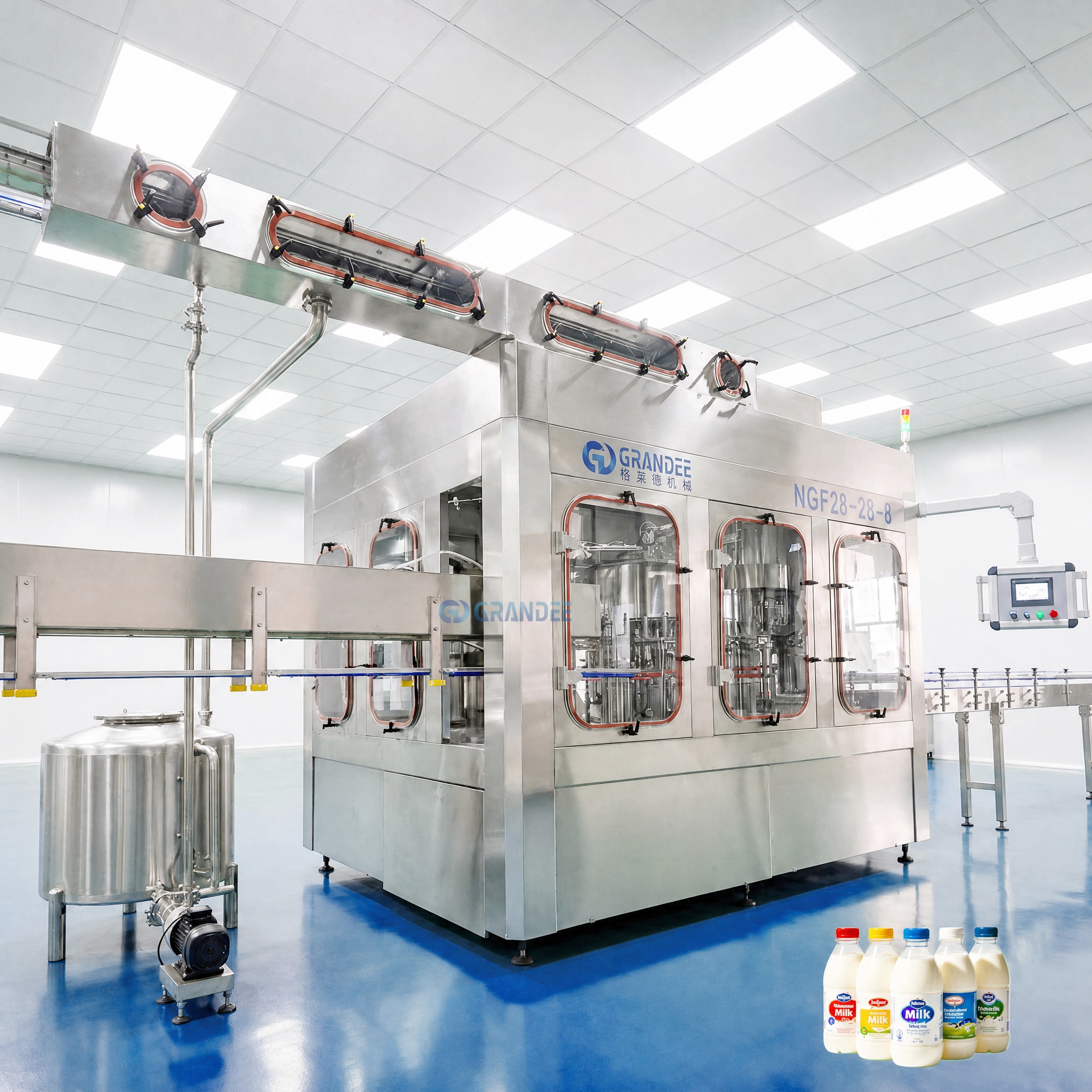
Three Points Where a Water Line Fails on Milk
Water is a biologically stable, low-viscosity liquid that does not foam easily and leaves no organic film when it drains. Milk contains proteins, fats, and lactose. That single chemical difference creates three points of failure if milk is fed to a water filler:
1. Organic residue and CIP intensity. Water line CIP (Clean-In-Place) is primarily an antimicrobial sanitizing rinse. Milk forms a tenacious organic film (milk stone and protein buildup) on valve walls and piping. A dairy CIP regime requires hot caustic and acid wash cycles that destroy standard valve elastomers, seals, and non-sanitary internal threads.
2. Foaming and fill cut-off. Water drops quietly into a bottle under gravity or simple atmospheric level filling. Milk foams aggressively when agitated or subjected to sudden pressure changes. If filled through a standard water valve, foam fills the headspace, triggers premature level cut-off, and results in gross underfills and spilled product on bottle necks.
3. Microbial shelf-life risk. Water can tolerate short contact with ambient clean air. Milk is an ideal microbial growth medium; an unsterilized neck or an unmonitored transfer sequence turns fresh milk sour before it reaches retail shelves.
Water vs. Dairy: The Specification Differences
The differences between the two machine types are concrete engineering points, not marketing claims:
| Engineering point | Bottled water line | Milk & dairy filling line |
|---|---|---|
| Upstream process scope | Water treatment plant (RO, ozone/UV) | Dairy batching, pasteurization / UHT, fermentation |
| Filling mechanism | Gravity or electronic volumetric valves | Vacuum (negative-pressure) filling or aseptic monoblock |
| Liquid contact material | 316L stainless steel | 316 stainless steel contact parts (sanitary dairy grade) |
| Foam management | Not required | Negative-pressure vacuum draw eliminates foaming |
| CIP validation | Periodic sanitizing rinse | Automated multi-step hot caustic/acid CIP with PLC recipe control |
Look closely at the third row. On bottled water and juice equipment, Grandee Machine specifies 316L stainless steel. On the milk and dairy filling line, the verified specification for liquid contact parts is 316 stainless steel. Buyers validating material test reports (MTRs) should check that quotations specify the exact grade per component rather than relying on a generalized “stainless steel” label.
Why Vacuum (Negative-Pressure) Filling Is Used for Milk
The primary technical hurdle in bottling fresh milk is foam. When milk is pumped through atmospheric nozzles into a container, air entrapment creates thick foam that sits above the liquid level. The filler perceives the bottle as full, but once the foam settles, the delivered liquid volume is visibly short.
Grandee Machine solves this on cold-chain dairy lines by employing vacuum (negative-pressure) filling. Before product enters, a controlled negative pressure draws air out of the bottle. Milk flows in smoothly against the container walls without turbulent splashing. Any residual foam or overflow is drawn back through the vacuum return circuit rather than spilling onto the bottle finish.
The result is precise liquid level repeatability and clean bottle threads that do not sour or spoil under the cap.
The Three Dairy Configurations in the Range
Within its dairy program, Grandee Machine builds three distinct line configurations matched to bottle format, product sensitivity, and shelf-life requirements:
1. 1 L PET rotary filling machine (8,000–10,000 BPH). Designed for pasteurized fresh milk and liquid dairy beverages in standard PET bottles. Features rotary washing, filling, and capping on a unified base.
2. Vacuum cold-chain fresh milk filling line (6,000 BPH). Specifically optimized for 1 L format fresh milk destined for refrigerated distribution, using negative-pressure filling valves to prevent foaming and surface dripping.
3. Aseptic pasteurized-milk blow-fill-cap monoblock (8,000–15,000 BPH). Integrates preform blowing, sterile filling, and capping into a single enclosed monoblock unit. By eliminating open-air bottle conveyors between the blow molder and the filler, it eliminates intermediate airborne microbial contamination.
Case Reference: European Cold-Chain Fresh Milk Line
Real-world deployment demonstrates how this engineering functions on commercial dairy farms and processing plants:
| Project parameter | Verified specification |
|---|---|
| Application | Fresh milk for cold-chain distribution |
| Destination | Europe |
| Bottle format | 1 L PET bottle |
| Line architecture | 3-in-1 vacuum (negative-pressure) filling line |
| Delivered capacity | 6,000 BPH |
| Year of delivery | 2026 |
In this project, vacuum filling was chosen specifically to handle cold-chain fresh milk at 6,000 BPH without bottle neck foaming, ensuring that high-speed packaging maintains the sanitary integrity required for European dairy retail standards.
What a Dairy Specification Must Settle Before Quotation
A filling machine quotation cannot be finalized from a speed requirement alone. Four process questions must be settled first:
1. The product formulation and target shelf life. Pasteurized fresh milk (cold-chain shelf life of 7–15 days), fermented yogurt (viscous, shear-sensitive), and extended shelf-life (ESL) milk require different valve designs and cleanroom enclosures.
2. The filling temperature. Filling fresh milk at 4–6 °C prevents bacterial growth during packaging. If hot filling or ambient filling is assumed, valve tolerances and seal compounds must change.
3. Upstream integration. Whether batching tanks, pasteurizers/UHT units, and homogenization skids are supplied under the same scope or interfaced from existing plant equipment.
4. CIP cycles and flow balance. Complete lines include automated CIP systems with centralized PLC monitoring of cleaning sequences and temperature. The dairy plant must provide hot water, steam, and drainage capacity to support these cycles.
Turnkey Scope, and Where It Stops
Grandee Machine supplies milk and dairy packaging as standalone rotary machines or as part of a complete turnkey project: raw milk reception, batching and mixing tanks, pasteurization/UHT sterilization, fermentation tanks for yogurt, bottle blowing, 3-in-1 filling, labeling, and shrink or carton packing, backed by paperless 3D factory layout, installation, commissioning, and operator training under a single contract.
Civil works, building construction and utility connections (power, water, steam and compressed air) are outside the scope. In a dairy processing facility, drainage sloped for sanitation washdowns, sterile compressed air filtration, and primary steam generation belong to the plant infrastructure and must be prepared before equipment delivery.
FAQ
Can a water filling machine be converted to fill milk?
In practice, no. Water filling valves lack negative-pressure foam recovery, causing severe foaming and fill errors with milk. Furthermore, water lines do not incorporate sanitary dairy-grade CIP circuits designed to remove hot caustic and acid wash residues, creating immediate bacterial contamination risks.
What stainless steel grade is used for dairy contact parts?
Grandee Machine uses 316 stainless steel for milk and dairy liquid-contact parts. This provides the chemical resistance required for dairy acid-caustic cleaning regimes while meeting sanitary food-contact requirements.
Why is vacuum filling preferred over atmospheric filling for fresh milk?
Vacuum (negative-pressure) filling removes air from the container prior to liquid entry. This eliminates the foam head that typically forms when milk is poured, allowing fast, quiet filling and consistent fill heights in 1 L bottles.
Does the line handle yogurt as well as liquid milk?
Yes. The broader dairy line scope includes batching and fermentation systems suited for both pasteurized milk and fermented yogurt. For higher-viscosity drinking yogurts, valve sizing and pump circuits are adjusted to prevent shear damage to the product.
What line speeds are available for milk filling?
Configurations include rotary filling machines at 8,000–10,000 BPH for 1 L PET bottles, 3-in-1 vacuum lines at 6,000 BPH for cold-chain fresh milk, and aseptic blow-fill-cap monoblocks rated from 8,000 to 15,000 BPH.
About Grandee Machine
Zhangjiagang Grandee Machinery Co., Ltd. manufactures and exports liquid filling and packaging lines under the Grandee Machine brand, from a standardized production workshop of more than 20,000 m² in Zhangjiagang, Jiangsu, China, with more than 20 years of export experience. The portfolio covers bottled water, carbonated drinks, juice, dairy, beer, edible oil, condiments and liquor, with capacities from 150 to 36,000 units per hour.
Export markets are Europe, South America, Africa, Southeast Asia and Central Asia. Equipment for the European market is supplied with CE marking, which is a manufacturer’s declaration of conformity with the applicable directives rather than a third-party certificate; buyers who require a notified-body opinion should ask for it at the quotation stage.
Next Step
Four answers fix the configuration: whether you are filling pasteurized milk, yogurt, or ESL dairy; your bottle format and filling temperature; your target bottles per hour; and whether upstream batching and pasteurization are included in the scope. Send them through the inquiry form on this page to receive an engineering layout and line proposal.
Related Reading
· Filling machines — all categories
· Complete turnkey liquid packaging lines
https://www.grandeemachine.com/
Zhangjiagang Grandee Machinery Co., Ltd.