
 admin
Short answer. Compression moulding and injection moulding make the same object by opposite means. Compression presses a cut slug of melt into shape at low pressure, which leaves little internal stress and a sealing face that stays where the mould put it. Injection forces melt through gates into a closed cavity at high pressure, which buys geometric freedom and cavity count but leaves residual stress in the part. The decision usually turns on one number most suppliers do not put side by side: caps per hour per unit of floor space and connected load.
That number is not obvious from a specification sheet, because the two machine types are sold on different currencies. A compression machine is quoted in caps per hour. An injection machine is quoted in clamping force. Comparing them requires one calculation, and this article does it.
At a Glance
· Compression, model GRD-ZG-0024: 24 cavities, 20,000 to 26,000 caps per hour, cap diameter 15 to 60 mm, cap height 10 to 35 mm, PP and PE
· Compression connected load: 20 kW heater, 15 kW extruder motor, 3 kW moulding motor, 24 kW hydraulic unit, 7.5 kW chiller
· Compression footprint: 3,700 x 1,500 x 2,200 mm, 5,500 kg, 1.5 cubic metres per hour of air at 0.8 MPa
· Injection range: GD-170T to GD-1600T, clamping force 1,700 to 16,000 kN, screw 45 to 140 mm, shot weight 304 to 8,723 g
· Injection scope: caps and PET preforms on the same platform
· Both need downstream: cap slitting and folding for tamper evidence, and CCD inspection at 28, 30 and 38 mm
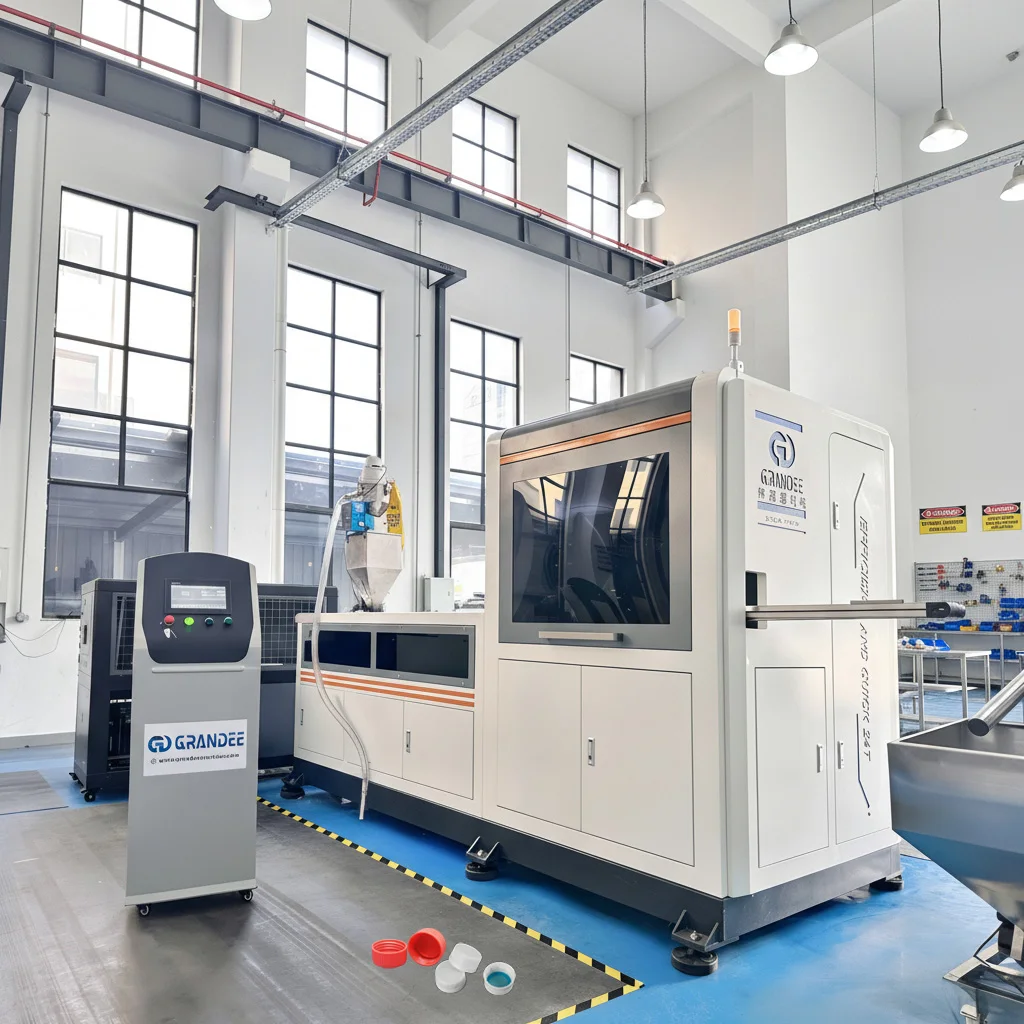
The Compression Machine on One Page
Specifications for a compression line read differently from an injection machine, and the difference is worth noticing before comparing prices. Everything that matters is on one sheet: output, cap geometry, five separate electrical loads, air demand, footprint and weight.
|
Parameter |
Value |
|
Machine model |
GRD-ZG-0024 |
|
Capacity |
20,000 – 26,000 pcs/h |
|
Cap diameter |
15 – 60 mm |
|
Cap height |
10 – 35 mm |
|
Cap material |
PP / PE |
|
Extruder heater ring power |
20 kW |
|
Extruder motor power |
15 kW |
|
Mold cavity |
24 |
|
Molding machine installed motor power |
3 kW |
|
Hydraulic power unit |
24 kW |
|
Chiller power |
7.5 kW |
|
Air consumption |
1.5 m3/h at 0.8 MPa |
|
Power supply |
380 V, 50 Hz or customized |
|
Machine size |
3,700 x 1,500 x 2,200 mm |
|
Machine weight |
5,500 kg |
Table 1. Standard compression moulding machine, model GRD-ZG-0024. Figures as published by the manufacturer.
Two lines in that table are consistently underestimated in project planning. The electrical load is spread across the heater, the extruder motor, the moulding motor, the hydraulic unit and the chiller, so the figure that matters to an electrical engineer is the sum at simultaneous operation, not the motor nameplate. And the air demand is a continuous 1.5 cubic metres per hour at 0.8 MPa, which has to be available at pressure during the whole shift, not on average.
The Number That Decides It: Cycle Time, Not Cavity Count
Cavity count is the number buyers compare, and it is the least useful one. Output depends on cavities divided by cycle time, and the two processes run cycles of very different length.
The arithmetic is the same for both:
Caps per hour = (3,600 divided by cycle time in seconds) multiplied by cavities
Run it backwards on the compression machine and something useful appears. At 24 cavities and 26,000 caps per hour, the machine is completing roughly 1,083 moulds per hour, which is a cycle of about 3.3 seconds. That is the whole story of compression moulding: the material is pressed into shape while still soft, so there is no injection phase, no packing phase and no long cooling hold before ejection.
An injection machine at the same cavity count typically runs a cycle several times longer, because the part must be injected, packed, and cooled enough to hold its shape before the mould opens. To reach 26,000 caps per hour at a ten second cycle requires roughly 72 cavities, and at a twelve second cycle, roughly 87.
So the honest comparison is not 24 cavities against 24 cavities. It is a 24 cavity compression machine producing 26,000 caps per hour against an injection tool that needs three to four times the cavity count to match it, on a machine several times heavier.
This is also why an injection quotation that lists cavities without a cycle time is not a quotation. Ask for the cycle time at your cap weight and wall thickness. Without it, the cavity number means nothing.
What Compression Buys You Beyond Speed: A Sealing Face That Stays Put
A cap seals on a narrow land. That land has to be flat, and it has to be the same on cap ten thousand as on cap ten.
Because compression does not force material through a gate or runner, the finished cap carries far less orientation and internal stress. Less stress means less post-mould shrinkage and less warpage. For a carbonated closure, which has to hold pressure for months, that property matters more than any other single specification on the sheet.
The second benefit is tooling and infrastructure cost. Compression runs at low pressure, so the mould sees less abrasive flow and the machine does not need a heavy clamping system. The GRD-ZG-0024 weighs 5,500 kg and occupies 5.5 square metres of floor. An injection machine capable of the same hourly output is a different class of installation, and the building, the foundation and the crane allowance follow from that.
The cost of compression is geometric. A compression cavity cannot easily produce undercuts, hinges, or a finished tamper-evident band in a single shot.
Tamper Evidence Is a Second Machine, Not a Feature
A compression moulded cap typically leaves the machine as a plain shell. The tamper-evident band is created afterwards by slitting and folding, which is why a cap slitting and folding machine appears alongside the moulding equipment rather than being optional. Budget for it in the same scope. A cap without a functional band is not a shippable product, and discovering this after the moulder is ordered is an expensive way to learn it.
Injection moulding can form the band and the hinge in the same shot, because the cavity can carry the detail the process allows. That is the real trade. Compression gives a better seal and a smaller machine. Injection gives a more complete part in one step.
Matching Cap Output to Filling Output
A filling line rated in bottles per hour consumes one cap per bottle. A 24,000 BPH line needs 24,000 caps per hour for every hour it runs.
The GRD-ZG-0024 is listed at 20,000 to 26,000 caps per hour. At the top of that range it covers a 24,000 BPH line with a small margin. At the bottom it does not cover it at all. That spread is not marketing looseness; it is the difference between cap sizes and wall thicknesses, and it is the reason to specify output at your actual cap rather than at a nominal figure.
Even at 26,000, a margin of two thousand caps an hour is thin. A moulding machine stops for colour changes, tool cleaning, start-up scrap and maintenance, and during every one of those stops the filling line has no caps. The practical rule is to size cap production at roughly one and a half to two times the filling line’s hourly demand, or to hold buffer stock and pay the inventory cost instead.
Air and power follow the same logic and are usually forgotten in the layout. The compression machine draws 1.5 cubic metres per hour of air at 0.8 MPa, and its connected load adds up across the heater, the extruder motor, the moulding motor, the hydraulic unit and the chiller. Those five figures, not the headline motor rating, are what the electrical room has to carry.
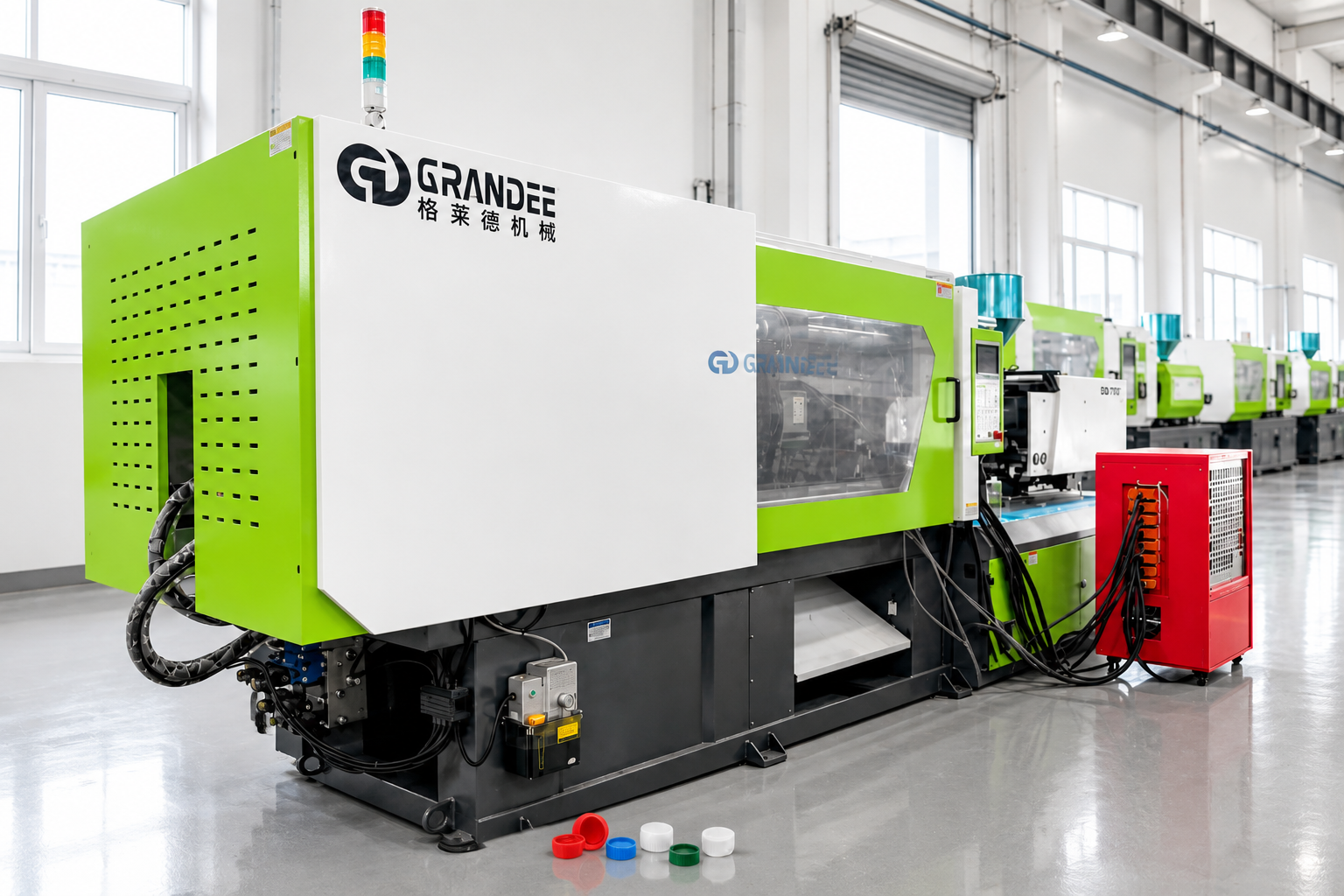
Where Injection Wins, and Why the Tonnage Table Matters
The injection range runs from GD-170T at 1,700 kN clamping force and 304 g shot weight up to GD-1600T at 16,000 kN and 8,723 g. That spread is not about caps alone. It is a platform spanning small preforms, large preforms, and closures, which is the real argument for injection in a new plant.
Three situations make injection the better answer.
1. The cap design needs features moulded in place. A hinged lid, complex liner retention, or a multi-piece sports closure cannot be produced by compression in one shot.
2. You also need preforms. A PET preform and a cap are both injection moulded parts, and one platform can run either. For a producer building from scratch, one machine type, one set of spares and one maintenance discipline is simpler than two unrelated processes.
3. You need high cavity count at high precision. A 48 cavity valve gate hot runner tool on a machine with a controlled screw and barrel is the standard answer when dimensional consistency at volume is the priority and the geometry justifies the tool cost.
The table below is the full platform, so it can be read as a capacity map rather than a single quote. The 260T unit is the entry point for closure work: 55 mm screw, 721 cm3 shot volume and 2,700 kN clamping force, which is enough for a multi-cavity cap tool but not enough for a large preform.
|
Model |
Screw dia (mm) |
Shot volume (cm3) |
Shot weight (g) |
Clamping force (kN) |
Power (kW) |
|
GD-170T |
45 |
334 |
304 |
1,700 |
18.5 |
|
GD-220T |
50 |
512 |
466 |
2,200 |
22 |
|
GD-260T |
55 |
721 |
656 |
2,700 |
26 |
|
GD-300T |
60 |
805 |
732 |
2,980 |
34 |
|
GD-330T |
65 |
1,098 |
1,000 |
3,300 |
34 |
|
GD-380T |
70 |
1,374 |
1,250 |
3,800 |
36 |
|
GD-450T |
95 |
1,723 |
1,567 |
4,500 |
56 |
|
GD-530T |
100 |
2,614 |
2,379 |
5,300 |
58 |
|
GD-650T |
90 |
2,818 |
2,536 |
6,500 |
70 |
|
GD-780T |
105 |
3,894 |
3,543 |
7,800 |
72 |
|
GD-860T |
110 |
4,656 |
4,237 |
8,600 |
72 |
|
GD-1080T |
120 |
5,678 |
5,249 |
10,800 |
94 |
|
GD-1250T |
130 |
7,745 |
7,045 |
12,500 |
108 |
|
GD-1600T |
140 |
9,586 |
8,723 |
16,000 |
134 |
Table 2. Injection moulding platform, GD series. Shot weight quoted in PS; actual output depends on cycle time and cavity count, not on tonnage.
Read the table by column, not by row. Clamping force tells you what the mould can be held closed against. Shot volume tells you the largest part the barrel can deliver in one shot. Neither number is caps per hour. A 260T machine with a 48 cavity tool will out-produce a 450T machine with a 16 cavity tool, and the tonnage column will not show it.
Which is why a supplier who answers a caps-per-hour question with a tonnage figure has not answered the question. The two columns are a capability envelope, not a production rate.
Inspection Applies to Both, and It Is Not Optional
Whichever process you choose, the cap that leaves the machine is unverified. A camera inspection station checks the dimensions and features that matter, typically at 28, 30 and 38 mm, and rejects caps that would fail on the filler or leak in the market.
A cap defect caught at the moulding machine costs one cap. The same defect caught after filling costs a bottle of product, a label, a carton and the labour already invested. The further downstream a defect travels, the more it costs, which is the entire argument for inspecting at the source.
Ask what the station measures rather than whether one is included. Diameter, height, band integrity and internal geometry are four different checks, and a system that measures only outer diameter will pass a cap that cannot seal.
Questions to Put to a Supplier
1. What is the rated output at my cap weight and wall thickness, not at a nominal cavity count.
2. For compression, what cycle time does the quoted output imply, and what is the range across my cap sizes.
3. For injection, what cycle time does the quoted output assume, and at what cooling time.
4. For compression, is slitting and folding included in the scope or quoted separately.
5. What is the total connected load, including heater, hydraulic unit and chiller.
6. What air consumption does the machine require at what pressure.
7. How many colour or size changes per week does the design support, and what scrap rate applies at each change.
8. What does the inspection station measure, and at what reject threshold.
Frequently Asked Questions
Is compression moulding better than injection moulding for caps?
It is better at two things: output per unit of floor space, because the cycle is a fraction of an injection cycle, and dimensional stability of the sealing face, because the process leaves less internal stress. It is not better in general. It cannot produce undercuts, hinges or a finished tamper-evident band in one shot.
Why does a 24 cavity compression machine match a much larger injection tool?
Because output is cavities divided by cycle time, and compression cycles run in a few seconds while injection cycles run several times longer. At 24 cavities and 26,000 caps per hour the compression cycle is about 3.3 seconds. Reaching the same output by injection at a ten second cycle needs roughly 72 cavities.
Do compression moulded caps need a separate machine for the tamper-evident band?
Usually yes. The process forms a plain shell, and the band is created afterwards by slitting and folding. Put that station in the same scope as the moulder, because a cap without a working band cannot be shipped.
How many caps per hour does a 24,000 BPH filling line need?
24,000, one per bottle. The compression model in this range is listed at 20,000 to 26,000 caps per hour, so it covers that line only near the top of its range. Size cap production at one and a half to two times filling demand, or carry buffer stock.
Can one injection machine make both caps and PET preforms?
Yes, and that is one of the practical arguments for injection in a new plant. The same platform runs preform and closure tooling, so one machine type covers both. The constraint is that the machine must be specified for both duties from the start, not adapted afterwards.
Next Step
Before comparing quotations, put three numbers on one page: filling line output in bottles per hour, the cap drawing with the tamper-evident band shown in section, and the number of colour or size changes you expect per month. Those three determine whether compression is even viable, and they are the three most often missing from a first enquiry.
Send the cap drawing and the line output to Grandee Machine and ask for a compression moulding proposal and an injection moulding proposal against the same requirement, both expressed in caps per hour at your cap, so the two can be compared on the only number that matters.
https://www.grandeemachine.com/
Zhangjiagang Grandee Machinery Co., Ltd.