
 admin
Selecting a suitable sliding door is an important decision when designing or upgrading a cold storage facility. The door needs to fit the room structure, maintain effective insulation and provide reliable access during daily operations. However, different cold rooms have different requirements. A light-duty sliding door may be suitable for one application, while another project may benefit from the structure and configuration of a medium-duty model.
For refrigeration contractors, equipment distributors and cold storage operators, understanding the differences between these two door types helps avoid unsuitable product selection. Factors such as the door frame, track system, panel thickness, sealing materials and heating configuration should all be considered.
As a manufacturer specializing in refrigeration and industrial access products, Changzhou Taiqi Refrigeration Technology Co., Ltd. provides both light-duty and medium-duty sliding door options. This article compares their main features and explains how buyers can select a suitable solution for their projects.
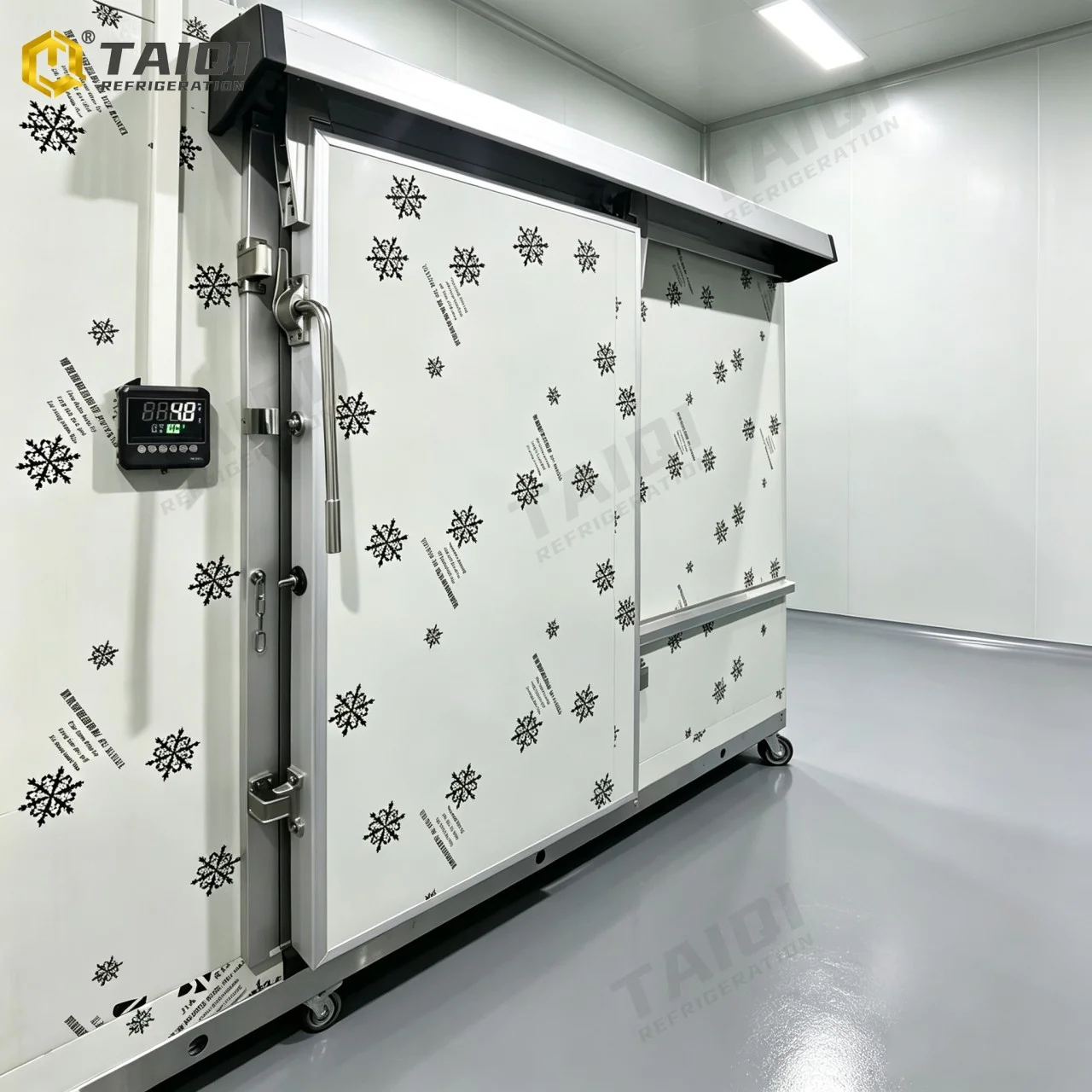
1. Understanding Light-Duty and Medium-Duty Sliding Doors
Light-duty and medium-duty sliding doors are both designed for cold room applications, but their structural configurations are different.
A light-duty sliding door generally uses a relatively lightweight frame and track arrangement. It is worth considering for cold rooms where the opening dimensions, door panel requirements and operating conditions are compatible with this configuration.
Taiqi's light-duty sliding door features a PVC door frame and lightweight aluminum alloy upper and lower tracks. The tracks are anodized and corrosion-resistant. Its hardware combines 304 stainless steel components with nylon parts, while EPDM rubber is used for sealing.
The medium-duty sliding door adopts a different structure. It uses an aluminum alloy door frame with a thermal break, together with a medium-duty upper track and an aluminum alloy side track. Its track-embedded core-lift block design is intended to support smooth opening and closing.
The distinction is therefore not simply about the product name. The frame and track arrangements are different, and buyers should evaluate these components together with the door panel and installation conditions.
2. Main Structural Differences Between the Two Models
When comparing cold room sliding doors, it is useful to examine the components that directly affect installation and operation.
Door Frame
The light-duty model uses a PVC door frame, while the medium-duty model uses an aluminum alloy frame with a thermal break.
These materials and structures create different product configurations. Buyers should consider the surrounding wall structure, installation requirements and operating temperature when deciding which frame arrangement is appropriate.
For projects where an aluminum alloy frame is preferred, the medium-duty model provides a corresponding option. The final selection should be confirmed according to the project specifications.
Track System
The track system is another important difference.
The light-duty model uses lightweight aluminum alloy upper and lower tracks. The medium-duty model uses a medium-duty upper track and an aluminum alloy side track, with a track-embedded core-lift block design.
The track, rollers and related hardware need to work together. Buyers should ask the manufacturer about the track arrangement, installation method and maintenance requirements before confirming an order.
Door Panel Thickness
Both models offer several door panel thickness options, but their listed ranges are not identical.
-
Light-Duty Sliding Door: 75 mm, 100 mm, 120 mm and 150 mm.
-
Medium-Duty Sliding Door: 75 mm, 100 mm, 120 mm, 150 mm and 200 mm.
The medium-duty model therefore provides an additional 200 mm panel option. Buyers should select panel thickness according to the cold room's temperature requirements and overall insulation design, rather than assuming that a thicker panel is always necessary.
Sealing and Insulation Materials
Both models use flame-retardant polyurethane insulation material with a listed density of 40 kg/m³ ± 2. EPDM rubber is used for the sealing system, and both products offer several surface material options, including color-coated steel, stainless steel and embossed aluminum sheet.
These shared features provide a consistent basis for comparison. The final insulation and sealing configuration should still be checked against the intended operating environment.
3. Product Comparison at a Glance
The following table summarizes the main specifications published for Taiqi's two sliding door models.
| Feature | Light-Duty Sliding Door | Medium-Duty Sliding Door |
|---|---|---|
| Door frame | PVC | Aluminum alloy with thermal break |
| Upper track | Lightweight aluminum alloy | Medium-duty aluminum alloy |
| Lower or side track | Lightweight aluminum alloy lower track | Aluminum alloy side track |
| Panel thickness | 75/100/120/150 mm | 75/100/120/150/200 mm |
| Hardware | 304 stainless steel and nylon components | 304 stainless steel and nylon components |
| Sealing material | EPDM rubber | EPDM rubber |
| Insulation | Flame-retardant polyurethane | Flame-retardant polyurethane |
| Frame heating | Three-sided PVC frame heating | Three-sided aluminum alloy frame heating |
| Additional options | Centrifugal air curtain | Threshold heating, electrical control system and centrifugal air curtain |
Specifications are based on the product information published by Taiqi. Buyers should confirm the required configuration and available options directly with the manufacturer before ordering.
4. How to Select the Right Sliding Door for Your Cold Room
There is no single door type that fits every cold storage project. A practical selection should begin with the actual installation and operating requirements.
Consider the opening dimensions
Measure the opening width and height accurately. Also provide information about the surrounding wall panels, frame position and available installation space. These details help the manufacturer assess whether the proposed door configuration is suitable.
Check the required panel thickness
The operating temperature and insulation design of the cold room should guide panel selection. If the project requires a 200 mm panel, the medium-duty model has a listed option for this thickness. For other requirements, both product ranges provide several configurations.
Evaluate the frame and track arrangement
The PVC frame and lightweight aluminum alloy tracks of the light-duty model differ from the aluminum alloy frame and medium-duty track arrangement of the medium-duty model. Buyers should consider the complete structure, not just one component.
Review heating requirements
Both models include frame heating configurations, but the medium-duty model also lists optional threshold heating. For low-temperature applications, discuss the heating arrangement and installation details with the manufacturer to determine what is appropriate for the project.
Consider operating and control requirements
The medium-duty product page lists an optional electrical control system, while the light-duty page does not list the same option. Buyers who require electrical operation should confirm the available configuration and control requirements before production.
5. Why Door Accessories and Manufacturing Support Matter
A sliding door is a complete assembly rather than an isolated panel. Tracks, rollers, frames, seals and other hardware components all contribute to its installation and daily operation.
For this reason, buyers should consider whether the manufacturer can provide compatible accessories and clear component information. It is also useful to confirm which parts are included in the standard configuration and which are optional.
Working with a manufacturer that covers both cold storage doors and related accessories can make product coordination more convenient. It gives buyers a direct channel for discussing component compatibility, product specifications and replacement part requirements.
Changzhou Taiqi Refrigeration Technology Co., Ltd. focuses on the research and development, production and sales of insulated cold storage doors, PVC high-speed doors, industrial doors, loading and unloading equipment, and cold room door accessories. Its product range allows buyers to discuss more than one type of access product with the same supplier.
6. Changzhou Taiqi Refrigeration: Manufacturing and Product Capabilities
For overseas buyers, evaluating the factory behind a product is just as important as reviewing its specifications.
Changzhou Taiqi Refrigeration Technology Co., Ltd. was established in 2016 and is based in Luoyang Town, Wujin District, Changzhou, Jiangsu, China. The company operates two production bases: the Changzhou Luoyang factory and the Taizhou Industrial Park factory.
Its business covers product design and R&D, manufacturing, sales, installation and solutions for cold chain insulation access points. Its main product categories include:
-
Insulated cold storage doors: Designed for refrigerated rooms and temperature-controlled facilities.
-
PVC high-speed doors: Used in entrances requiring frequent passage and efficient access.
-
Industrial doors: Serving different industrial access requirements.
-
Loading and unloading equipment: Supporting loading bay and material transfer operations.
-
Cold room door accessories: Providing related components and fittings for refrigeration door systems.
This product coverage is relevant to cold storage contractors and distributors who may need several types of doors and supporting equipment for one project.
The company's focus on both refrigeration doors and industrial access products also gives buyers an opportunity to discuss product selection and related requirements through one manufacturing supplier.
7. Explore Taiqi's Light-Duty and Medium-Duty Sliding Doors
Buyers comparing the two models can review their specifications directly before submitting project details.
Visit the Light-Duty Sliding Door product page to learn more about its PVC frame, lightweight aluminum alloy tracks and listed configurations.
For projects that require an aluminum alloy frame with a thermal break and a different track arrangement, refer to the Medium-Duty Sliding Door product page.
To help the factory assess your requirements, include the following information in your inquiry:
-
Cold room opening width and height.
-
Required door panel thickness.
-
Intended operating temperature.
-
Wall panel structure and installation conditions.
-
Preferred frame and surface material.
-
Manual or electrical control requirements.
-
Any additional heating or air curtain requirements.
Providing these details makes it easier to discuss a suitable configuration and confirm the product specifications before production.
For more information about the company's manufacturing background and complete product range, visit the official website of Changzhou Taiqi Refrigeration Technology Co., Ltd..
Conclusion
Medium-duty and light-duty sliding doors have different structural configurations, particularly in their door frames and track systems. The light-duty model uses a PVC frame and lightweight aluminum alloy tracks, while the medium-duty model features an aluminum alloy frame with a thermal break and a medium-duty track arrangement. Their available panel thicknesses and additional options also differ.
For cold storage buyers, the right choice depends on the opening dimensions, insulation requirements, operating temperature and installation conditions. Comparing the complete door assembly is more useful than judging a product by its category name alone.
With two production bases and a product portfolio covering insulated cold storage doors, PVC high-speed doors, industrial doors, loading and unloading equipment, and cold room door accessories, Changzhou Taiqi Refrigeration Technology Co., Ltd. provides overseas buyers with a supplier to consult for different cold room access requirements.
www.taiqirefrig.com
Changzhou Taiqi Refrigeration Technology Co., Ltd.