
 admin
Published: November 13, 2026 | By W&W Motor Engineering Team
Short answer: the motor will usually spin, and it will not do useful work. A shaded pole motor is a volts-per-hertz device: 220 V at 50 Hz is 4.4 V/Hz, 115 V at 60 Hz is 1.9 V/Hz, and the second figure is 44% of the first. Flux falls to 44%, torque falls to about 19% of rated, and a shaded pole motor — which starts on 20–40% of its running torque even when correctly wound — has nothing left to break the load away. If your question is can i run a 220v 50hz shaded pole motor on 115v 60hz, the answer is that you can wire it, you cannot load it.
1. Can I Run a 220V 50Hz Shaded Pole Motor on 115V 60Hz?
No — and the failure mode is quiet, which is what makes it dangerous. At 1.9 V/Hz the iron is barely magnetised, so magnetising current is low, the motor runs cool, and on a bench with no impeller attached it sounds smooth and draws less current than nameplate. Engineers approve it on that test. Fit it to the fan and the rotor sits at high slip, line current climbs toward locked-rotor value within seconds, and the winding overheats while the fan turns slowly enough to look like a balance problem.
Torque follows the square of the flux ratio. That single rule explains every combination in an export programme, and it is worth memorising because it is the whole article in one line:
• 220 V / 50 Hz motor on 115 V / 60 Hz — flux 44%, torque ≈ 19%, speed tries to rise 20% but the rotor cannot accelerate. Will not start under load; overheats if held energised.
• 220 V / 50 Hz motor on 230 V / 60 Hz — flux 87%, torque ≈ 76%, speed +20%. This one starts and is the case most people wrongly treat as safe: the fan now absorbs 1.73× its 50 Hz power while the motor offers 0.91× its rated power. It runs, and it runs hot.
• 115 V / 60 Hz motor on 230 V / 50 Hz — flux ≈ 200%, the iron saturates, current spikes and the winding fails in minutes, usually before the first temperature reading.
• 220 V / 50 Hz motor on 220 V / 60 Hz — flux 83%, torque ≈ 69%, speed +20%. Fine for a propeller fan with margin, not for a pump or a condenser fan running near its curve.
The question can i run a 220v 50hz shaded pole motor on 115v 60hz almost always arrives late, at the point where a European platform is being localised for North America and the motor is the one drawing nobody reopened. By then the impeller is tooled and the only remaining freedom is the winding — which is the right place to solve it, and the only place.
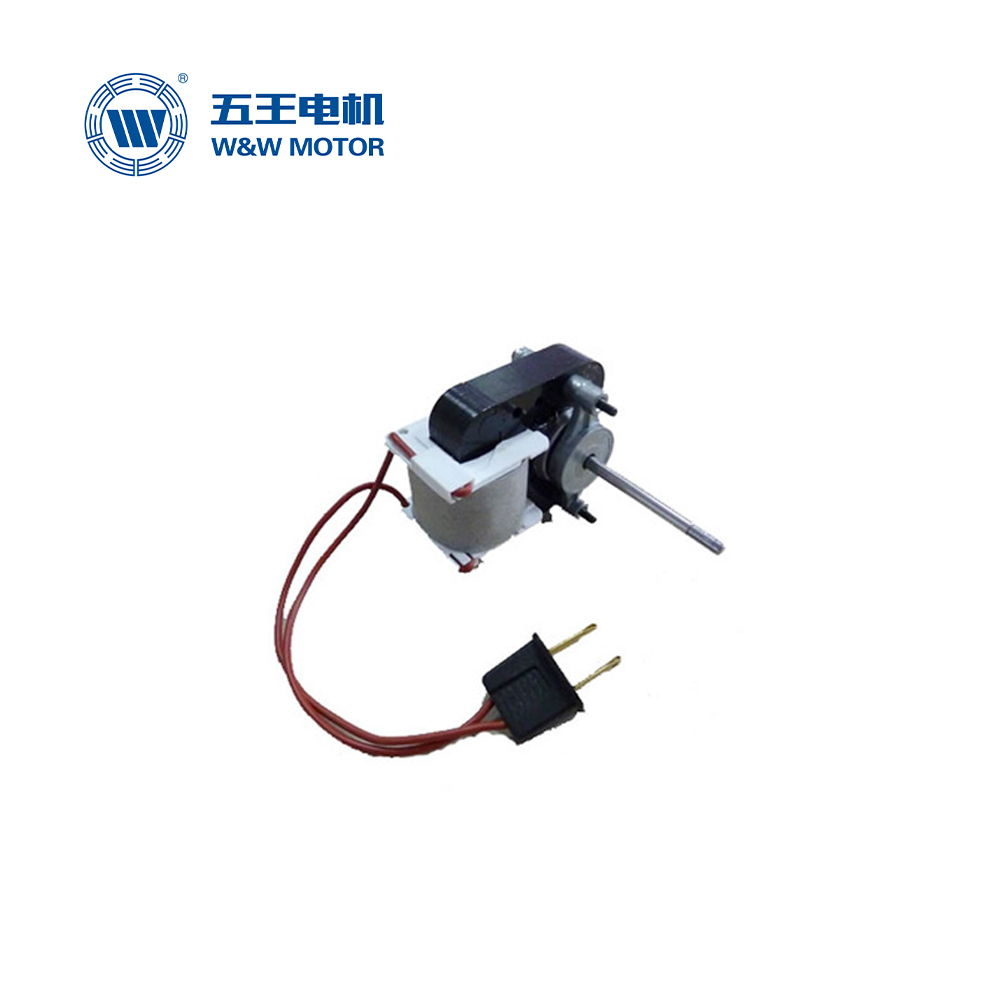
The nameplate is where this decision is usually made too late. A W&W Motor 61 series motor ordered as 220 V / 50 Hz and shipped into a 115 V market cannot be corrected by the appliance builder — the fix belongs at the winding stage, which means the order has to specify the destination market before tooling, not after the first UL submission.
✅ Bottom line: at 44% flux the motor keeps 19% of its torque and none of its starting margin. Rewind for the market; do not rewire for it.
2. What Derating Applies When a 50 Hz Motor Runs on 60 Hz — and the Reverse?
Speed follows frequency, torque follows flux, and power is the product of the two. Everything else in this section is arithmetic on those three facts. Going from 50 Hz to 60 Hz multiplies speed by 1.20; going the other way multiplies it by 0.83. If voltage stays where it was, flux moves by the same ratio in the opposite direction, and torque by its square.
This is why the general rule — shaded pole motor derating when running 60hz motor on 50hz — is the mirror image of the 50-to-60 case, and why the two are so often confused. A 60 Hz motor placed on a 50 Hz supply at the same voltage gains 20% flux, moves toward saturation, and draws more magnetising current than it was built for; the speed drops 17% and the fan absorbs only 58% of its power, so the airflow loss masks a winding that is running hotter than nameplate. Reduce the voltage by 17% and the motor is back on its design point — which is exactly what a variable-frequency drive does, and exactly what a transformer alone does not.
For a 115v 60hz shaded pole motor for us appliance manufacturers, none of this should ever be needed. The US market is a 60 Hz market with a 115 V nominal supply, and the correct engineering answer is a 60 Hz winding with 115 V nameplate, UL or cUL Recognized, rather than a European motor adapted at the panel. The 61 series is built across 110–240 V at 50/60 Hz for exactly this reason, and the 30 W 6135 shaded pole motor is the frame most often dual-ordered for oven and fan programmes that ship to both regions.
One field rule is worth carrying into design reviews: hold V/f within ±10% of the design ratio and the motor stays thermally honest. Beyond that, de-rate usable torque by the square of the V/f ratio and re-check the fan curve, because a centrifugal fan's power demand rises with the cube of speed — 20% more rpm is 73% more power, and no 5% service factor covers that.
✅ Bottom line: keep V/f constant or lose torque to its square. A fan motor moved 50→60 Hz needs 73% more power, not 20% more speed.
FAQ
Q: Can a step-up transformer solve the 220V 50Hz motor on 115V 60Hz problem?
A: It fixes voltage and leaves frequency wrong. A transformer taking 115 V to 220 V still delivers 60 Hz, so the motor sees 3.67 V/Hz against a design point of 4.4 — flux 83%, torque 69%, speed 20% high. On a propeller fan with headroom that will often run; on a pump or a near-curve condenser fan it will not, and the transformer's own losses and enclosure cost more than a correct winding. Order the winding.
Q: Is a dual-rated 50/60 Hz motor the answer for a dual-market appliance?
A: Only if the nameplate is read properly, because the same shaded pole motor derating when running 60hz motor on 50hz arithmetic decides whether it is a real design point or a restatement of the 50 Hz one. A motor marked 50/60 Hz is usually wound for one design point and stated at two, with different rated watts and speeds at each frequency — and at 60 Hz the same fan will pull more current. Ask for the watt, speed and current at both frequencies, not a single dual-range figure, and check which of the two the fan curve was drawn against.
Q: Does W&W Motor supply 115V 60Hz versions for US appliance manufacturers?
A: Yes. W&W Motor supplies a 115v 60hz shaded pole motor for us appliance manufacturers as a standard catalogue variant across the 61 series shaded pole motor range, with UL and cUL Recognized construction, and as OEM or ODM builds with custom shaft, bracket, lead length and connector. Typical wholesale MOQ is 1,000 units, samples in about 7 days and bulk production in 17–25 days. Because the factory in Changzhou winds in house rather than buying finished motors from a trading supplier, a 60 Hz variant of an existing 50 Hz design is a document change plus a winding change — not a new platform.
Next step
Send the destination market, supply voltage and frequency, impeller diameter and the airflow you need at each market's speed, and the W&W Motor engineering team will return the correct winding for each version with the watt, speed and current stated separately at 50 Hz and 60 Hz — normally within two working days. Motors for the US market ship with the UL file number on the quotation, and a sample of each winding can be run side by side before you commit a China manufacturer tooling programme to either one.
www.wuwangdianji.com
W&W Motor