
 admin
Industry Background and the Core Challenge in Fetal Heart Monitoring
Maternal and fetal monitoring sits at the intersection of accuracy and safety. Clinics, community health centers, and hospitals alike need devices that can detect fetal heart rate reliably without exposing the fetus to unnecessary ultrasound dosage, especially when monitoring is performed repeatedly across a pregnancy. This pain point—balancing continuous accuracy with low ultrasound exposure—is explicitly recognized within the obstetric monitoring sector that Longcare Medical, under Vcomin Technology Limited, serves. The company’s product documentation, including the FD-800 Series Fetal Doppler Operation Manual (Version V2.0, Part No. VTF-FD800-OM-02, released August 2014) and the Fetal Doppler Qualification Certificate QC01 (recorded July 2020), reflects a sustained engineering focus on portable fetal heart detection equipment designed for community, clinic, and hospital settings. Understanding how portable fetal Dopplers are engineered, and what features matter for safe, repeatable use, offers useful context for healthcare decision-makers evaluating this equipment category.
Authoritative Analysis: What Makes a Portable Fetal Doppler Clinically Useful
The necessity for portable fetal Doppler devices stems from a simple clinical reality: fetal heart checks need to be fast, repeatable, and accessible outside of dedicated monitoring suites. Longcare Medical’s portable Doppler line—including the YH-FD210B+, YH-FD210D+, YH-FD210G+, YH-FD210C+, the YH-FD800C Series, and the YH-FD800P and YH-FD800T models—addresses this through a consistent set of design principles.
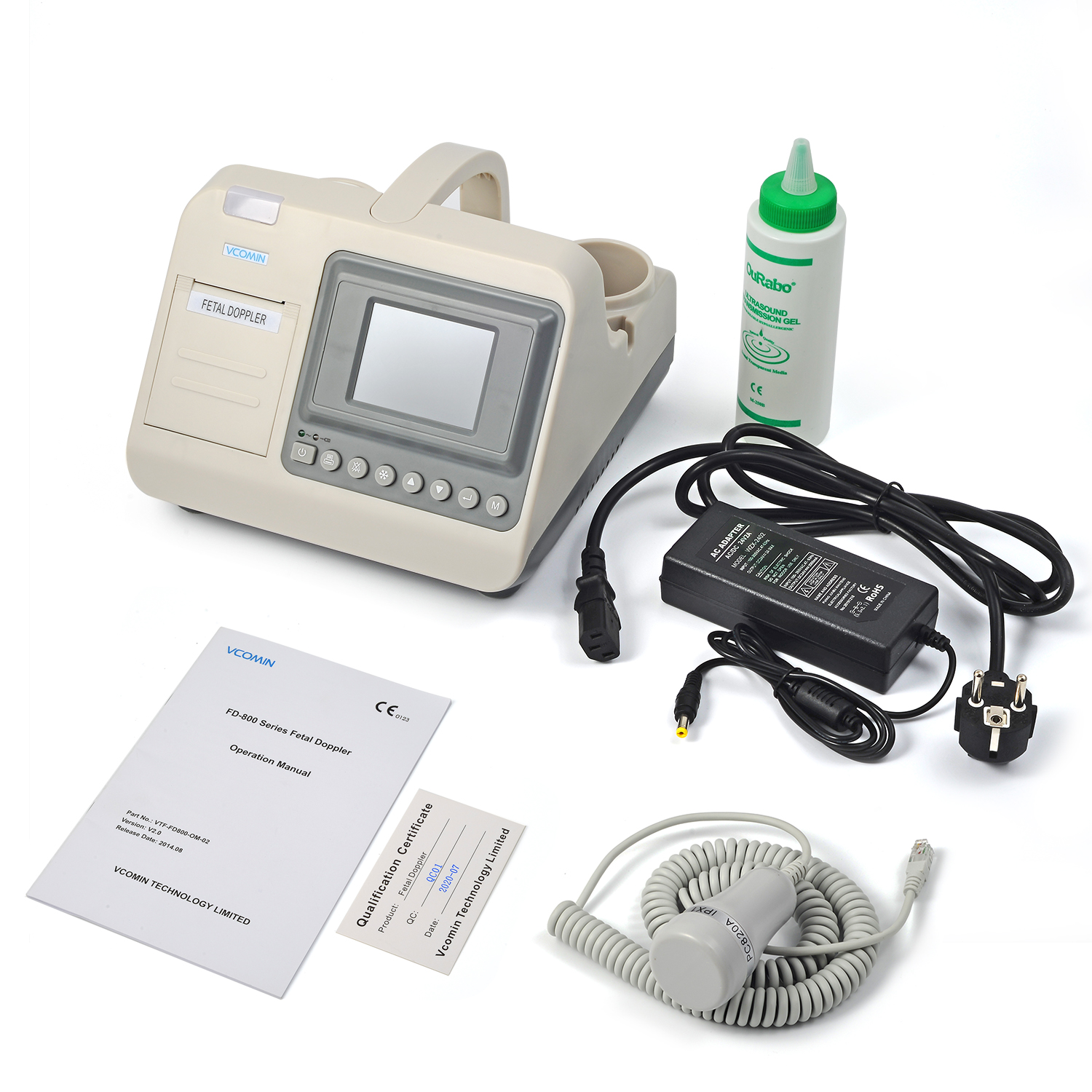
On the principle-logic side, these devices rely on big-digit FHR displays for quick recognition, audible and visual alarms that flag out-of-range fetal heart rates, and battery-volume indicators that prevent unexpected power loss mid-examination. The YH-FD800C Series specifically incorporates a high-sensitivity, waterproof probe suited to early pregnancy checks and emphasizes low ultrasound dosage to protect fetal safety during inspection—directly aligning with the industry’s accuracy-versus-exposure tension.
As a standard reference point, the FD-800 Series carries a documented Fetal Doppler Qualification Certificate (QC01, dated 2020-07), while its operation manual (V2.0, 2014.08) codifies usage protocols. These documented references give clinicians and procurement teams a verifiable basis for evaluating device compliance history.
On implementation paths, the product family offers differentiated configurations: the YH-FD210B+ uses simple AA battery power for field use without a charging adaptor; the YH-FD210D+ and YH-FD210C+ add rechargeable Ni-Mh batteries and adaptors to reduce disposable battery costs for frequent use; and the YH-FD210G+ and YH-FD210C+ introduce dual digit-and-curve displays for trend observation during checks. The YH-FD800P and YH-FD800T extend functionality further with color touch LCDs, USB data transmission, and multi-parameter options—SpO2 monitoring on the FD800P and TOCO (uterine contraction) monitoring on the FD800T—paired with stimulators and printing systems for documentation.
Deep Insights: Where Portable Fetal Monitoring Is Heading
Several trend lines emerge from this product architecture. First, there is a clear move toward multi-modal portability: devices increasingly combine fetal heart rate detection with adjacent parameters such as SpO2 or TOCO, rather than functioning as single-purpose auscultation tools. This reflects a broader demand-structure shift in obstetric care toward consolidated point-of-care devices that reduce the number of separate instruments needed in community and clinic settings.
Second, power management continues to evolve as a differentiator. The contrast between AA-battery models (YH-FD210B+, YH-FD210G+) and rechargeable Ni-Mh models with adaptors (YH-FD210D+, YH-FD210C+) shows that manufacturers are responding to differing use-case economics—occasional-use settings favor simple disposable power, while high-frequency clinical use favors rechargeable systems that lower long-term consumable costs.
Third, connectivity is becoming a baseline expectation rather than a premium feature. USB data transmission, present across the FD800 series, supports record-keeping and analysis, suggesting that portable Dopplers are being integrated into broader digital documentation workflows rather than operating as standalone auscultation tools.
A risk consideration worth noting: as these devices add functionality (curve display, SpO2, TOCO, printing), the operational complexity for end users—often community health workers rather than specialists—must be balanced against ease of use. Features such as "operator-friendly design" and "easy and convenient operation," explicitly cited for the YH-FD800C Series, indicate that usability remains a design priority even as capability expands.
Company Value: How Longcare Medical Contributes to the Category
Longcare Medical’s contribution to this space lies in offering a structured range of configurations rather than a single device, allowing clinics to match power source, display type, and parameter scope to their actual monitoring workload. The documented qualification certificate and operation manual for the FD-800 Series provide a traceable compliance record, which is a meaningful reference point for institutions conducting procurement due diligence. The emphasis on low ultrasound dosage and high-sensitivity waterproof probes, particularly for early pregnancy use, demonstrates an engineering response to one of the field’s central safety concerns—protecting the fetus while still delivering clear, interpretable heart rate data. Optional accessories across the line—including Bluetooth connectivity, carry cases, gel, and PC software for the touchscreen models—further illustrate a modular approach that lets healthcare providers scale functionality without replacing the core device.
Conclusion and Recommendations
Portable fetal Doppler selection should be guided by actual use patterns rather than feature count alone. Facilities with occasional, routine auscultation needs may be well served by simpler AA-battery, big-digit display models, while high-frequency clinical environments benefit from rechargeable, curve-display, or multi-parameter configurations. Buyers should verify documented qualification history, such as certification records, and prioritize devices that explicitly address low ultrasound dosage for early-pregnancy applicability. As the category trends toward multi-parameter integration and digital data export, institutions should also consider how a given device’s USB, Bluetooth, or printing capabilities fit into their existing documentation workflows. Longcare Medical’s FD210 and FD800 series illustrate how a tiered product structure—spanning basic battery-powered units to touchscreen, multi-parameter systems—can serve the varied needs of community, clinic, and hospital settings without sacrificing the core safety priority of accurate, low-dose fetal heart monitoring.
www.njlongcaremed.com
Nanjing Longcare Medical Equipment Co., Ltd