
 admin
Why Confined-Space Welders Need a Different Cooling Solution
Welding engineers working in confined spaces face a specific thermal management problem that most cooling garments were never designed to solve. Welding cells, workshop benches, and tight enclosures frequently lack access to on-site ice or water, which immediately rules out ice-based cooling systems. Fan-based cooling garments depend on dry ambient air to work through evaporation, making them less reliable in enclosed or humid welding environments. Phase-change material (PCM) garments offer temporary relief, but the stored cold mass depletes over time and must eventually be recharged or replaced mid-shift.
This combination of constraints—no water, no ice, and often no dry air—creates a narrow but important use case: a cooling garment that generates its own cold continuously, without consuming a finite resource. This is precisely the gap addressed by Southern Sparkle Wearable Technology Co., Ltd., operating under the brand ELEHEAT, a manufacturer of industrial wearable cooling and heating garments built on thermoelectric Peltier technology.
How Thermoelectric Peltier Cooling Works
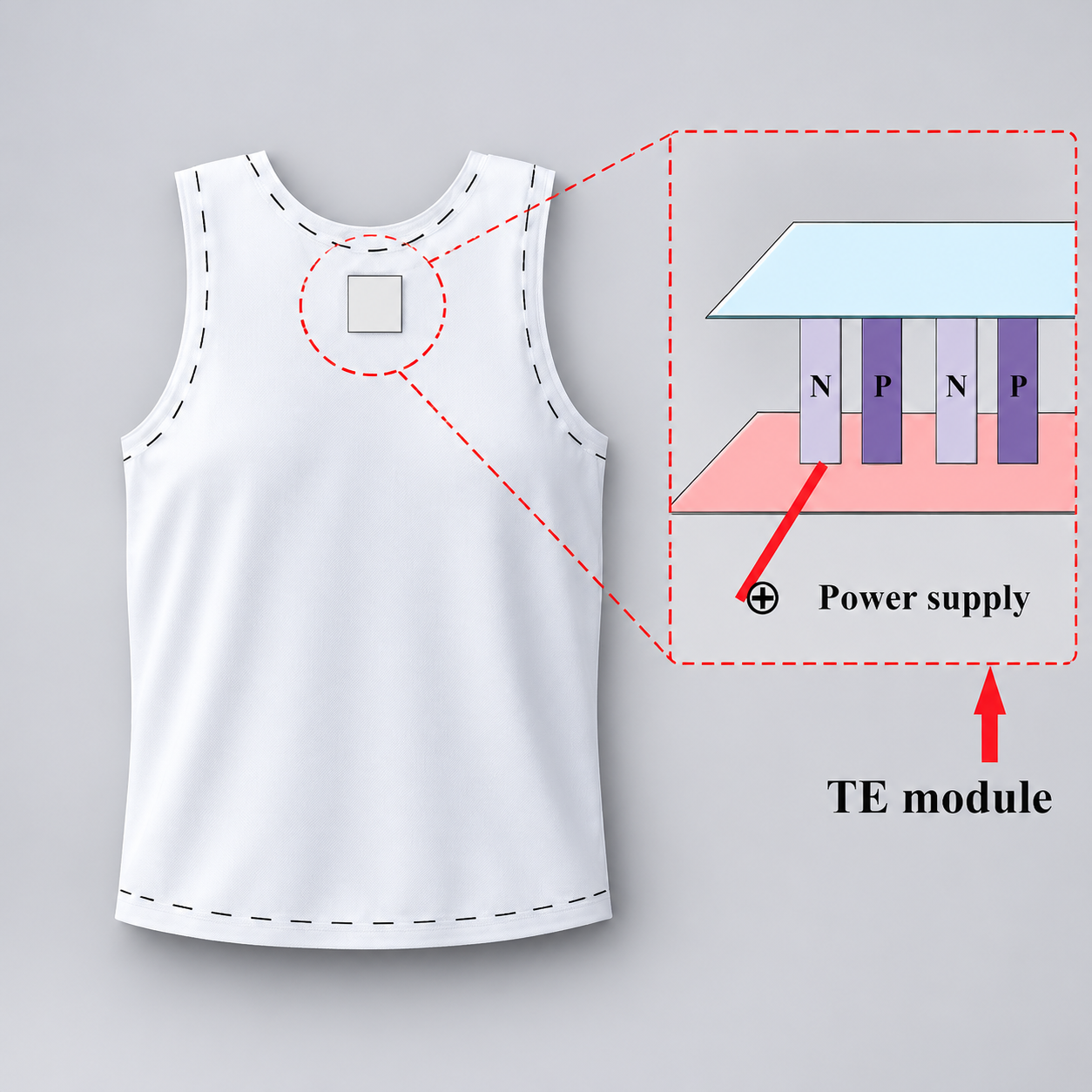
The core of ELEHEAT’s approach is a semiconductor Peltier plate that moves heat electrically from one surface to another. In the ELEHEAT Peltier vest, this plate sits against the wearer’s back, drawing heat away from the skin side and transferring it to a finned heat sink and fan on the outside of the garment, where it can be exhausted into the surrounding air. Because the cooling effect is generated electrically rather than stored chemically or mechanically, the vest continues to cool for as long as it has power—a meaningful distinction from PCM sets, which stop cooling once the stored cold is consumed.
A second technical feature worth understanding is targeted vascular cooling. Rather than covering the entire torso with a cooling panel, the ELEHEAT system places a localized cold surface over superficial vessel regions—areas such as the wrist, inner forearm, side of the neck, and axilla, where large veins run close to the skin. As blood circulates past this cooled area, the body experiences a whole-body cooling sensation that originates from a relatively small contact point. It is important to note that this describes a cooling sensation produced through circulation, not a separately measured reduction in internal body temperature; the two are distinct claims and should not be conflated when evaluating the technology.
Reversible Operation: One Garment, Two Functions
A distinguishing characteristic of the ELEHEAT Peltier vest is that the same semiconductor plate can switch from cooling to heating simply by reversing the electrical current. This reversibility means a single garment can serve welders and confined-space workers during hot shifts and also provide heated workwear during cold-store or winter shifts, vehicle cab work, or cooler ambient conditions. For organizations managing crews across variable environments, this reduces the need to stock, size, and train staff on two separate garment types—one for heat, one for cold.
Technical Specifications Relevant to Welding Environments
For a welding engineer evaluating this category of equipment, several technical parameters matter:
- Runtime: The garment operates for 3 to 5 hours on a 20,000 mAh battery pack.
- Power input: Standard operation runs on 12 to 24 V DC, with packs up to 50 V available across ELEHEAT’s wider battery range.
- Ambient performance limit: Cooling performance declines above roughly 35 degrees C, because the hot side of the plate cannot efficiently reject heat into air that is already hot. This is a heat-rejection constraint tied to how quickly the finned heat sink and fan can carry heat away, rather than a limitation of the plate’s nominal rating.
- Module-level testing: The plate, heat sink, and fan are run-tested together as one module before assembly, since the heat rejection path—not the plate itself—is typically where failures occur.
These specifications matter directly for confined-space welding: if ambient conditions in the welding cell stay below roughly 35 degrees C and no water or ice is available on site, the Peltier garment is positioned as a suitable fit. In hotter plant conditions, alternative approaches such as fan-based evaporative vests or PCM sets may represent a lower-risk starting point for sites that have not previously used cooling wear, since evaporative cooling and stored-cold systems operate on different mechanisms better suited to those specific ambient profiles.
Supporting Components and Manufacturing
ELEHEAT’s product line extends beyond the vest itself to the components that make continuous thermoelectric operation possible. ELEHEAT thermal circuits are manufactured in-house at the company’s 12,000 square meter plant in Dongguan, China, supporting the production of the cooling garments. ELEHEAT battery modules provide the rechargeable power source, delivering the same 3 to 5 hour runtime on a 20,000 mAh pack and supporting 12 to 24 V DC garments, with packs up to 50 V available in the broader range. These battery packs carry CE marking, and a model test report covering cooling performance, runtime, and electrical safety accompanies each quotation—information welding engineers and procurement teams can use to verify suitability before committing to an order.
Battery weight is also a practical consideration raised directly by the company: since the pack is part of the load a worker carries, this matters for work at height and in confined spaces where mobility and comfort are already constrained by the work environment itself.
Customization and Deployment for Industrial Buyers
Recognizing that welding environments vary in layout, heat exposure, and crew size, ELEHEAT offers customization across plate count, heat sink size, input voltage (12 to 24 V), temperature steps, shell fabric, color, and size grading. Minimum orders are set at 50 sets for stock models and 200 sets for custom specifications, with samples available in 7 to 10 days and bulk production completed in 25 to 35 days after approval. A 12-month warranty covers electrical parts on battery packs and fan kits, though consumable items such as tubing, filters, and ice packs fall outside that warranty scope.
A Practical Framework for Evaluation
For a welding engineer specifically searching for continuous thermoelectric cooling in a confined space, the relevant evaluation criteria are straightforward: confirm ambient temperatures remain within the stated operating range, confirm water and ice are indeed unavailable on site (which favors a powered thermoelectric approach over ice-dependent alternatives), and confirm runtime requirements align with shift length relative to the 3 to 5 hour battery capacity. Where these conditions align, the ELEHEAT Peltier vest—built around reversible thermoelectric operation, targeted vascular cooling, and continuous powered operation rather than depleting stored cold—represents a solution engineered specifically for the confined-space, water-and-ice-free welding scenario described.
Southern Sparkle Wearable Technology Co.,Ltd.