
 admin
In high-speed liquid packaging engineering, the nameplate rated capacity of a rotary filling machine rarely equals the net operating efficiency of the complete production facility. A rotary monoblock filler rated at 24,000 bottles per hour (BPH) can suffer substantial overall equipment effectiveness (OEE) losses if the conveying interconnects between upstream stretch blow molding, rotary filling, automated labeling, and end-of-line secondary packaging lack dynamic buffering and velocity synchronization. Conveying systems are not passive transport hardware; they function as mechanical energy reservoirs and dynamic decoupling buffers that isolate individual process stations from transient micro-stoppages.
Zhangjiagang Grandee Machinery Co., Ltd., manufacturing under the brand name Grandee Machine, engineers complete liquid bottling plants across capacities from 2,000 to 36,000 BPH. In high-speed bottling line engineering, system throughput depends on two fundamentally distinct conveying architectures: stainless steel overhead air conveyors for ultra-lightweight empty PET containers, and motorized flat top slat chain conveyors for filled, heavy containers. This technical guide examines the aerodynamic principles of air conveyors, multi-lane mass-flow accumulation dynamics of slat conveyors, mathematical modeling of line buffers, and turnkey integration requirements across 6,000 to 24,000 BPH packaging lines.
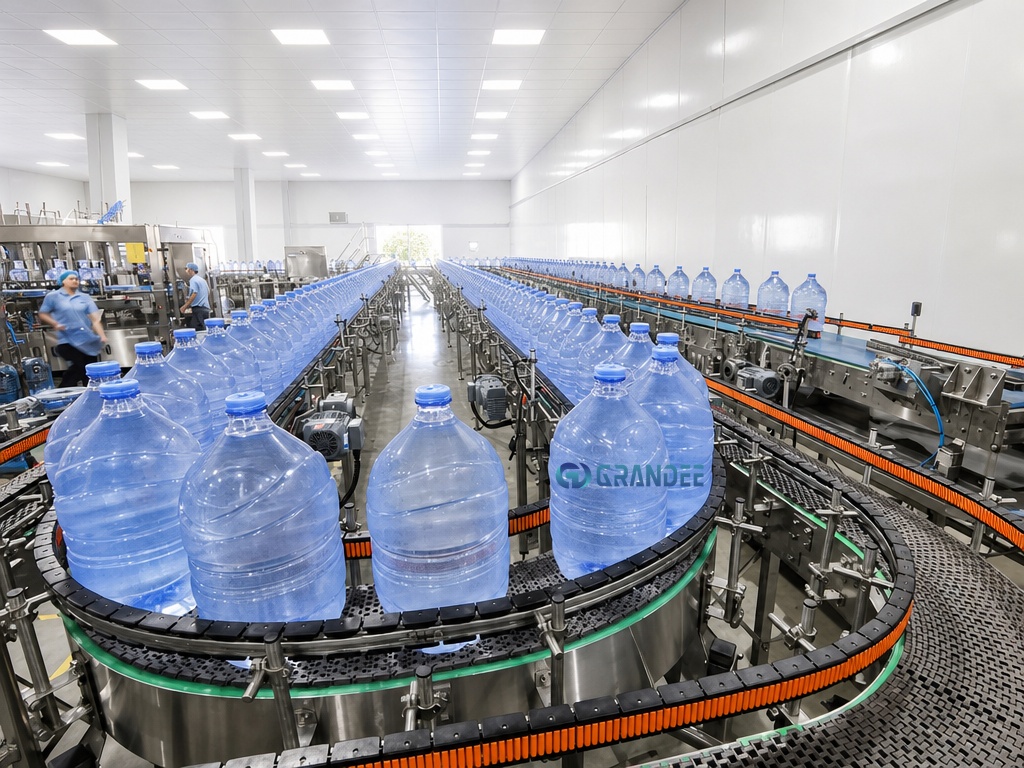
Conveyor Mechanical Principles: Air Suspension vs. Flat Top Slat Chains
Container physical state dictates the selection and engineering configuration of conveying media along the packaging line:
- Overhead Air Conveyors (Empty PET Containers): Empty PET bottles possess high volumetric displacement but negligible structural mass (e.g., a 500 ml container weighing only 11 to 18 grams). Mechanical belt conveying at speeds exceeding 12,000 BPH induces aerodynamic lift, container toppling, and severe surface scuffing. Air conveyors utilize centrifugal blowers equipped with pre-filters and HEPA filtration to pressurize a closed overhead plenum (static pressure: 300 to 650 Pa). Air discharge louvers direct high-velocity aerodynamic jets against container neck finishes, suspending the bottle by its neck support ring within low-friction ultra-high-molecular-weight polyethylene (UHMW-PE) neck guides. The container glides without base contact, eliminating container crushing and neck scuffing prior to filling.
- Flat Top Slat Chain Conveyors (Filled Containers): Once filled and capped, container mass increases by thirty to fifty times (e.g., 500 to 520 grams per unit). Slat conveyors utilize modular, interlocking thermoplastic (POM acetal) or austenitic stainless steel (SUS304) slat chains running over wear strips. Slat conveyors provide the mechanical load-bearing capacity, lateral stiffness, and frictional traction required to transport, split, merge, and accumulate filled bottles through cooling tunnels, vision inspection carousels, labeling stations, and case packing infeed tables.
Line Balancing Principles and V-Graph Velocity Sizing
Line balancing establishes a calculated velocity hierarchy across consecutive equipment stations, visually configured as a “V-Curve” centering on the liquid filling monoblock. The filling machine represents the critical capital core and pace-setter of the line; it must operate continuously at steady-state speed without being starved by upstream blow molders or blocked by downstream packaging machines:
- The Core Pacemaker Rule: The rotary filling and capping monoblock is designated as 100% baseline speed (V_filler).
- Upstream Over-Capacity (Blow Molding): To ensure the filler never starves, upstream rotary blow molders are engineered with an over-speed ratio of 105% to 110% of nominal filler speed (V_blow = 1.05 to 1.10 × V_filler).
- Downstream Over-Capacity (Labeling & Packaging): Downstream secondary and tertiary packaging units (roll-fed OPP or shrink sleeve labelers, film shrink wrappers, and case packers) must operate with a speed advantage of 115% to 125% (V_downstream = 1.15 to 1.25 × V_filler) to rapidly evacuate accumulated containers following transient downstream stoppages (such as label reel splicing or film roll changeovers).
Dynamic Buffer Calculation: Mathematical Formulas and Sizing Matrix
A dynamic buffer provides accumulating conveyor capacity between two asynchronous machines. It allows upstream equipment to continue operating at full speed while downstream equipment clears a short-term fault, without triggering upstream back-pressure shut-downs.
1. Required Dynamic Buffer Accumulation Time (T_buffer):
• Overhead Air Conveyor (Blow Molder → Filler): 1.5 to 2.5 minutes
• Slat Conveyor (Filler Discharge → Labeler): 2.0 to 3.5 minutes
• Slat Conveyor (Labeler Discharge → Case Packer): 3.0 to 5.0 minutes
2. Total Buffer Bottle Count Capacity:
Total Buffer Bottles = (Line Rated BPH ÷ 60) × Buffer Time (minutes)
3. Effective Conveyor Length Calculation:
Conveyor Length (meters) = [Total Buffer Bottles × Bottle Outside Diameter (mm)] ÷ [1,000 × Number of Parallel Conveyor Lanes]
Where Bottle Outside Diameter is measured in millimeters (mm), and Number of Parallel Conveyor Lanes is the chain width count.
Applying these mathematical parameters to standard 500 ml cylindrical PET water bottles ($D_{\text{bottle}} = 68 \text{ mm}$), the required accumulation buffer architecture across standard capacity tiers scales as follows:
| Nominal Line Speed (BPH) | Overhead Air Conveyor Buffer (1.5 min) | Filler-to-Labeler Slat Buffer (2.5 min) | Labeler-to-Packer Slat Buffer (4.0 min) | Recommended Slat Table Configuration |
|---|---|---|---|---|
| 6,000 BPH | 150 bottles (≈ 10.2 meters, single lane) | 250 bottles (≈ 17.0 m single lane, or 2 lanes × 8.5 m) | 400 bottles (≈ 3 lanes × 9.1 meters) | 2 to 3 parallel multi-lane tables with VFD frequency regulation |
| 12,000 BPH | 300 bottles (≈ 20.4 meters overhead line) | 500 bottles (≈ 4 lanes × 8.5 meters) | 800 bottles (≈ 5 lanes × 10.9 meters) | Multi-lane bi-directional FIFO accumulation table or 4-to-6 lane tables |
| 18,000 BPH | 450 bottles (≈ 30.6 meters overhead line) | 750 bottles (≈ 6 lanes × 8.5 meters) | 1,200 bottles (≈ 8 lanes × 10.2 meters) | Multi-lane dynamic pressureless combiners and mass-flow tables |
| 24,000 BPH | 600 bottles (≈ 40.8 meters, dual air duct) | 1,000 bottles (≈ 8 lanes × 8.5 meters) | 1,600 bottles (≈ 10 lanes × 10.9 meters) | Continuous zero-pressure non-contact circulation accumulation systems |
Pressureless Combiners and Variable Frequency Drive (VFD) Control
When containers transition from multi-lane mass-flow accumulation tables (e.g., 6 to 10 lanes wide) into single-lane inline machines such as rotary labelers or date coders, physical bottle jams and line back-pressure present acute risks:
- Static Mechanical Guide Jamming: Forcing containers through converging fixed side guides generates high lateral compressive forces. For thin-walled lightweight PET containers, this compressive stress causes panel deformation, ovalization, and violent interlocking jams that halt the conveyor.
- Dynamic Pressureless Combiners: Grandee Machine employs multi-lane pressureless combining tables driven by independent variable frequency drives (VFDs). Adjacent conveyor chains operate with an engineered speed gradient (e.g., Lane 1 at 18 m/min, Lane 2 at 24 m/min, Lane 3 at 32 m/min, Lane 4 at 42 m/min). As containers drift across chains of increasing speed, lateral acceleration separates adjacent bottles into an elongated, single-file stream under zero compressive pressure, eliminating bottle scuffing and label damage.
- Photoelectric Sensing Logic: Laser retro-reflective sensors positioned along buffer zones continuously communicate with PLC controllers. Multi-stage thresholds—low accumulation (normal run), medium accumulation (downstream speed acceleration), high accumulation (upstream filler deceleration), and overflow limit (upstream machine emergency ramp-down)—ensure smooth speed transitions without harsh stop-start electrical shocks.
Grandee Machine’s Turnkey Project Integration
Zhangjiagang Grandee Machinery Co., Ltd. incorporates custom-engineered air conveyors, flat top slat conveyors, rotary blow molders, and rotary filling monoblocks into unified liquid packaging lines under the Grandee Machine brand. Spanning capacities from 2,000 to 36,000 BPH across bottled water, carbonated soft drinks, juice, and condiments, Grandee Machine coordinates complete line automation under unified PLC architectures.
During plant layout engineering, Grandee Machine supplies full 3D plant layouts, integrating overhead air duct support trusses, stainless steel floor conveyor drain pans, cleanroom transition air locks, and centralized motor control cabinets. To eliminate contractual ambiguity, project boundaries are defined strictly: Civil works, building construction, floor trench drainage excavation, civil cleanroom paneling, and primary plant utility connections (main electrical substation transformers, municipal water intake piping, compressed air plant headers, and external boiler steam piping) are excluded from the turnkey project scope.
Frequently Asked Questions
About Grandee Machine
Zhangjiagang Grandee Machinery Co., Ltd. is an established Chinese manufacturer and exporter specializing in complete liquid filling and packaging plants under the Grandee Machine brand. Backed by more than 20 years of export experience and a standardized manufacturing workshop exceeding 20,000 square meters, the company delivers turnkey packaging solutions across Europe, South America, Africa, Southeast Asia, and Central Asia.
Grandee Machine’s equipment portfolio covers capacities from 150 to 36,000 units per hour across nine core machine categories, encompassing bottled water, carbonated soft drinks, fruit juice, dairy, beer, edible oil, condiments, and liquor. Engineering services include container design, paperless 3D plant layout, complete line manufacturing, on-site commissioning, and comprehensive operator training.
Next Step
To evaluate conveyor layout design, dynamic accumulation buffer calculations, and line balancing for your bottling plant, compile your operational parameters:
- Bottling facility architectural layout drawing detailing clear ceiling heights, building columns, and floor drainage trench locations.
- Container specifications: Outer diameter, height, neck finish drawing, and filled product weight.
- Target production throughput in bottles per hour (BPH).
- Packaging format specifications: Single bottles, shrink-wrapped bundles, or corrugated cartons.
Submit your plant parameters to Grandee Machine’s packaging engineering team to receive full 3D line conveyor schematics, buffer sizing calculations, and complete turnkey project integration proposals.
Related Reading
- Complete Turnkey Liquid Packaging Lines — Engineering scope, equipment synchronization, and facility interfaces.
- Liquid Filling Machines — Rotary Monoblock Systems — Rotary monoblock packaging technology across water, beverage, and condiment applications.
- Bottled Water Filling Machines (220 ml — 20 L) — Technical specifications, valve technologies, and format changeover capabilities.
https://www.grandeemachine.com/
Zhangjiagang Grandee Machinery Co., Ltd.