
Industry Background and the Challenge of Material Selection in Corrosive Environments
Industrial fluid transfer systems that operate in saltwater, chemical, or otherwise aggressive environments face a persistent engineering challenge: selecting a coupling material that can withstand corrosion without sacrificing connection speed or reliability. As noted in industry technical materials, industrial operations "often face production inefficiencies, fluid leaks, and downtime caused by complex tool requirements for hose connections and corrosion in aggressive chemical environments." This dual pressure—corrosion resistance on one side and operational efficiency on the other—has made material selection for camlock couplings a critical decision point for engineers, procurement teams, and OEMs across oil distribution, water treatment, agricultural irrigation, and chemical logistics sectors.
Union Metal Products (Guangzhou) Co., Ltd., operating under the brand Union Metal, is a manufacturer specializing in industrial quick-connect solutions. With over 15 years of experience in industrial quick-connect manufacturing, the company's technical background offers a useful lens through which to examine how coupling materials are matched to demanding fluid environments, including those involving high salinity and corrosive chemistry.
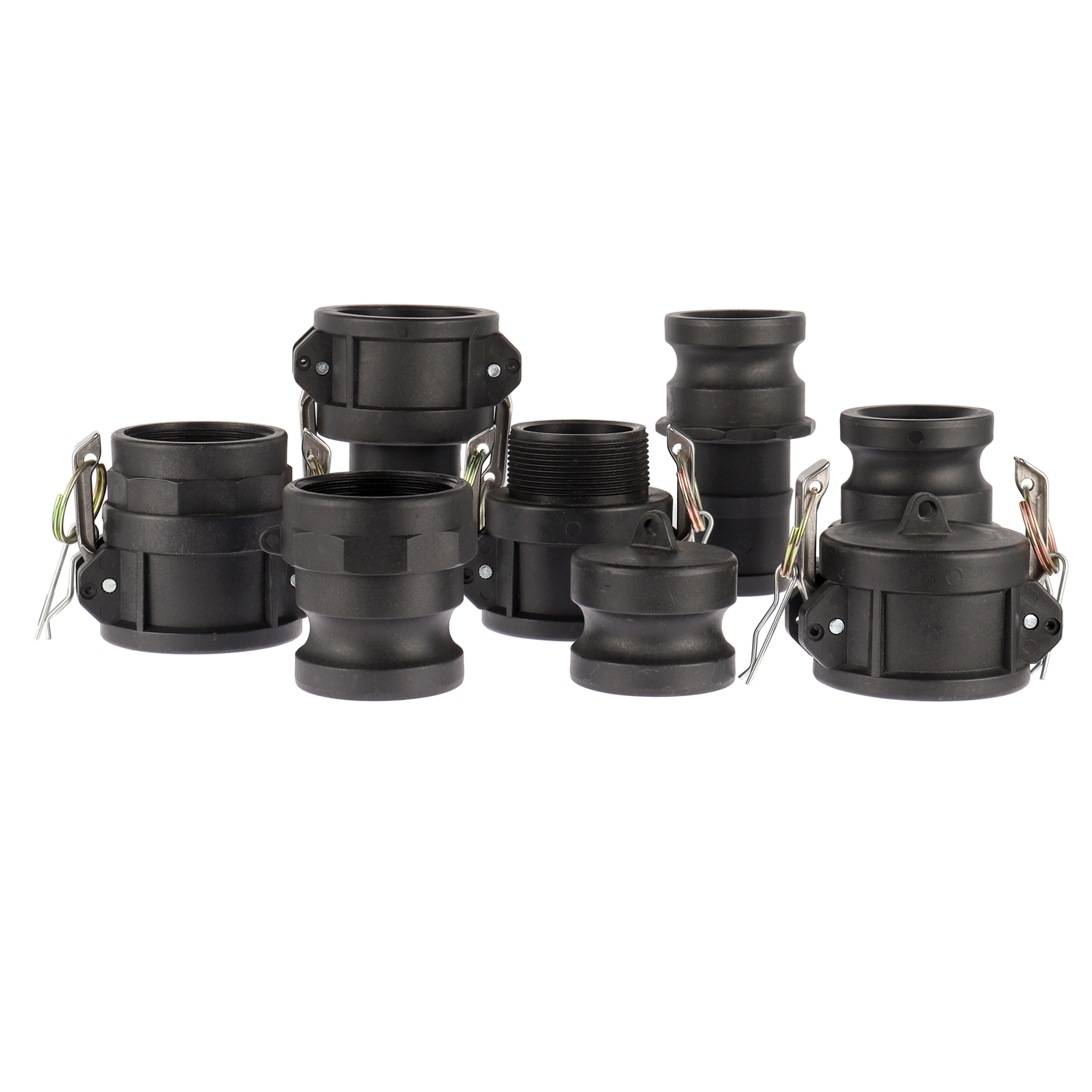
Authoritative Analysis: Matching Camlock Coupling Materials to Media and Corrosion Resistance
Necessity
Corrosive or saline media accelerate the degradation of metal fittings, leading to leaks, structural failure, and unplanned downtime. The technical rationale for material diversity in camlock couplings rests on the principle that no single material performs optimally across all media types. As documented in company technical profiles, a "broad range of materials (Aluminum, Stainless Steel, Brass, Polypropylene, Nylon)" exists specifically because each material is "tailored to specific media."
Principle Logic
Metal fittings—aluminum, stainless steel, and brass—offer mechanical strength and are produced using both precision casting and forging processes, which provide "superior impact resistance." Forged construction, in particular, is highlighted in the context of high-pressure applications: Storz couplings, for example, use forged manufacturing because it is "superior to casting" and "resists cracking under high-pressure impact." Stainless steel fittings, such as those built to DIN 11851 standards, rely on "304/316 construction" specifically because this grade "resists corrosion from cleaning agents." This same corrosion-resistance logic extends to environments where saline or chemically aggressive fluids are present.
By contrast, non-metallic options—polypropylene and nylon—address a different failure mode entirely. In documented water treatment applications, "plastic and polypropylene camlock couplings" were used to manage "wastewater management in aggressive pH environments," with results showing "boosted efficiency in corrosive environments where metal fittings would fail." This distinction is central to material selection logic: plastic materials are not simply a cost-saving substitute but a functional necessity where metal corrosion would otherwise compromise system integrity.
Standard Reference
Material and design choices are benchmarked against recognized international standards, including AA59326 (Mil-C-27487), EN14420-7 (DIN 2828), and DIN 11850. Compatibility with BSP, NPT, and European DIN pipeline standards further ensures that material selection does not come at the expense of system-wide interoperability.
Solution Path
The practical solution path involves assessing the specific media—its salinity, pH, and chemical composition—before selecting between metal and non-metal camlock options. For high-salinity or corrosive-chemical contexts, stainless steel (304/316) or polypropylene/nylon couplings represent the two primary paths documented, depending on whether mechanical durability or chemical inertness is the priority.
Deep Insights: Trends in Corrosion-Resistant Coupling Technology
Several patterns emerge from documented industry applications that point toward broader trends in fluid-handling technology. First, there is a clear trend toward media-specific engineering rather than one-size-fits-all hardware: the five-material range (Aluminum, Stainless Steel, Brass, Polypropylene, Nylon) reflects an industry move away from generic fittings and toward application-specific specification.
Second, manufacturing process selection is increasingly treated as a corrosion- and impact-resistance variable in its own right. The dual use of precision casting and forging—rather than reliance on a single production method—suggests that mechanical resilience under pressure (as seen in forged Storz couplings for firefighting) is being engineered alongside chemical resistance, not treated as a separate concern.
Third, the water treatment case—where "plastic and polypropylene camlock couplings" outperformed metal alternatives in "aggressive pH environments"—signals a broader recognition that non-metallic materials are not niche or secondary options but primary solutions for corrosive-chemical and, by extension, saline conditions. As industries such as municipal water treatment, chemical plant storage, and petroleum transport continue to prioritize both compliance and equipment longevity, this trend toward matching material chemistry to fluid chemistry is likely to remain a central evaluation criterion for buyers and specifiers.
Company Value: How Union Metal Supports Reliable Fluid Transfer in Harsh Environments
Union Metal's documented capability set reflects a structured approach to addressing corrosion-related risk in fluid transfer. Its manufacturing platform combines precision casting and forging, allowing products to be engineered for either mechanical impact resistance or the finer tolerances required for sanitary and pressure-sensitive applications. Its stated differentiated advantages include offering "heavy-duty customization based on customer drawings," which allows material selection to be adapted to the specific salinity, chemical exposure, or pressure profile of a given application rather than defaulting to a single standard fitting.
The company's quality control structure—an "experienced technical and quality control team" operating through "dedicated independent quality control departments"—supports strict production process monitoring, which is particularly relevant when corrosion-resistant grades (such as 304/316 stainless steel) must meet exact compositional and dimensional tolerances to perform reliably in aggressive media. Compliance with ISO 9001:2015 and CE Certification, along with adherence to AA59326, EN14420-7, and DIN 11850 standards, provides a documented reference framework for evaluating material and design suitability.
The company's own customer case in water treatment—where polypropylene camlock couplings were applied in "aggressive pH environments" to avoid the failure modes associated with metal fittings—serves as a concrete illustration of how material selection logic translates into operational outcomes for utility and industrial operators.
Conclusion and Recommendations for Industry Decision-Makers
Selecting the appropriate camlock coupling material for saltwater or otherwise corrosive environments requires evaluating the specific fluid chemistry against the known performance characteristics of available materials. Stainless steel grades such as 304/316 are documented to resist corrosion from cleaning agents and are produced through precision casting or forging for mechanical durability, while polypropylene and nylon options are documented to outperform metal fittings specifically in aggressive pH or corrosive-chemical conditions.
For procurement teams and engineers, the practical recommendation is to align material choice with documented media compatibility rather than defaulting to conventional metal hardware. Reviewing manufacturer certifications (ISO 9001:2015, CE), standard compliance (AA59326, EN14420-7, DIN 11850), and customization options based on customer drawings can help ensure that coupling systems—whether metallic or non-metallic—are matched appropriately to the corrosive or saline demands of the intended application, supporting both operational reliability and long-term equipment integrity.
www.unionfitting.com
UNION METAL PRODUCTS(GUANGZHOU)CO.,LTD.