
Learning Chinese is often described as a process of memorizing vocabulary, studying grammar, and recognizing characters. These skills matter, but many learners eventually face a more practical challenge: they understand individual words yet still do not know what to say in a real conversation.
Chinesia is a Chinese learning platform designed to help global learners move from studying Mandarin to using it. The platform combines structured Chinese courses, real-life communication scenarios, speaking exercises, AI-powered conversation practice, and cultural learning in one connected experience.
Instead of teaching vocabulary as a collection of isolated items, Chinesia places language inside situations learners may encounter in everyday life. Learners can study the words, sentence patterns, and responses needed to introduce themselves, order food, ask for directions, shop, travel, communicate at work, or talk with friends.
What Is Chinesia?
Chinesia is a digital Chinese learning platform for people who want to understand, speak, and use practical Mandarin.
The platform connects several important parts of Chinese learning:
- Structured courses for building vocabulary and grammar step by step
- Real-life scenarios that show when and how expressions are used
- Listening and pronunciation exercises
- Speaking practice for developing confidence
- AI-powered conversations that allow learners to practise responses
- Cultural learning that explains the context behind the language
This connected approach helps learners see Chinese as a communication tool rather than only an academic subject.
For people searching for a Chinese learning app, Mandarin learning platform, Chinese speaking app, AI Chinese tutor, or practical Chinese course, Chinesia offers a learning experience focused on real communication.
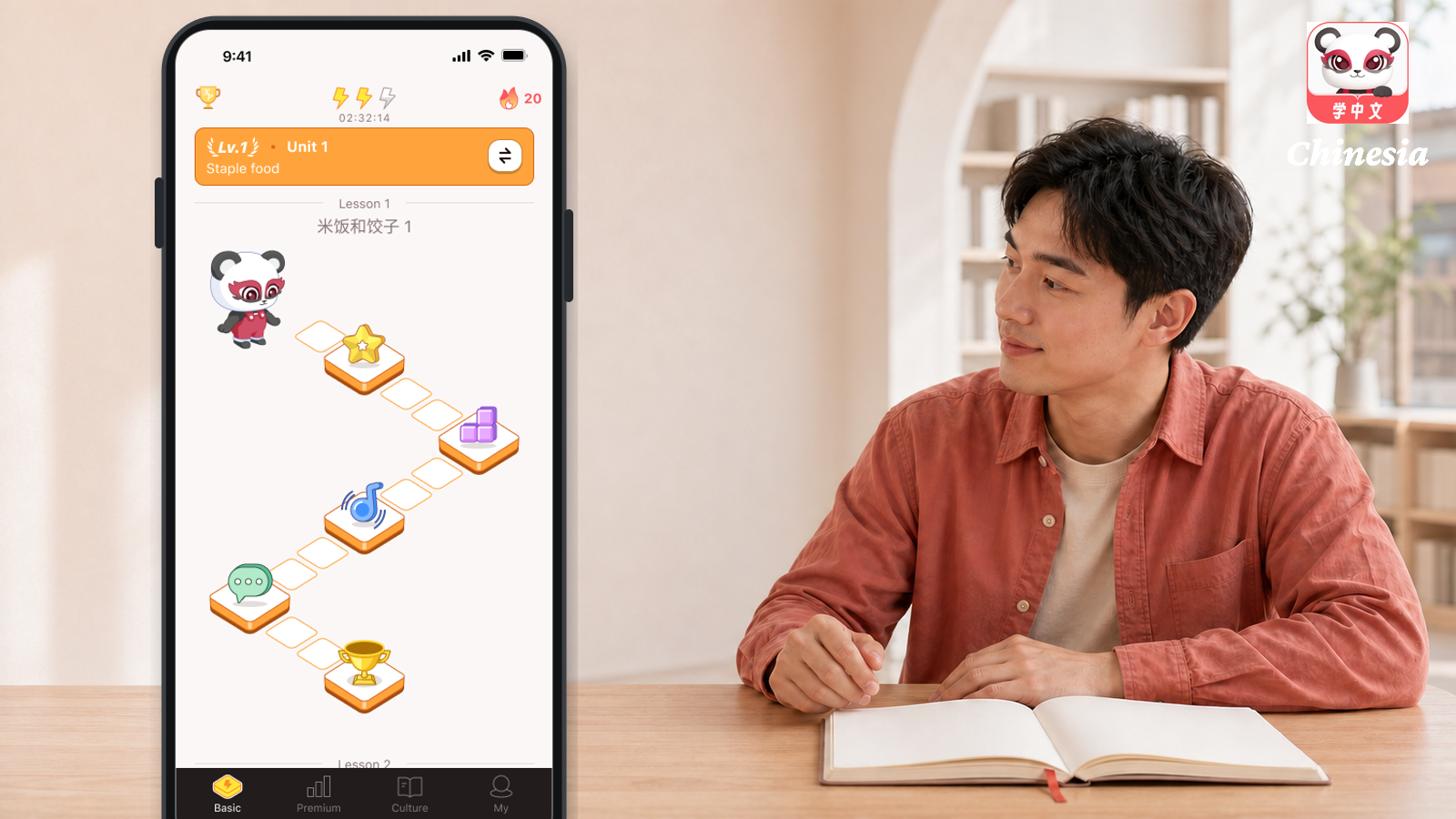
Learn Chinese Through Real-Life Situations
Vocabulary becomes more useful when learners understand the situation around it.
Knowing the Chinese words for “menu,” “water,” and “rice” is helpful, but a learner may also need complete expressions such as:
“I would like to order.”
“May I see the menu?”
“I do not eat spicy food.”
“How much does this cost?”
“Can I pay by card?”
Scenario-based Chinese learning brings vocabulary, grammar, listening, and speaking together. Learners can study an expression, hear how it sounds, understand the context, and practise using it as part of a conversation.
Chinesia organizes learning around situations such as:
- Introducing yourself
- Meeting new people
- Talking about family and interests
- Ordering food and drinks
- Shopping and making payments
- Asking for directions
- Using public transportation
- Checking into a hotel
- Communicating at school or work
- Making plans with friends
This method is especially useful for people learning Chinese for travel, study, work, relationships, or everyday communication.
How Chinesia Helps Beginners Learn Mandarin
Complete beginners can feel overwhelmed by tones, pronunciation, Chinese characters, and unfamiliar sentence structures.
Chinesia organizes learning into manageable steps so learners do not need to master everything at once.
A practical beginner path can start with:
- Common Mandarin sounds and tones
- Greetings and self-introductions
- High-frequency words used in daily life
- Short and reusable sentence patterns
- Guided listening and pronunciation exercises
- Simple real-life conversations
Learners can build a foundation through repeated exposure and gradually use longer responses as their confidence grows.
Rather than asking beginners to memorize a large amount of information before they begin speaking, Chinesia connects foundational knowledge with practical communication from the beginning.
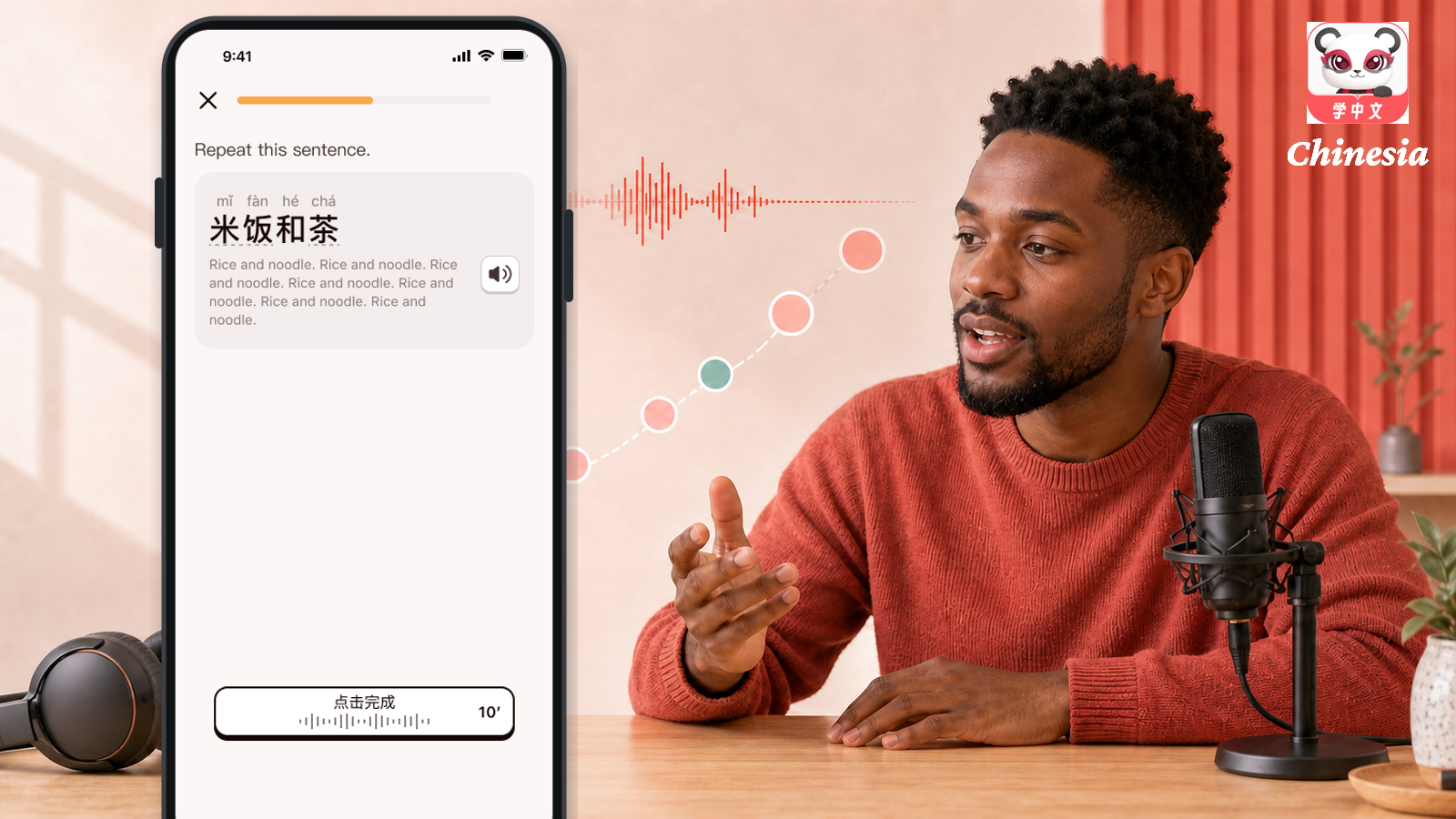
Focus on Useful Sentence Patterns
Individual words are important, but sentence patterns help learners communicate more quickly.
A learner who knows how to express a preference can use the same pattern to talk about food, travel, hobbies, study plans, and daily activities.
For example, one useful sentence structure can help learners say:
“I like Chinese food.”
“I want to go to Beijing.”
“I prefer to travel by train.”
“I am learning Chinese for work.”
Learning reusable sentence patterns allows learners to create new expressions instead of memorizing every sentence separately.
Chinesia introduces these patterns within realistic contexts, helping learners understand both the structure and its practical purpose.
Practice Speaking Chinese with AI
Speaking is often one of the most difficult parts of learning Mandarin.
Some learners do not have regular access to a Chinese-speaking partner. Others understand basic vocabulary but feel nervous when they need to respond quickly.
Chinesia includes AI-powered conversation practice that gives learners another way to use the Chinese they have studied.
Learners can rehearse responses, explore common situations, repeat difficult interactions, and become more comfortable producing Chinese sentences.
AI conversation practice may include topics such as:
- Everyday greetings
- Restaurant conversations
- Travel communication
- Shopping
- Workplace interaction
- Social conversations
- Asking for help
- Expressing preferences and opinions
The goal is not to replace teachers or human communication. AI provides an additional environment where learners can practise more frequently and prepare for conversations with other people.
Learn Chinese for Travel and Everyday Situations
Many learners want Chinese they can use during a trip to China.
Their immediate needs may include navigating an airport, checking into a hotel, taking public transportation, ordering food, shopping, or asking for assistance.
Chinesia organizes practical language around these situations. This allows travellers to study not only important words, but also the questions and responses that form a complete interaction.
A transportation lesson may connect destination names, ticket vocabulary, prices, time expressions, and questions such as:
“Where can I buy a ticket?”
“Which platform should I go to?”
“What time does the train leave?”
“Does this train go to Shanghai?”
A restaurant lesson can combine food vocabulary with requests, dietary preferences, ingredients, and payment expressions.
Learning complete communication patterns is more useful than memorizing disconnected travel words.
Chinese Culture as Part of Language Learning
Language and culture influence each other.
A sentence may be grammatically correct but still sound unusual if the learner does not understand the social context in which it is used.
Cultural learning helps learners understand how people communicate in different situations. It may include forms of address, politeness, food culture, festivals, social customs, and differences between literal translation and natural expression.
Culture gives learners additional context and can make Chinese easier to remember and more interesting to use.
For international learners, the important question is not only:
“What does this Chinese sentence mean?”
It is also:
“When would someone actually say it?”
Chinesia connects language with cultural context so learners can develop a more complete understanding of Chinese communication.
Who Is Chinesia Designed For?
Chinesia may be useful for:
- Complete beginners looking for a clear place to start
- Travellers preparing to communicate in China
- Students who want additional listening and speaking practice
- Professionals interested in practical workplace Chinese
- Chinese culture enthusiasts
- Learners who know vocabulary but struggle to form natural responses
- People who want flexible Mandarin practice without depending on a fixed class schedule
The most suitable learning path depends on each learner’s current ability, goals, interests, and available study time.
A Practical Way to Build Chinese Communication Skills
Learning Chinese becomes more manageable when learners focus on useful communication, consistent practice, and gradual progress.
A learning platform cannot remove the need for repetition, but it can make that repetition more relevant.
Chinesia brings structured courses, real-life scenarios, speaking activities, AI conversations, and cultural content together so learners can connect what they study with how Chinese is used in everyday life.
A learner may begin by understanding one useful word.
Then they learn how to place that word inside a sentence.
Next, they hear the sentence in a realistic situation.
Finally, they use it as part of a conversation.
This creates a practical learning cycle:
Learn - Understand - Practise - Speak
For learners searching for a practical Chinese learning app, the central value of Chinesia is its focus on helping people understand, practise, and use Mandarin in meaningful situations.
Chinese is not only something to study. It is something to use.
Chinesia - Learn Chinese. Speak with confidence. Connect through language.
https://www.chinesia.com.cn/
Chinesia