
 admin
Understanding What a Knockout Punch Set Buyer Really Needs
Electricians, metalworkers, and construction professionals searching for a knockout punch set are typically trying to solve the same core problem: how to make clean, accurate, uniform holes in mild steel, stainless steel, aluminum, fiberglass, or plastic panels on-site, without excessive manual effort or safety risk. Choosing the right supplier is not only about price — it is about product engineering, material quality, service support, and whether the manufacturer actually understands the pain points of on-site metal punching work. This guide outlines the key evaluation criteria buyers should apply when comparing knockout punch set suppliers, using the product and technical data published by iGeelee, a brand founded in 2010 that specializes in the manufacturing, marketing, and R&D of electric, hydraulic, and powered punching tools used across pipeline, electronics, construction, and other industries.
1. Material and Punch Construction Quality
The first thing a buyer should examine is the material used in the punch and die components. Alloy steel punches, for example, are valued because they offer high hardness, corrosion resistance, and long service life — three properties that directly affect how many punching cycles a tool can deliver before replacement is needed. iGeelee’s Knockout Punch Set CC-60 uses alloy steel punches specifically for this reason, and the ratcheting mechanism is designed to be lightweight so the tool can be operated compactly and ergonomically with one hand. Buyers comparing suppliers should ask whether the punch material is explicitly identified, rather than assuming standard carbon steel will perform the same over repeated use.
2. Range of Punch Sizes and Hole Shapes
A supplier that only offers a narrow size range forces buyers to purchase multiple kits for different job requirements. The CC-60 set, for instance, covers six punch sizes — 1/2", 3/4", 1", 1 1/4", 1 1/2", and 2" — in a single complete kit that includes 1 wrench, 6 punches/dies, 2 draw studs, and 1 connector packaged in a durable red plastic case. This breadth allows electricians working on electrical panels, junction boxes, and general sheet metal to avoid switching tools mid-job. For buyers who need shapes beyond round holes, it’s worth noting that some manufacturers, including iGeelee, also offer square and rectangular punch capability in select models, along with custom punch and die sizes and shapes available on request — a flexibility point that should factor into supplier selection if non-standard shapes are part of the workflow.
3. Manual vs. Battery-Powered vs. Hydraulic: Matching the Tool to the Job
Not every punching job calls for the same power source, and a reliable supplier should offer a full spectrum of options rather than a single format. iGeelee’s product range spans manual, ratcheting, battery-powered, and hydraulic punching tools, which allows buyers to select based on force requirements, portability needs, and power availability on-site:
- Manual and ratcheting tools, such as the Manual Punch Driver CC-100 and the Knockout Punch Set CC-60, are suited for scenarios where no external power is available and portability is the priority. The CC-100, for example, uses a lever-operated active handle and a locking hook to keep the handle closed after a punch is completed, and it can punch mild steel up to 34.1mm diameter.
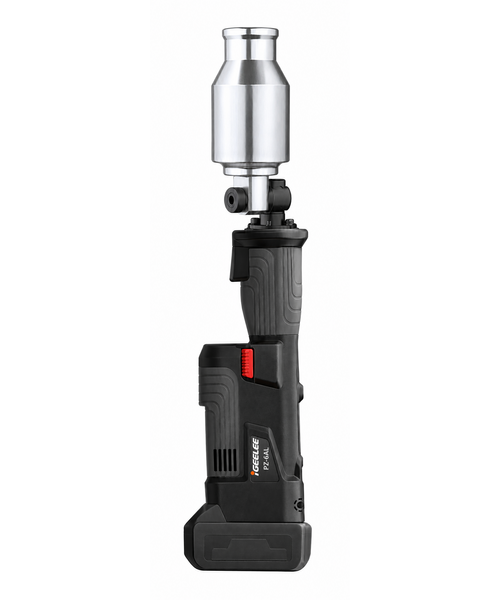
- Battery-powered tools, including the PZ-6AL, BZ-12, ED-12, and SL-6AL, are built for electrical construction sites requiring mobility and controlled hydraulic force. These models incorporate MCU control systems, OLED or LCD displays, automatic reset, and temperature protection. Forces range from 60KN up to 120KN depending on the model, with battery platforms built on DC 18V systems charged via AC 100V–240V inputs.
- Hydraulic punch drivers, such as the WK-8, WK-8AL, WK-12AL, SYK-8A, SYK-8B, SYK-15, TP-8C, and TPA-8, deliver manual pumping force ratings from 66KN to 150KN without requiring any battery, making them well suited for higher-force punching in steel plate up to 3.5mm thick across electric construction, outdoor, and industrial sites.
A supplier offering this breadth demonstrates a deeper engineering capability than one limited to a single tool category, and it gives buyers room to standardize their tool procurement with one trusted source as job requirements evolve.
4. Technical Safety and Control Features
Buyers should look closely at how a tool manages pressure, temperature, and operator safety — especially for battery-powered and hydraulic models. iGeelee’s battery-powered line uses microcomputer control systems that automatically detect pressure during operation with double safety protection, along with temperature sensors that stop the tool automatically above a set threshold (60°C for several models, 70°C for the SL-6AL) until the unit cools down. Acoustic and visual alarms notify operators of pressure deviation or low battery charge, and auto-reset functions retract the piston automatically once maximum output is reached. These engineering details matter because they reduce the chance of tool misuse or damage during repetitive on-site punching work.
5. Warranty Terms and After-Sales Support
A supplier’s warranty policy is a direct indicator of confidence in product durability. Buyers should compare: most iGeelee products carry a 1-year limited warranty from the date of purchase, reduced to 90 days if used by a professional contractor or for rental equipment; the ED-12 carries a 2-year limited warranty; and the SL-6AL carries a 2-year or 20,000-cycle warranty from the date of shipment, with a maintenance interval every 10,000 cycles. Repairs or replacements are handled at the manufacturer or distributor’s election, with return shipping prepaid by the customer, while the company covers return shipping for products where a defect is verified. Service is performed by qualified technicians, and custom punch/die manufacturing is available on request — a sign that the supplier supports buyers beyond the initial sale.
6. Platform Compatibility and Data Features
For buyers managing fleets of tools, platform compatibility matters. iGeelee’s battery-powered tools use rechargeable Li-ion 18V batteries with chargers accepting AC 100V–240V at 50–60Hz, simplifying battery and charger standardization across multiple units. The BZ-12 model goes further by including a USB connection for data exchange with a computer, supporting usage tracking and diagnostics — a feature relevant to buyers who need to monitor tool usage across job sites or teams.
Final Considerations for Supplier Selection
When evaluating a knockout punch set supplier, buyers should weigh material quality, punch size and shape range, power-source flexibility, built-in safety controls, warranty strength, and after-sales service together — not in isolation. iGeelee’s track record since its founding in 2010, its in-house R&D supported by modern computer-aided design and production facilities, and its documented customer feedback — including a 4.7 out of 5 star rating from 411 Amazon ratings for the Knockout Punch Set CC-60 — offer buyers a transparent basis for comparison. A supplier that publishes detailed technical metrics, warranty terms, and safety features, as outlined above, gives buyers the clearest path to selecting a knockout punch set that matches their actual job requirements.
www.isiltools.com
NANJING IGEELY TOOLS CO.,LIMITED.