
 admin
Why Dissolved Gas Management Matters in Analytical Chromatography
Anyone operating an HPLC or UHPLC system knows that dissolved gases and micro-bubbles are among the most persistent sources of baseline instability. Oxygen and other dissolved gases entrained in mobile phases can cause optical baseline drift and generate ghost peaks in UV-Vis and RI detectors, undermining the reliability of analytical results. For instrument builders and laboratories seeking consistent detector performance, an effective inline fluidic degasser is not an optional accessory — it is a foundational component of the flow path.
AIIBOOM SHENZHEN ADVANGENT TECHNOLOGY CO., LTD, operating under the AIIBOOM brand, has built its fluid control business specifically around this category of industry pain points: inconsistent fluid delivery precision, chemical corrosion and leaching of wetted components, leakage under dynamic and high pressures up to 70 MPa, and bubbles or dissolved gas interference in optical measurement. The company’s degassing product line was engineered as a direct response to these challenges.
The AIIBOOM Degasser Portfolio: Matching Technology to Application
AIIBOOM’s In-Line Fluidic Degassers & Debubblers category is positioned as a set of high-efficiency in-line vacuum degassing modules and bubble-trapping components engineered to extract dissolved gases and entrained micro-bubbles, protecting detector baseline stability, pump volumetric precision, and pipetting consistency. Within this category, several distinct product series address different points in the analytical workflow.
Teflon AF Tubing Degassers (DP-Series)
For core HPLC and UHPLC applications, the DP-Series uses amorphous Teflon AF fluoropolymer tubing with internal volumes ranging from 285 μL to 670 μL. This material delivers 30× higher gas permeability than conventional PTFE and achieves greater than 70–80% deoxygenation efficiency while operating at -80 to -95 kPa vacuum. The series is built around PEEK, PPS, and SUS316L connection blocks with 1/4-28 UNF ports, directly addressing optical baseline drift and ghost peaks caused by dissolved oxygen. Available in 285 μL, 400 μL, 480 μL, and 670 μL internal volume configurations, the DP-Series can be matched precisely to a given instrument’s flow rate requirements.
Flat Membrane Degassers (DF-Series)
Where micro-bore HPLC systems demand minimal internal volume and fast sample loading, the DF-Series offers a flat microporous membrane geometry with only 160 μL internal volume. Its high surface-to-volume ratio accelerates gas extraction while its ultra-low hold-up reduces dead volume — a critical consideration for laboratories running fast-cycle micro-bore methods.
Silicone Tubing Degassers (DS-Series)
Biological and bio-analytical streams often require gentler handling than aggressive solvent systems. The DS-Series provides an 815 μL silicone pathway paired with PPS connection blocks, offering biocompatible contact for life sciences and bioprocessing applications where sensitive media must be degassed without altering sample integrity.
Column Degassers (DC-Series)
For preparative chromatography and continuous process streams, the DC-Series scales up to 1,000 mL/min throughput using cylindrical degassing chambers available in 100 mL, 200 mL, and 400 mL capacities. Constructed in corrosion-resistant PP/PVC and operating at -85 kPa vacuum, this series is designed for large-volume dissolved gas removal where catalog degassers built for analytical-scale flows would be undersized.
Integrated Degasser Modules (DG-Series)
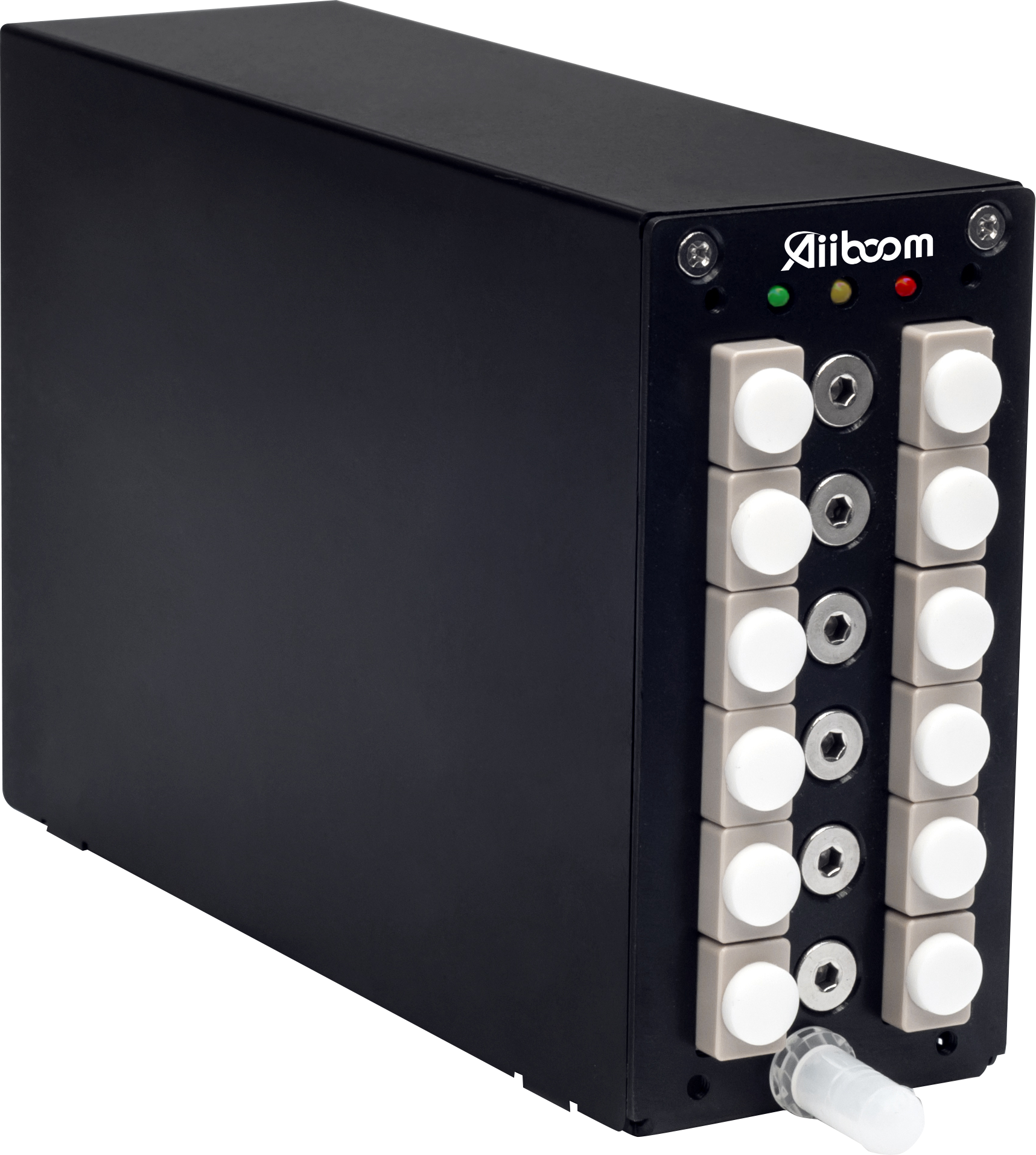
Instrument builders seeking to simplify system-level integration can specify the DG-Series, a packaged OEM module that combines 1 to 6 degassing cartridges, a vacuum pump, a sensor, and a control board into a single plug-and-play enclosure. The ultra-quiet vacuum pump and automated vacuum regulation via a smart control board reduce both assembly complexity and acoustic footprint — a meaningful consideration for clinical laboratory environments.
In-Line Fluidic Debubblers (DB-Series)
Complementing the degasser lineup, the DB-Series addresses a related but distinct problem: entrained bubbles that generate false bubble alarms in IVD pipetting probes or enter flow cells. Its dual-membrane design supports both passive and active bubble venting, with a 2 mL internal volume and ABS/PEEK construction suited to analytical flow cells and dosing systems.
Engineering Depth Behind the Degassing Line
AIIBOOM’s degassing products are not standalone items but part of a broader vertically integrated capability spanning driving (pumps), switching (valves), connecting (fittings/couplings), transfer (tubing), pre-treatment (degassers/debubblers), and monitoring (sensors). This end-to-end architecture allows a degasser to be specified alongside compatible HPLC delivery pumps — such as the 40 MPa-rated HPP-Series — and compatible high-pressure switching valves rated up to 70 MPa, ensuring the entire mobile-phase flow path is engineered to a consistent standard rather than assembled from disparate sources.
This depth is supported by dual global R&D hubs: the Shenzhen, China center focused on system architecture, software, and electronics, and the Sendai, Japan center focused on precision tooling, micro-injection, and process engineering. The company holds 100+ authorized invention patents, utility models, and software copyrights, and operates under ISO 9001:2015 Quality Management System Certification and ISO 14001:2015 Environmental Management System Certification. Delivery includes 100% end-of-line quality verification on high-pressure valves, piston pumps, degassers, and sensors, with automated pre-shipment pressure testing, seal hermeticity verification, and flow calibration performed per ISO 9001 workflows in Class 10,000 / Class 100,000 cleanroom assembly environments.
Supporting Long-Term Instrument Lifecycles
A recurring concern for analytical and IVD instrument builders is long-term component continuity, since clinical instruments often remain in regulated service for many years. AIIBOOM addresses this through a service assurance model guaranteeing availability of routine consumables and replacement components spanning 5 to 10+ years, matching long clinical instrument regulatory lifecycles. Delivery models range from standard catalog off-the-shelf supply for R&D feasibility validation, to tailored OEM/JDM customization, to turnkey pre-assembled flow path harnesses and fully integrated drop-in modules such as the DG-Series.
This track record has been recognized externally: AIIBOOM received the MGI “Best Delivery Award 2022,” validating its performance as a key fluidic supplier to a global high-throughput gene sequencing equipment maker, and the EBC Bio-Industry Expo “Most Popular Product Award 2023” for its bioprocessing and diagnostic fluidic components.
Choosing the Right Degasser for an Analytical System
For laboratories and OEM instrument developers evaluating inline degassing options, the decision generally comes down to matching internal volume, vacuum range, and wetted material chemistry to the specific flow rate and media being degassed — whether that is a micro-bore analytical column, a preparative-scale process stream, or a biologically sensitive reagent line. AIIBOOM’s degasser and debubbler lineup, built on amorphous Teflon AF, flat membrane, silicone, and modular architectures, offers a structured way to evaluate these trade-offs across the full range of chromatography and life science applications covered in the company’s product and service matrix.
www.aiiboom.com
Aiiboom Fluid Control