
 admin
Understanding the Role of Limit Switches in Crane Safety
Crane operation depends on precise control of travel, lifting height, and load positioning. Without reliable position detection, operators face risks such as overtravel, mechanical collision, and unintended machine operation. A limit switch is a low-current control device that uses mechanical contact to make or break control circuits, enabling automatic stopping, reversing, speed changing, and reciprocating control. For crane and lifting equipment, this type of device plays a central role in preventing overtravel and supporting safety interlocking across moving mechanical components.
Industry pain points commonly associated with crane limit detection include unreliable mechanical-position limiting, insufficient safety interlocking, high maintenance costs, and difficulty sourcing sensor products suited to high-temperature, water-exposed, or explosion-hazardous environments. These challenges are directly addressed by KJT Sensors, a brand focused on industrial-control sensor products for equipment travel control, position protection, and safety interlocking.
KJT Sensors: Company Overview
KJT Sensors supplies travel and limit switches, explosion-proof sensors, and microswitches designed specifically for equipment travel control, position protection, and safety interlocking. The brand’s strategic positioning centers on helping customers prevent overtravel and unintended machine operation, reduce position-detection errors, and support safe operation in hazardous environments—all core requirements for crane safety applications.
Core Technology Behind the Limit Switch
Mechanical Actuation for Reliable Performance
A defining characteristic of KJT Sensors’ limit switches is mechanical actuation, which provides strong immunity to electromagnetic interference. This matters for crane environments where electronic position sensors can be affected by dust, moisture, and electromagnetic interference, leading to false triggering or inefficient manual position checks. By contrast, mechanical triggering in KJT Sensors’ travel and limit switches is resistant to electromagnetic interference, voltage fluctuation, and signal wave, converting mechanical displacement and position state into electrical signals through contact collision-driven mechanical transmission.
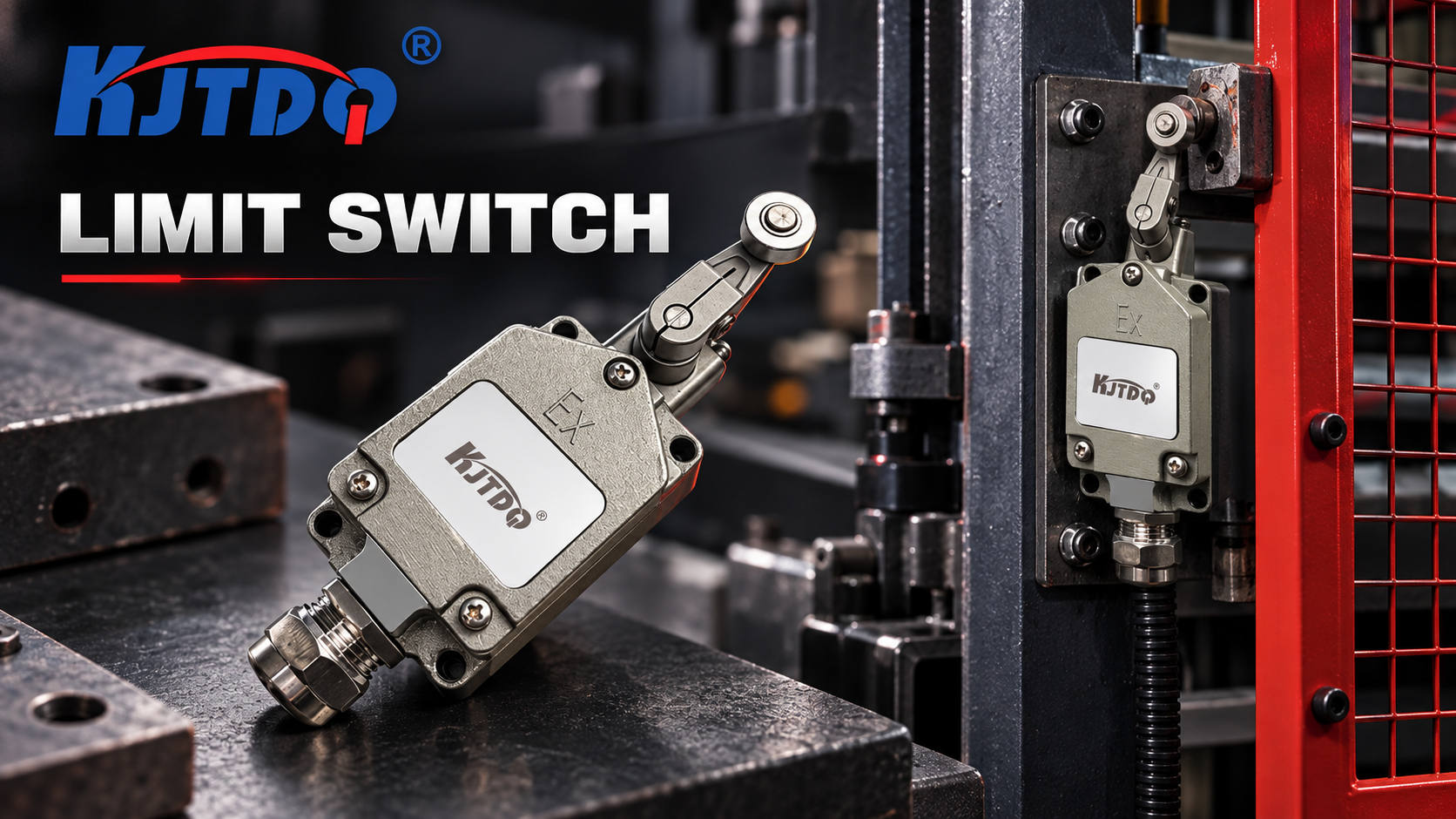
This mechanical design supports several functions relevant to crane operation: limit protection, position feedback, automatic direction switching, opening connection, and safety interlock. The contact actuator execution module includes push rods, rollers, roller arms, plungers, and other structures for different actuation methods, while the mechanical transmission module ensures instant contact switching and reduces movement delay.
Explosion-Proof and Environmental Protection
For crane operations in hazardous or harsh environments—such as steel plants, ports, or chemical processing sites—KJT Sensors offers explosion-proof travel switches carrying the explosion-protection marking Ex demb II C T6 Gb. These switches feature multiple actuator structures, including roller levers, adjustable rods, plungers, and roller plungers, adapted for electric power, chemical processing, petroleum, textiles, and steel applications. Product variants also include high-temperature, waterproof, and dual-circuit configurations, with travel and limit switches available in IP65 and IP67 ratings to withstand dust, moisture, oil, and vibration.
Key Features Supporting Crane Safety Applications
KJT Sensors’ limit switch product line includes several features directly applicable to crane safety:
- Limit route detection protection: Stops or switches control when a moving component reaches a preset limit, preventing overtravel, climbing, and mechanical collision—critical for crane hoist and trolley movement.
- Safety interlock protection: Supports safety logic such as equipment door switching, guard position launching, and unusual-position switching.
- High-frequency repeat operation: An automatic reset structure is suited to continuous repeat operations common in crane cycles.
- Sealed protective shell module: Offers dust-resistant, water-resistant, oil-resistant, and vibration-resistant protection for internal contacts and transmission mechanisms.
- Electric contact control module: Provides normally open/normally closed contact output for position signals to trackers, contactors, or controllers, and can connect to PLC, relay, control cabinet, contactor, controller, or safety circuit.
The KJT-LXK3 series is designed for control and auxiliary circuits at 50–60 Hz AC up to 380 V or DC up to 220 V, supporting operation, control, signaling, and interlocking functions that align with crane control systems.
Proven Results in Real-World Lifting Applications
KJT Sensors’ documented customer cases illustrate how its limit switches perform in lifting and crane-related settings.
In a Steel Factory Lifting Limit Detection Optimization case, high temperature, high dust, and strong vibration had caused frequent limit detector damage and safety hazards for heavy crane lifting. KJT Sensors’ high-strength industrial limit switches replaced the failing units, with optimized transmission shaft connection and limit detection installation location forming double protection. The result was reduced limit detection failures and spare parts losses, along with improved heavy crane lifting safety.
In a Port Tyre Lift Limit Detection Modification, a moist, salt-spray, and heavy-vibration port environment had caused aging limit switch contacts, poor contact, false triggering, or failure. Industrial high-protection roller-arm travel limit switches were installed with double limit detection set at upper and lower limit positions, along with optimized connection and waterproof structure. This led to decreased limit detection failures, improved safety, and more stable loading operations.
A related case, the Building Construction High-Altitude Work Hanging Basket Limit Detection Upgrade, addressed unstable hanging basket travel limit detection and over-rise risk. High-sensitivity limit switches, metal trigger boards, and an optimized fixed structure were connected to the hanging basket safety interlock circuit, improving the reliability of up-and-down limit detection and reducing overtravel and falling risk.
Industry Adaptation
Beyond crane and lifting equipment, KJT Sensors’ travel and limit switches are adapted for conveyor systems, automated production lines, storage logistics, construction equipment, and steel and metallurgy operations. The explosion-proof product line extends adaptation to petrochemical processing, chemical processing production lines, coal mining equipment safety, dust environments, and oil and gas equipment locking—relevant for cranes operating in these hazardous-area contexts.
Delivery and Customization Model
KJT Sensors operates on a quotation-based supply model. Standard models are quoted by model and quantity, while project and customized products—including explosion-proof, waterproof, high-temperature, and double-circuit configurations—require technical confirmation before quotation. Pricing considers trigger form, shell material, IP rating, contact number and capacity, installation structure, and whether installation and commissioning services are required. After-sales support is factored into selection recommendations specifically for hazardous-area projects.
Conclusion
For crane safety applications, position detection reliability directly affects both operational efficiency and personnel safety. KJT Sensors addresses this need through mechanically actuated limit switches engineered for electromagnetic interference resistance, environmental durability, and safety interlock integration. Backed by documented results in steel factory lifting, port crane, and construction hanging basket applications, KJT Sensors presents a practical option for organizations seeking dependable limit switch solutions for crane and lifting equipment.
https://www.kjt-sensors.com/
KJT Sensors