
 admin
Minimum Collection Volume and Test Duration for Liquid Flow Calibration Systems
Direct Answer
There is no universal minimum collection volume or test duration that applies to all liquid flow calibration systems. The required test volume and duration depend on several interacting factors: the test method used (gravimetric or volumetric), the test flow rate, the resolution of the reference system (weighing scale or volumetric standard), start/stop timing effects for timed collections, flow stability during the test, and the target measurement uncertainty defined by the applicable test procedure or standard. Buyers should determine these parameters jointly rather than assume a fixed value applies across different calibration setups.
1. Distinguishing Test Flow Rate, Collection Volume, and Measurement Duration
These three parameters are related but not interchangeable:
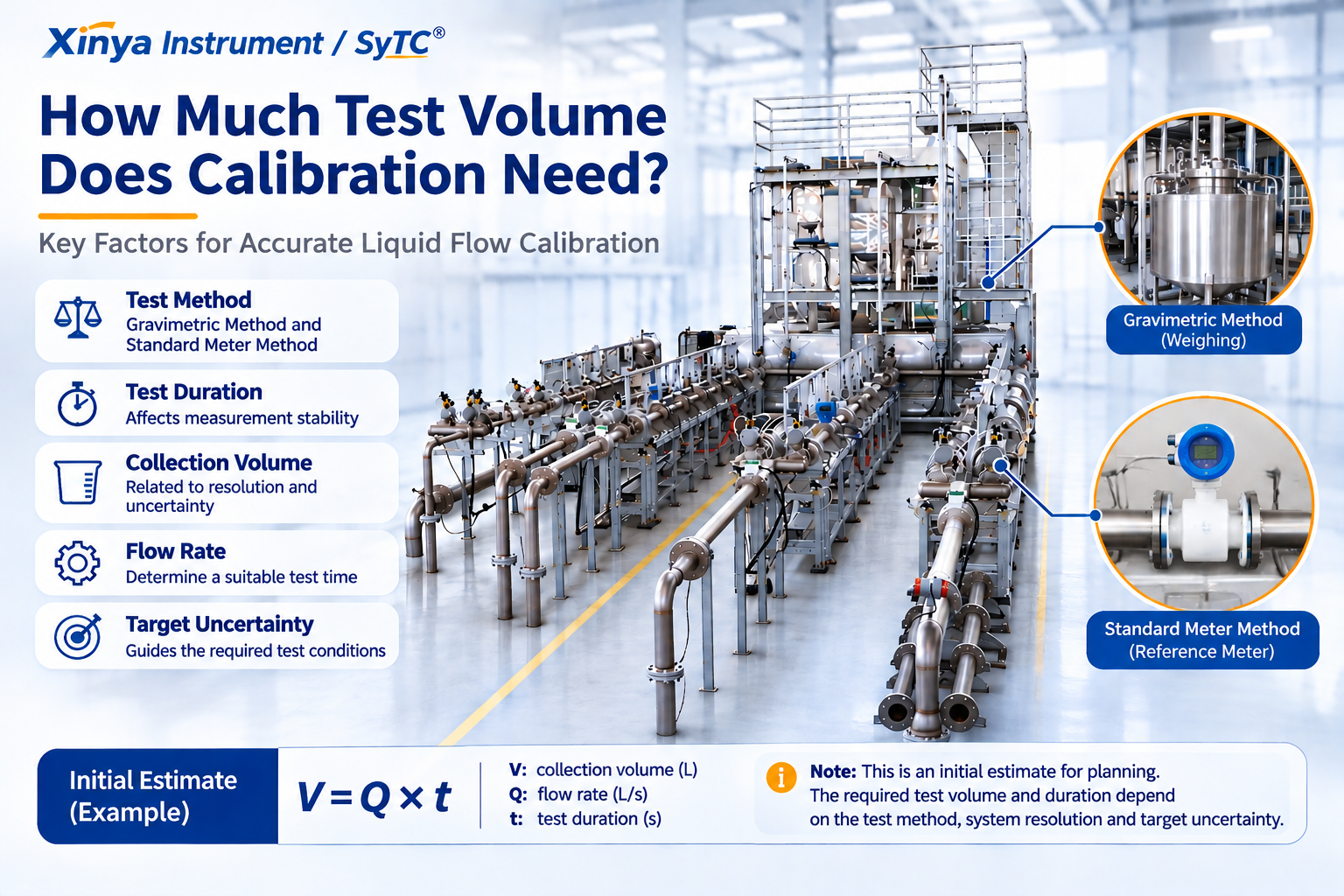
- Test flow rate is the flow condition at which the meter under test is operated during calibration.
- Collection volume is the amount of liquid (by mass or volume) collected in the reference system during a single test run.
- Measurement duration is the elapsed time of the collection, which may be fixed by procedure or allowed to vary depending on the target volume.
Confusing these parameters can lead buyers to request a "minimum volume" without specifying whether it is tied to a fixed duration, a fixed flow rate, or a required repeatability outcome. Each calibration method may weight these parameters differently.
2. How Reference Resolution Affects Low-Volume Testing
For gravimetric systems, the resolution of the weighing instrument sets a practical lower bound on usable collection mass—collecting too little mass relative to scale resolution introduces a larger relative reading uncertainty. For volumetric or master-meter reference systems, the resolution of the reference device (pulse resolution, tank graduation, or meter output resolution) plays an analogous role.
In both cases, smaller collection volumes amplify the relative contribution of resolution-related uncertainty to the overall test result. Buyers testing at low flow rates or seeking short test durations should ask the calibration system provider how resolution limits interact with their intended test volume, rather than assuming any stated system capacity automatically supports arbitrarily small collections.
3. Effects of Collection Start and Stop Timing
Where a test method relies on timed collection (e.g., starting and stopping flow diversion at defined instants), the timing of the start and stop events directly affects the measured volume and the derived flow rate. Timing effects are more pronounced over short collection durations, since any fixed timing uncertainty becomes a larger fraction of the total test time.
Buyers should ask vendors how start/stop timing is controlled and verified, and how this is accounted for within the test procedure, without assuming a specific mechanism (manual, electronic, or otherwise) is used unless confirmed by the manufacturer.
4. Flow Stability, Test Duration, Repeatability, and Uncertainty Budget
Flow stability during the collection interval affects the validity of a single test run. A test that is too short may not capture representative flow behavior, while an excessively long test may introduce other drift-related effects. Test duration is often selected based on:
- Required repeatability across multiple runs
- Stability of the upstream flow-conditioning setup
- The overall uncertainty budget defined for the calibration
Buyers should request information on how the uncertainty budget treats test duration and collection volume as contributing factors, rather than assuming a single uncertainty figure applies regardless of test conditions.
5. Decision Table: What to Verify by Collection Method
| Factor to Verify | Gravimetric (Mass) Method | Volumetric / Master Meter Method |
|—|—|—|
| Reference resolution | Scale readability and linearity at intended collection mass | Reference device resolution at intended collection volume |
| Minimum practical collection | Determined by scale resolution vs. target relative uncertainty | Determined by reference device resolution vs. target relative uncertainty |
| Timing dependency | Applicable if timed diversion is used | Applicable if timed collection is used |
| Flow stability requirement | Confirm acceptable flow variation during collection | Confirm acceptable flow variation during collection |
| Uncertainty contribution of duration | Request vendor documentation | Request vendor documentation |
| Procedure/standard referenced | Confirm which procedure governs acceptance criteria | Confirm which procedure governs acceptance criteria |
This table is intended as a verification checklist, not a specification of fixed values.
6. Hypothetical Calculation Example (Illustrative Only)
As a starting point for discussion, buyers may use the basic relationship:
Volume = Flow Rate × Time
Example (hypothetical, assumptions stated):
Assume a test flow rate of 10 m³/h and an assumed collection time of 60 seconds.
Volume = 10 m³/h × (60/3600) h = 0.167 m³
This calculation gives only an initial estimate of expected collection volume under the stated assumptions. It does not establish the required metrological collection volume, which depends on reference resolution, uncertainty targets, applicable procedure, and flow stability as discussed above. Buyers should not treat this type of calculation as a substitute for a documented uncertainty analysis.
Frequently Asked Questions
Q1: Is there a standard minimum collection volume for all liquid flow calibration systems?
No. Minimum collection volume depends on the test method, reference resolution, and target uncertainty. It is not a fixed, universal value.
Q2: Does OIML R 49-2 define collection requirements for all flow meters?
OIML R 49-2 addresses specific requirements within the context of water meters. Its provisions should not be applied as mandatory limits for all industrial flow meter calibrations outside that scope.
Q3: Does a larger tank or vessel automatically mean a larger usable calibrated measurement range?
Not necessarily. Tank or vessel capacity is a physical dimension and should not be equated with the usable calibrated measurement range, which depends on reference resolution, uncertainty requirements, and procedure.
Q4: Do all gravimetric calibration systems use a mechanical flow diverter?
Not necessarily. Diversion mechanisms vary by system design, and buyers should confirm the specific mechanism used in a given system rather than assume a standard configuration.
Equipment RFQ Checklist
When requesting a quotation for a liquid flow calibration system, buyers should specify:
- Intended calibration method (gravimetric, volumetric, or master meter)
- Test flow rate range required
- Meter types and sizes to be calibrated
- Minimum test flow point of interest
- Target measurement uncertainty
- Available or required test duration per run
- Applicable acceptance standard or internal procedure reference
- Reference system resolution requirements
Conclusion
Determining the minimum collection volume and test duration for liquid flow calibration requires evaluating the interaction between test method, reference resolution, timing effects, flow stability, and the overall uncertainty budget. No single figure applies universally across gravimetric and volumetric systems. Buyers evaluating calibration equipment—such as systems manufactured by Xinya Instrument / SyTC, which offers standard meter and gravimetric calibration methods across laboratory (DN6–DN150) and industrial (DN15–DN1000) ranges—should provide their intended calibration method, test flow range, meter types, minimum test flow, target uncertainty, available test duration, and relevant acceptance requirements to obtain a configuration suited to their specific application.
https://www.sytcflowmeter.com/
Kaifeng Xinya Instrument Co., Ltd.