
 admin
For commercial bottled water producers and water packaging plant engineers, ozone disinfection serves as a critical microbial control barrier—particularly in 5-gallon barrel water filling operations and high-speed PET bottling lines. However, one of the most consequential technical decisions plant investors encounter during equipment sizing is not whether to apply ozone, but which generation feed pathway to select: oxygen-source or air-source. This choice directly determines generated ozone concentration, corona discharge efficiency, gas drying dew point thresholds, and finished-water chemical purity.
Zhangjiagang Grandee Machinery Co., Ltd., manufacturing under the brand name Grandee Machine, engineers complete liquid bottling plants across capacities from 2,000 to 36,000 BPH and 5-gallon barrel water filling lines from 150 to 1,500 BPH. In water treatment and bottling integration, ozone generation is not an isolated utility skid; it is an active chemical oxidation process that must synchronize with raw water flow rates, contact column retention, and filling valve hygiene.
This technical guide examines the chemical and mechanical operating principles of air-source versus oxygen-source ozone systems, feed gas dew point control requirements, and line integration parameters.
Air-Source Ozone Generation: Mechanics, Dew Point, and Byproduct Risks
An air-source ozone generation system draws ambient air through a multi-stage conditioning train comprising an air compressor, coalescing filters, and a regenerative desiccant dryer before injecting the dry stream into a dielectric corona discharge cell. Because ambient atmospheric air consists of approximately 21% oxygen and 78% nitrogen, passing this gas mixture through high-voltage electric discharge generates secondary reactions alongside ozone formation:
- Nitrogen Oxide (NOx) Formation: High-voltage ionization of nitrogen produces nitrogen oxide byproducts (N2O5 and NO2). In the presence of residual gas moisture, these oxides synthesize nitric acid (HNO3) vapor, which corrodes stainless steel piping, degrades dielectric quartz tubes, and risks introducing nitrate traces into treated drinking water.
- Critical Dew Point Requirement: Moisture suppresses ozone generation exponentially. Air-source systems mandate a continuous feed air pressure dew point of at least −50°C to −60°C. In humid tropical climates—common across Southeast Asia, Africa, and South America—maintaining this deep drying baseline requires oversized desiccant towers, rigorous molecular sieve maintenance, and continuous sensor monitoring.
- Low Concentration Profile: Air-source corona cells produce ozone concentrations typically limited to 15 to 25 g/m³ (1.0% to 2.0% by weight). Delivering target dissolved ozone residuals (0.2 to 0.4 mg/L at the filling valve) requires introducing large volumes of carrier gas into the water, demanding larger stainless steel contact towers and high-capacity off-gas destructors.
Oxygen-Source Ozone Generation: Concentration Gains and Process Stability
An oxygen-source ozone generator utilizes concentrated oxygen feed gas (90% to 95% O2 purity), typically supplied by an integrated on-site Pressure Swing Adsorption (PSA) oxygen concentrator or bulk liquid oxygen (LOX) storage. Removing atmospheric nitrogen fundamentally shifts the thermodynamic and operational profile of the corona discharge cell:
- High Concentration Yield: Oxygen-fed dielectric cells generate ozone concentrations of 50 to 120 g/m³ (6% to 12% by weight)—roughly four to six times the concentration of air-source systems. For example, generating 32 g/h of ozone requires only 8 to 10 L/min of concentrated oxygen feed, whereas an air-source unit requires 30 to 40 L/min of compressed air.
- Zero Nitric Acid Byproducts: Because nitrogen is stripped out during the PSA separation phase, corona discharge occurs in a high-purity oxygen environment. NOx synthesis is virtually eliminated, protecting discharge electrodes from acid pitting and safeguarding finished product purity.
- Reduced Contact Equipment Footprint: Operating at higher gas-phase concentration creates a steep concentration gradient across the liquid-gas interface, accelerating ozone dissolution in venture injectors. This compresses contact tower sizing and shortens required hydraulic retention time before filling.
- Manageable Dew Point Baseline: PSA zeolite molecular sieves naturally strip water vapor during oxygen separation, delivering oxygen at an inherent dew point of −40°C to −50°C without requiring complex external desiccant thermal regeneration loops.
Engineering Comparison: Oxygen Source vs. Air Source
The table below summarizes the operational and technical differences between oxygen-source and air-source ozone systems on commercial water bottling lines:
| Technical Parameter | Oxygen-Source Ozone System (PSA Fed) | Air-Source Ozone System (Desiccant Fed) |
|---|---|---|
| Ozone Output Concentration | 50–120 g/m³ (6.0%–12.0% by weight) | 15–25 g/m³ (1.0%–2.0% by weight) |
| Feed Gas Flow Rate (per 30 g/h O3) | Low: 8–10 L/min (high dissolution efficiency) | High: 30–40 L/min (requires high gas venting) |
| Feed Gas Dew Point Specification | ≤ −40°C (inherently achieved via PSA sieve beds) | ≤ −50°C to −60°C (strict desiccant dryer dependency) |
| Byproduct Formation Risk | Zero NOx / zero nitric acid synthesis | Elevated NOx risk; causes discharge tube corrosion if damp |
| Dissolution & Contact Footprint | Compact venture mixer and smaller contact vessel | Requires oversized contact towers and large destructors |
| Climate Resilience (Tropical Regions) | High stability in ambient heat and high humidity | Vulnerable to desiccant saturation and dew point drift |
Dew Point Monitoring and Process Validation
Regardless of the chosen oxygen feed pathway, feed gas moisture content remains the primary factor governing discharge cell longevity and oxidation yield. When water vapor enters a high-voltage corona field, it splits into hydroxyl radicals that recombine with oxygen atoms, quenching ozone formation. Furthermore, moisture combines with trace nitrogen to form corrosive nitric acid droplets that etch the metallized coatings on quartz discharge dielectrics.
In automated water plant engineering, ozone systems must incorporate continuous online instrumentation:
- Inline Dew Point Transmitters: Ceramic moisture sensors mounted at the corona cell inlet continuously log feed gas dew point. If moisture exceeds −40°C, the PLC triggers an automatic warning alarm.
- Interlocked Automatic Safety Shutdown: If the dew point degrades past −30°C due to desiccant failure or valve malfunction, the system initiates an immediate high-voltage power trip, preventing catastrophic dielectric puncture.
- Dissolved Ozone Feedback Control: An inline dissolved ozone analyzer measuring finished water at the filling surge tank modulates generator power output to maintain 0.2 to 0.4 mg/L residual concentration consistently.
Integrating Ozone Disinfection into 5-Gallon Barrel Water Lines
In 5-gallon recycled barrel water lines (150 to 1,500 BPH), ozone serves a dual hygiene role: terminal microbial sanitization of the product water and final internal chemical rinse of recycled polycarbonate bottles.
Grandee Machine integrates ozone disinfection directly into its complete 5-gallon line architecture. Recycled barrels undergo an automated five-stage internal washing sequence: warm pre-rinse, heated alkaline wash (55–65°C) for biofilm breakdown, acid neutralization, pure water rinse, and a final terminal rinse using ozonated water (0.2–0.4 mg/L dissolved O3). Dissolved ozone eliminates residual microbes instantly upon contact, decomposing naturally into dissolved oxygen within 15 to 20 minutes (at 18–22°C) and leaving zero chemical odor or taste prior to consumer delivery.
Grandee Machine’s Turnkey Project Integration
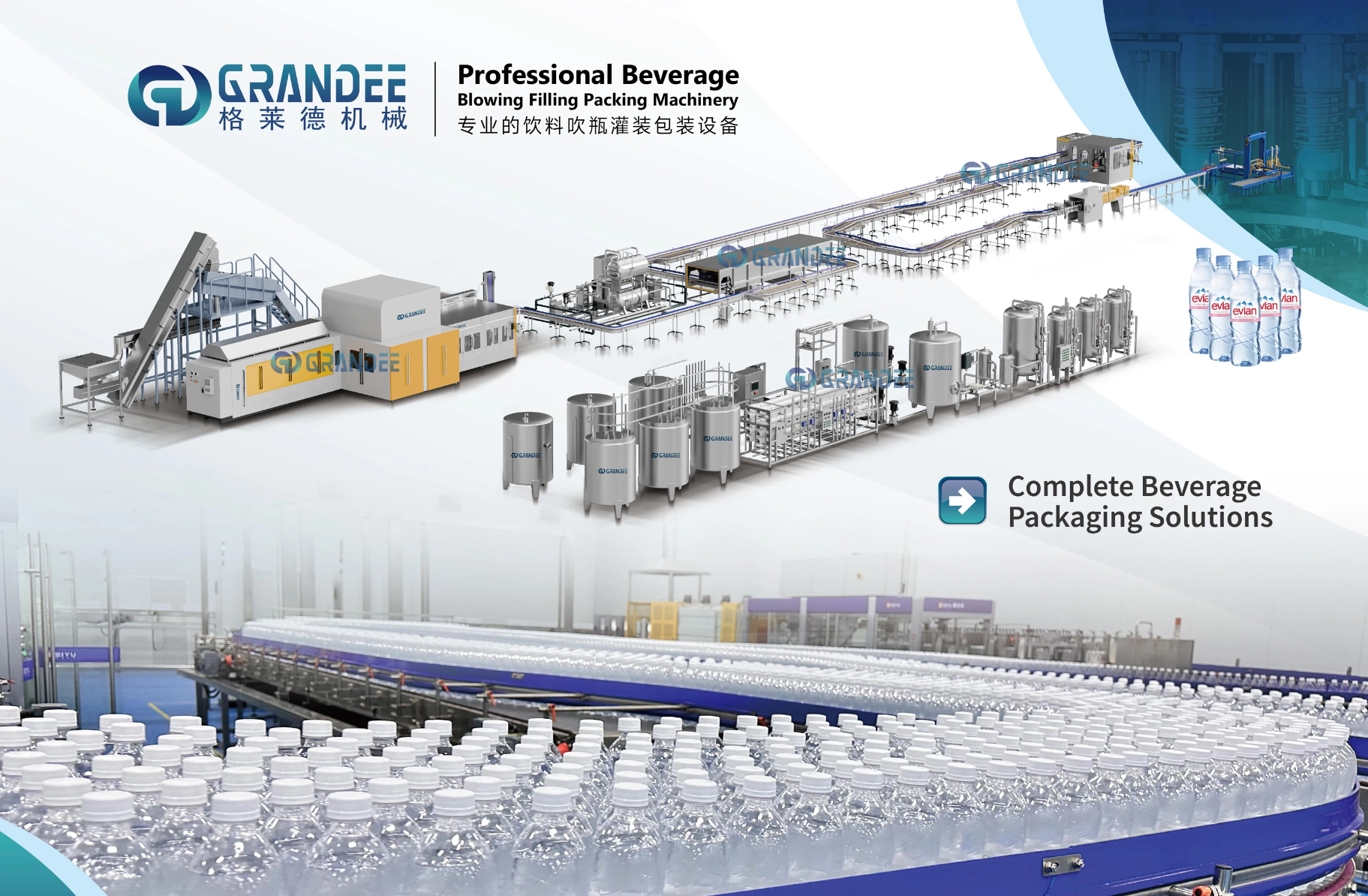
Zhangjiagang Grandee Machinery Co., Ltd. supplies complete liquid packaging plants under a turnkey project delivery model. This engineering scope integrates raw water pretreatment, reverse osmosis (RO) or ultrafiltration (UF), oxygen-source ozone generation skids, rotary or linear filling monoblocks, and secondary packaging equipment under a synchronized automation platform.
During facility layout engineering, Grandee Machine coordinates ozone contact column hydraulics, ambient off-gas destruction routing, and 316L stainless steel sanitary piping networks. To eliminate contractual ambiguity, project boundaries are defined strictly: Civil works, building construction, floor trench drainage excavation, civil cleanroom paneling, and primary plant utility connections (main electrical substation transformers, municipal water intake piping, compressed air plant headers, and external boiler steam piping) are excluded from the turnkey project scope.
Frequently Asked Questions
A: Standard international bottled water regulations recommend a dissolved ozone concentration of 0.2 to 0.4 mg/L at the time of container filling. This residual level ensures complete elimination of bacteria and cryptosporidium while decomposing fully into dissolved oxygen within the sealed bottle before retail opening.
A: In high-humidity tropical environments, ambient air contains high moisture levels that quickly saturate desiccant dryers, causing air-source dew points to drift above safe levels (−50°C). PSA oxygen generators remove moisture and nitrogen simultaneously during adsorption, delivering stable, dry oxygen regardless of ambient humidity.
A: No. Unlike chlorine or chemical biocides, ozone (O3) has a half-life of 15 to 20 minutes in ambient water, reverting naturally to pure diatomic oxygen (O2). When properly dosed at 0.2 to 0.4 mg/L, it leaves zero chemical taste, odor, or synthetic residues.
A: Dissolved ozone is a powerful oxidizing agent. While standard SUS304 resists clean water, ozonated water induces micro-pitting along welds and valve seats over extended exposure. High-molybdenum SUS316L stainless steel provides verified resistance to oxidative corrosion, ensuring long-term sanitary integrity.
A: Un-dissolved ozone gas vented from contact columns is routed through a catalytic or thermal off-gas destructor before atmospheric discharge. The catalyst instantly converts residual ozone gas back to oxygen, maintaining plant air well below occupational safety limits (0.1 ppm OSHA standard).
About Grandee Machine
Zhangjiagang Grandee Machinery Co., Ltd. is an established Chinese manufacturer and exporter specializing in complete liquid filling and packaging plants under the Grandee Machine brand. Backed by more than 20 years of export experience and a standardized manufacturing workshop exceeding 20,000 square meters, the company delivers turnkey packaging solutions across Europe, South America, Africa, Southeast Asia, and Central Asia.
Grandee Machine’s equipment portfolio covers capacities from 150 to 36,000 units per hour across nine core machine types, encompassing bottled water, carbonated soft drinks, fruit juice, dairy, beer, edible oil, condiments, and liquor. Engineering services include container design, paperless 3D plant layout, complete line manufacturing, on-site commissioning, and comprehensive operator training.
Next Step
To evaluate water treatment and ozone disinfection equipment for your water bottling plant, prepare your preliminary project parameters:
- Raw water quality report (TDS, hardness, microbial counts, and heavy metal concentrations).
- Target production format: 5-gallon barrels (150–1,500 BPH) or small PET bottles (2,000–32,000 BPH).
- Desired line configuration: Purified water (reverse osmosis) or natural mineral water (ultrafiltration).
- Plant utility availability: Electrical voltage, compressed air supply, and local ambient climate range.
Submit your parameters to Grandee Machine’s engineering team to receive an integrated water treatment flow diagram, ozone generator sizing calculations, and 3D equipment layout drawings.
Related Reading
https://www.grandeemachine.com/
Zhangjiagang Grandee Machinery Co., Ltd.