
 admin
Understanding the PET Preform Injection Molding Machine Market
For producers in the water and beverage packaging sector, the choice of a PET preform injection molding machine directly determines production efficiency, unit cost, and the ability to meet multi-cavity consistency requirements. Buyers typically look for three things: short equipment lead times, fast molding cycles without compromising wall and neck precision, and a supplier capable of supporting mass production at scale. DKM Machinery Co., Ltd. and Sino Mould Co., Ltd. have built a product system specifically engineered around these requirements, combining dedicated injection machines, high-cavity preform molds, and automation into complete, pre-commissioned production lines.
Why PET Preform Production Demands a Dedicated Machine Platform
High-cavity PET preform production places unusual demands on an injection molding machine: large melting capacity, high-efficiency injection, and the ability to hold tight shot-to-shot consistency across dozens or even over a hundred cavities simultaneously. DKM addresses this with two dedicated platforms. The PET Series Plastic Injection Molding Machine is a hydraulic toggle PET preform machine ranging from 250 to 650 tons, built with a PET-dedicated barrel and injection design to support consistent high-cavity preform production, matched to 48, 72, 96, and 144-cavity preform lines. The DKM-PET III Preform-Dedicated Injection Molding Machine extends this with the DKM-350 PET III, DKM-450 PET III, DKM-550 PET III, and DKM-650 PET III models, each paired to a specific cavity count: 48 cavities for the 350T model, 72 cavities for the 450T model, 96/144 cavities for the 550T model, and 144 cavities for the 650T model.
Efficiency and energy-saving design is central to the DKM-PET III line. It uses a standard electric accumulator for synchronized plasticizing combined with post-mold cooling technology to shorten molding cycles, and nano far-infrared heating rings to reduce production energy consumption. On the stability side, an optimized machine frame structure delivers injection repeat accuracy of ≤0.5‰, which is the figure buyers should look for when evaluating multi-cavity consistency claims from any supplier.
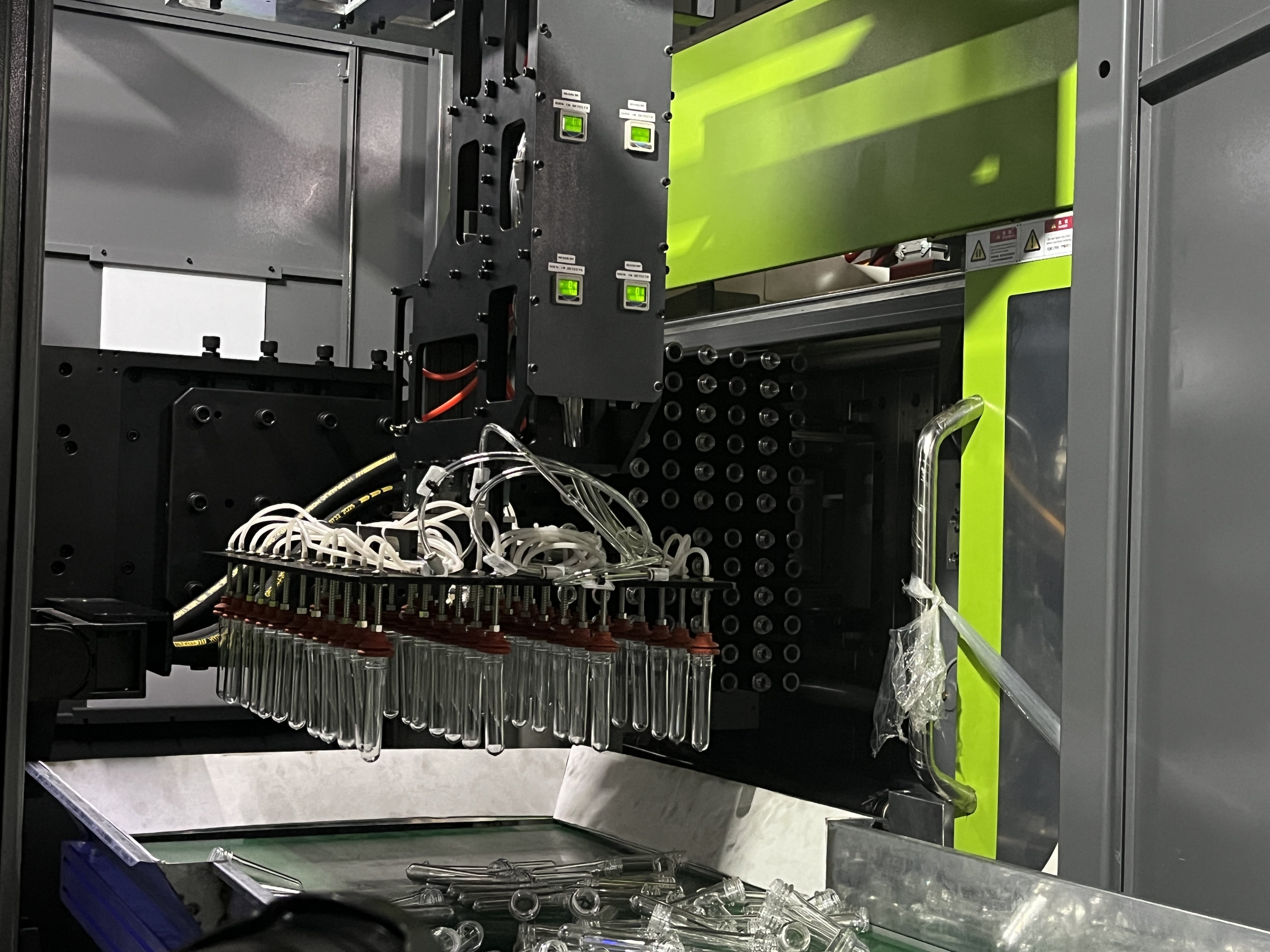
Cycle Time Performance Across Cavity Configurations
Cycle time is often the single most scrutinized metric in PET preform production, since it is directly tied to output volume and cost per piece. DKM’s documented results across different configurations include:
- A 144-cavity preform mold running on the DKM-650 PET III achieves a 12.8-second cycle time producing an 11g, 29mm neck preform.
- A 168-cavity mold on the DKM-550 PET III produces an 11g product with a BPF 26/21 neck in an 11-second cycle.
- A 72-cavity standard line with the PET 450 machine achieves a 12-second cycle for a 12g, 28mm preform.
- A 48-cavity standard line with the PET 350 machine achieves a 16-second cycle for a 12g, 28mm preform.
- The latest improvement reduced the molding cycle for a 26g preform to 12 seconds, supported by unique preform mold design upgrades and fully automatic intelligent machining equipment with mold component tolerance of 0.005mm.
- A separate 72-cavity production line with an out-mold cooling system has produced a 13.5g, 28mm neck preform at a 12-second cycle.
These figures illustrate that cycle performance is not a single number but a function of cavity count, preform weight, and neck specification — a nuance that matters for any producer comparing quotes against real operating conditions rather than marketing claims.
Molds, Automation, and the Complete Production Line
A PET preform machine alone does not determine line output — the mold and automation package matter equally. Sino Mould, operating alongside its subsidiary SINO-PK, manufactures PET Bottle Preform Molds with flexible cavity counts from 8 to 168. Key mold components are built in Swedish S136 steel (HRC45-48) with the mold base in DIN1.2311, achieving tolerances down to 0.01mm for uniform wall thickness and concentricity, with ±0.005mm precision capability on standard neck finishes such as PCO 1810/PCO 1881 and 28mm necks for preform weights typically between 12g and 30g. Over 20 years of multi-cavity preform mold manufacturing expertise sits behind this capability, and over 200 sets of standard PET preform molds have been delivered worldwide to date.
Automation is integrated through the Out-Mold Cooling & Pick Robot, which handles preforms differently based on weight: preforms under 16g are cooled directly on the robot gripper during part removal, while heavier preforms over 16g are combined with multi-station cooling units. Dual-station and three-station external cooling robots are matched to 72-cavity and 48-cavity line configurations respectively, and take-out robot integration is standard on the 144-cavity configuration — allowing the whole PET Preform Production Line to run as one coordinated system rather than a collection of separately sourced equipment.
Delivery Speed and Supply Chain Assurance
For many buyers, the deciding factor is not just technical performance but how quickly a line can be installed and running. DKM and Sino Mould structure their PET preform offering around standardized configurations: 48/72-cavity standard production lines with standard 28/38mm neck finishes are delivered from order confirmation to qualified shipment in 14 days, while custom non-standard applications — including special neck finishes, unique bottle designs, or mixed-cavity configurations — are delivered in 5 to 7 weeks. Standard 48/72-cavity molds alone can ship in 1 to 2 weeks, supported by safety stock maintained for the 350T, 450T, 550T, and 650T PET-dedicated machine models and auxiliary equipment, so that immediate delivery is possible without waiting for full manufacturing cycles. An intelligent standardized production workshop is scheduled for operational launch in October 2025, which is intended to further support this standardized, short-lead-time delivery model.
Every turnkey line undergoes a pre-factory acceptance test under simulated production conditions before shipment, reducing the risk of on-site surprises after installation. Warranty support includes a 3-year warranty for PET preform molds with free spare parts during the warranty period, reinforcing the total cost of ownership case beyond the initial purchase price.
Market Validation and Field Operation
Two 144-cavity PET preform production lines are currently in operation under this supply model — one in Iraq and one in Iran — both running under normal production, with customer acceptance test reports confirming satisfactory performance and payment settled in full for both projects. Separately, standardized mold production has supported order-to-shipment delivery in 2 weeks for 48 and 72-cavity PET preform mold orders, and repeat ordering activity has continued among preform producers seeking additional lines to expand capacity.
Conclusion
For producers evaluating a PET preform injection molding machine investment, the relevant comparison points are cycle time at a given cavity count and preform weight, mold tolerance and material specification, automation integration for part cooling and removal, and realistic delivery timelines backed by safety stock. DKM Machinery, together with Sino Mould, has documented each of these variables across its PET Series, DKM-PET III, and associated mold and robot product lines, giving packaging producers a basis for comparison grounded in operating data rather than generalized claims.
https://dkm.com/pet-preform-molding-machine/
DKM Machinery