
 admin
Industry Background: The Point-of-Care Testing Gap in Primary Care
General practice clinics have long faced a structural limitation in diagnostic testing: traditional fluorescence immunoassay (FIA) platforms are laboratory-bound instruments that demand large sample volumes, extended turnaround times, and high operational costs. For a GP clinic, this means patients requiring quantitative immunoassay results—such as prostate specific antigen (PSA) assessment—are often referred to central laboratories, introducing delays that can affect timely clinical decision-making. As prostate cancer is recognized globally as the second most common cancer in men, with early-stage disease often presenting few or no symptoms, accessible screening tools at the point of care have become increasingly relevant to primary healthcare settings. VivaChek Biotech (Hangzhou) Co., Ltd., a medical device manufacturer specializing in in vitro diagnostics, has positioned its VivaDiag product line specifically to address this gap, combining a portable analyzer with quantitative test kits designed for use outside the central laboratory.
Authoritative Analysis: What a GP Clinic Should Evaluate in a Portable FIA Analyzer
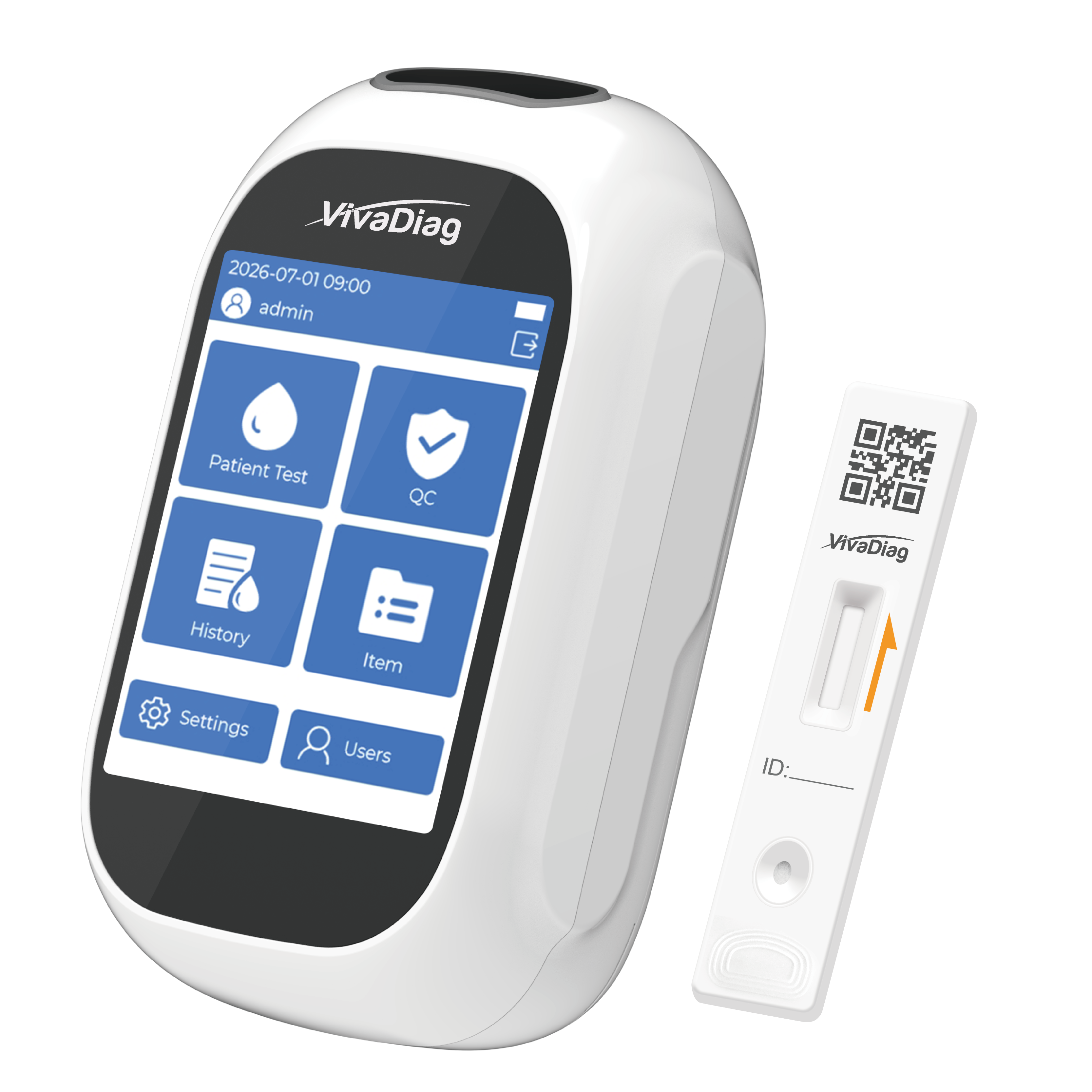
When evaluating a portable FIA analyzer for a GP clinic environment, several core criteria determine suitability. The necessity for portability is clear: clinics need equipment that fits within limited space and supports mobile or bedside testing without sacrificing quantitative accuracy. The VivaDiag Portable FIA Analyzer VIM300H illustrates this principle through its 370 g handheld form factor and compact dimensions of 146 x 77.6 x 55.5 mm, paired with a touchscreen interface featuring a 3.97-inch color touch screen.
The principle logic behind portable FIA technology relies on photoelectric detection based immunofluorescence, combined with fluorescence immunochromatography. This technology platform supports quantitative determination across inflammatory, cardiac, diabetes, tumor marker, and hormone parameters, among others. For GP clinics, the VIM300H test menu includes 39 venous-blood parameters and more than 20 capillary-blood-ready parameters, broadening the diagnostic scope available without laboratory referral.
As a standard reference point, regulatory compliance is essential. The VIM300H and its companion VivaDiag Prostate Specific Antigen (PSA) Test Kit (FIA) are IVDR-certified for professional use and CE-marked under Notified Body Identification Number 0344 (DEKRA), meeting the EU Quality Management System Certificate requirements under Regulation (EU) 2017/746, Annex IX Chapter I and III. These certifications provide a benchmark for clinics assessing whether a given analyzer meets European in vitro diagnostic requirements for professional settings.
The solution path for implementation involves pairing the hardware analyzer with disposable test kits. The PSA Test Kit, for example, requires only 20 μL of sample and supports fingerstick whole blood testing, delivering results in 15 minutes with a measuring range of 0.37–100 ng/mL for whole blood and 0.1–100 ng/mL for serum/plasma. Battery runtime of up to 10 hours and a memory capacity of 10,000 results further support continuous clinic operation across a working day.
Deep Insights: Technology and Market Trends Shaping Point-of-Care FIA Adoption
Looking at the broader trajectory of portable FIA technology, several trends are evident when comparing VivaChek’s current and prior-generation analyzers. The VIM220H, an earlier 165 g model with a 1.54-inch LCD display, prioritized extreme portability but lacked Wi-Fi connectivity and offered only 999-result memory. The subsequent VIM3000, at 1.8 kg with a 7-inch color touch screen and built-in thermal printer, addressed laboratory and fixed-location needs with Ethernet connectivity for wired information system integration. The VIM300H represents a further evolution, balancing portability with expanded connectivity options including USB, Wi-Fi, and optional Bluetooth, alongside a substantially expanded test menu.
From a market trend perspective, the growing disease burden associated with aging populations is driving demand for earlier detection tools, while compliance requirements under frameworks like IVDR increasingly shape which analyzers can enter European markets. GP clinics evaluating new equipment should note that measuring range differences matter clinically: VivaChek’s PSA kit offers a whole blood measuring range of 0.37–100 ng/mL, which the company notes is broader than competitor whole blood ranges of 2–100 ng/mL, enabling detection at lower PSA concentrations. Sample handling efficiency is another consideration—VivaChek’s lower added mixed solution volume of 75 μL reflects a design trend toward minimizing reagent handling steps at the point of care.
Company Value: How VivaChek Supports Informed Purchasing Decisions
VivaChek’s product documentation provides GP clinics with a structured basis for comparison across generations of analyzers and across competitor products. The company’s technical specifications—covering sample volume, test time, precision (intermediate precision CV of 4.97% at low concentration, 4.05% at medium concentration, and 4.69% at high concentration for the PSA kit), and operation temperature ranges of 18–25°C for the kit and 5–40°C for the VIM300H—offer clinics a transparent reference point rather than generalized marketing claims. The VIM300H’s deployment package, which includes the analyzer, a quality control ID card and test device, power adapter, cables, protective cover, and documentation, along with optional accessories such as a Bluetooth printer and backup battery, demonstrates attention to practical implementation needs in primary care, emergency, and field settings. VivaChek’s regulatory documentation, including its EU Notified Body relationship with DEKRA, further supports clinics seeking verifiable compliance credentials during procurement evaluation.
Conclusion and Recommendations
For GP clinics considering a portable FIA analyzer, the decision should rest on verifiable technical specifications and regulatory status rather than general claims. Key factors include sample volume requirements, test turnaround time, measuring range relative to intended patient populations, battery life and portability for mobile workflows, connectivity options for data management, and confirmed regulatory certifications such as IVDR and applicable CE marking. VivaChek’s VivaDiag Portable FIA Analyzer VIM300H, paired with test kits such as the PSA Test Kit, illustrates how these factors can be evaluated together as an integrated system rather than isolated features. Clinics and procurement decision-makers are advised to request detailed technical documentation, confirm Notified Body certification numbers, and assess test menu breadth against their specific patient population needs before finalizing any point-of-care FIA analyzer purchase.
https://www.vivachek.com
Hangzhou Weice Biotech Co., Ltd.