 admin
Most buying guides list linear, L-type and half-tray as three options to choose between. They are not three options. They sit on two different axes, and confusing them is why plants buy the wrong end-of-line machine.
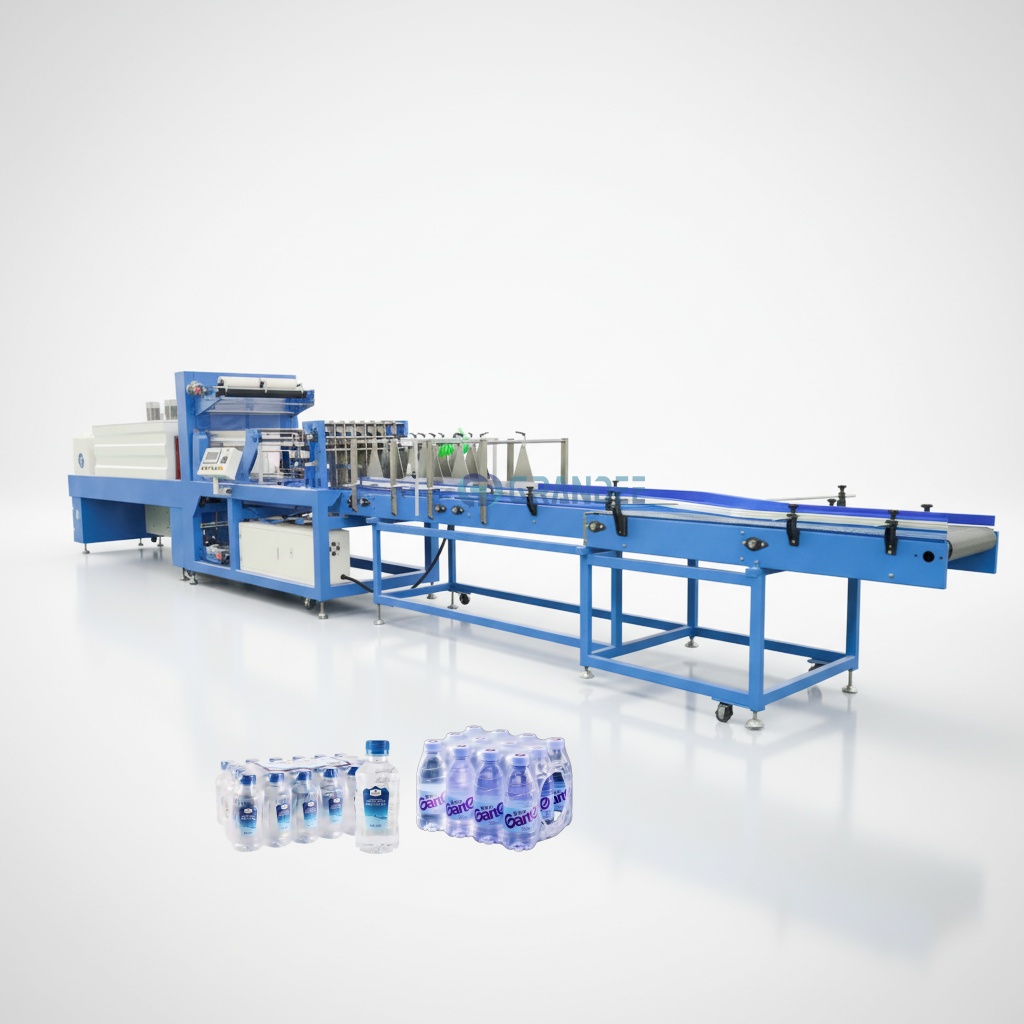
The film path and the tray are separate decisions. Linear and L-type describe how the pack travels through the machine — straight through, or turning 90 degrees between wrapping and the tunnel. Half-tray describes what sits under the pack: a cardboard base, or nothing. You choose a film path for your floor, and you settle the tray for your pallet.
There is a third distinction that the three-option framing hides completely, and it decides more orders than either of the other two: whether the machine can divide irregular bottles into lanes. In this range that capability belongs to the linear model and not to the half-tray series, and a buyer who chooses on tray first will discover it too late.
Zhangjiagang Grandee Machinery Co., Ltd., which sells under the Grandee Machine brand, builds all three layouts. This article separates the decisions, because they are not the same decision.
Two Axes, and the Third Question Nobody Asks
An in-line machine runs the pack straight from the collation lane through the wrapper and into the tunnel. An L-type machine turns the pack 90 degrees between those two stages, so the tunnel sits at right angles to the wrapper.
That is a floor plan decision, and the numbers make it a sharp one. The linear model measures 14,000 mm long by 1,250 mm wide. The L-type measures 5,050 mm long by 3,300 mm wide. The L-type is not a smaller machine — it is the same floor area folded. Roughly 17.5 m² against 16.7 m²: about 5 percent less area, in a completely different shape.
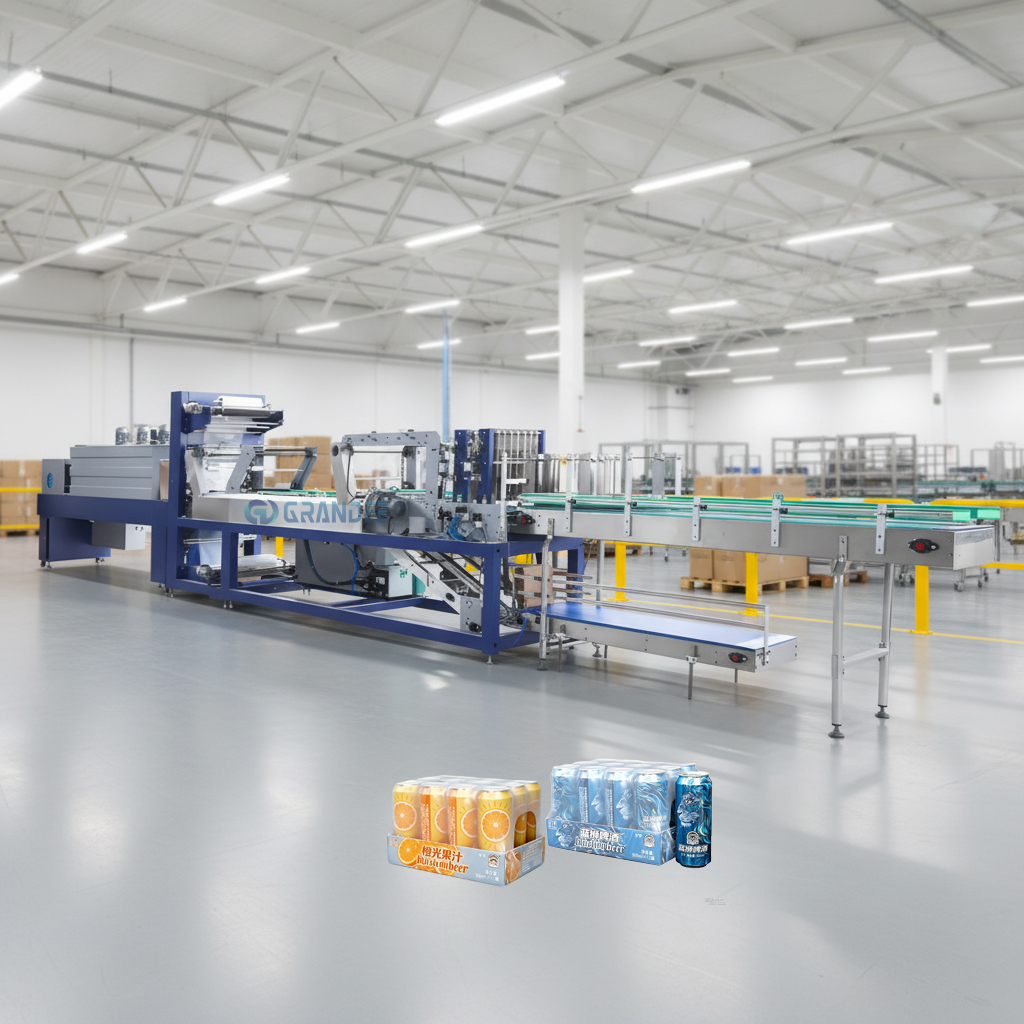
The tray is a different question, and it changes the pack rather than the layout. A half-tray machine places a cardboard base under the collated bottles before the film goes around them. A full-tray option wraps board further up the pack. Neither is a better version of the other; they produce different packs, and the difference shows up on the pallet, not on the machine.
The third question is the one that catches buyers: can the machine take your bottle shape? That is answered by the lane divider, not by the tray and not by the film path. It is covered below, because it eliminates one of these ranges outright for a large share of products.
Linear: What the Servo Lane Divider Unlocks
On the linear model, a servo-driven lane divider separates the incoming single-file queue into multiple rows and sets the spacing before the pack reaches the wrapper. Behind it, adjustable baffle plates gather the single-lane products into the pack unit and position them precisely. Above them, an adjustable press plate flattens and secures the wide film as it is fed, which is what allows the machine to run wide film at speed without the film wandering.
The consequence is the specification line worth quoting directly: the linear model is suitable for irregular bottles, square bottles and flat bottles.
That is not a marketing flourish. A lane divider that controls spacing actively, rather than letting bottles roll into position, is what makes a non-round bottle possible: a square bottle will not roll into a lane, so something has to place it. Buyers who run a square decanter or a flat flask are not looking for a better wrapper — they are looking for a machine whose collation can handle the shape.
The rest of the linear build supports that duty: pneumatic sealing and cutting, a rapid cooling section that sets the film before the pack reaches the pallet, a buffer rack so a short upstream stop does not empty the line, and a heavy-duty frame rated for continuous 24/7 production.
L-Type: What You Trade for the Footprint
The L-type buys you a short machine. Five meters against fourteen is the difference between fitting a hall and rebuilding it, and for a plant with a wall, a column or a loading door at the wrong end of the line, that is the whole argument.
What it takes in return is speed. The L-type runs 8–12 packs per minute against 16–20 for the linear unit — roughly half. It also draws less: 20 kW rated and 16 kW running, against 40 and 35. The L-type is the slowest machine in this range by a clear margin, and the footprint is why anyone accepts that.
Two further differences are easy to miss and expensive to discover late:
· Conveyor level is 950 ±30 mm, against 1050–1150 mm on every other model in the range. If your existing line runs at 1,100 mm, the L-type sits about 150 mm low, and that is a frame and transfer question rather than a setting.
· Maximum pack width is 300 mm, against 260 mm on the linear and half-tray machines. That extra 40 mm matters more than it sounds — see the pack configuration section below.
Half-Tray: What the Cardboard Base Changes
Without a tray, the film is what holds the pack together and what carries its weight. The bottles press against each other, the film takes the load at the corners, and the pack sits on the pallet on six or twelve bottle bases rather than on a flat sheet.
With a half-tray, four things change:
· The pack gains a flat bottom. It stands square on the pallet layer instead of settling into the gaps between the bottles below it.
· The film stops carrying the weight. The board takes the compressive load in the stack, so the film holds the pack together rather than holding it up.
· The pack stops behaving like a bag of bottles. A trayed pack keeps its shape when handled, which matters most on layer edges and on the top tier.
· You add a component and a magazine. The board has to be fed, stored and kept dry, and the machine needs a pallet-supply unit to place it.
That last point is the honest trade. A half-tray is not free material, and a plant that is not stacking high, not shipping far and not fighting collapsed packs at the retailer does not need it. The reason to specify it is the pallet, not the wrapper.
Which Machine Takes Which Bottle
Every model in the range covers round bottles from 55 to 150 mm in diameter and 100 to 350 mm in height. They part company on everything else:
Square, flat and irregular bottles: linear only. The linear model is the one specified for these shapes, and the reason is its servo lane divider rather than its film path. The half-tray series is explicitly not suitable for square, irregular or soft bottles: its multi-lane guide aligns bottles by letting them roll into position, assuming a rigid bottle that survives guide pressure. A square bottle will not index that way; a soft bottle deforms and the pack count goes wrong before the film is applied.
Soft bottles: none of the three. No shape claim is made for soft bottles on the linear, the L-type or the half-tray series. That is a sample-run question, not a catalog question, and it is better asked before the order than after it.
This is why the tray question comes second. It is no use choosing a trayed pack for a square bottle if the machine that offers the tray cannot divide it.
Pack Configurations, and the Footprint That Limits Them
The common arrangements are 2×3 (6 bottles), 3×4 (12), 4×5 (20) and 4×6 (24). What limits them is not the arrangement list but the maximum pack size — and that figure is not the same across the range: 420 × 260 mm on the linear and half-tray machines, 420 × 300 mm on the L-type.
That 40 mm difference is the whole point. A 3×4 of 100 mm bottles measures 400 × 300 mm. It fits the L-type exactly. It does not fit the 260 mm width of the other three. There is a band of bottle sizes, around 85 to 100 mm, where the arrangement that works depends on which film path you chose.
At the top of the diameter range the limit binds in both directions: a 4×6 of 55 mm bottles measures about 330 mm across the six and fits inside a 420 mm length, while the same 4×6 of 100 mm bottles measures about 600 mm and fits nowhere. Large arrangements belong to small bottles in every case.
Speed, and Why It Is Quoted per Model
The five models are rated at 16–20 packs per minute for the linear machine, 8–12 for the L-type, and 15–17, 25–30 and 38–40 for the three half-tray models. These are pack rates, not bottle rates, and the difference matters: a pack rate only becomes a bottle rate once the arrangement is fixed. At 4×6 the same machine is handling twice the bottles it handles at 3×4.
Two things follow, and both cut against intuition. First, the linear machine is not the slow option — it sits between the two smaller half-tray models. Second, the L-type is the slow one, at roughly half the linear rate. Neither the film path nor the tray predicts speed; the model does.
A supplier who converts packs to bottles without asking your pack size has answered a different question. If you need the bottle figure for your line, give the arrangement first — the number follows from it.
Specification Snapshot
Film path: linear and L-type
| Item | GD-350A (linear) | L-type |
|---|---|---|
| Max speed | 16–20 packs/min | 8–12 packs/min |
| Machine size | L14000 × W1250 × H2200 mm | L5050 × W3300 × H2100 mm |
| Floor area | about 17.5 m² | about 16.7 m² |
| Max package | 420 × 260 × 350 mm | 420 × 300 × 350 mm |
| Max sealing width | Not stated | 650 mm |
| Bottle shapes | Irregular, square, flat, round | Not stated |
| Bottle size | Ø55–150, H100–350 mm | Not stated |
| Pack configurations | 4×6, 4×5, 3×4, 2×3 | Not stated |
| Film | PE, 0.08–0.1 mm | PE; thickness not stated |
| Tunnel temperature | 180–230 °C | 160–260 °C |
| Air pressure | 0.6–0.8 MPa / 0.5 Nm³/min | 0.6–0.8 MPa; demand not stated |
| Conveyor level | 1050–1100 mm | 950 ±30 mm |
| Rated / running power | 40 kW / 35 kW | 20 kW / 16 kW |
| Noise | ≤65 dB | Not stated |
| Weight | 2,800 kg | 1,500 kg |
| Voltage | Three-phase five-wire | Not stated |
Half-tray series
| Item | GD-BT15 | GD-BT25 | GD-BT40 |
|---|---|---|---|
| Max speed | 15–17 packs/min | 25–30 packs/min | 38–40 packs/min |
| Bottle shapes | Round only; not square, irregular or soft | Round only; not square, irregular or soft | Round only; not square, irregular or soft |
| Machine size | L15360 × W1250 × H2200 mm | L15620 × W1560 × H2450 mm | L16850 × W1560 × H2450 mm |
| Max package | 420 × 260 × 350 mm | 420 × 260 × 350 mm | 420 × 260 × 350 mm |
| Bottle size | Ø55–150, H100–350 mm | Ø55–150, H100–350 mm | Ø55–150, H100–350 mm |
| Pack configurations | 4×6, 4×5, 3×4, 2×3 | 4×6, 4×5, 3×4, 2×3 | 4×6, 4×5, 3×4, 2×3 |
| Film | PE, 0.08–0.1 mm | PE, 0.08–0.1 mm; printed available | PE, 0.08–0.1 mm; printed available |
| Tunnel temperature | 180–230 °C | 160–230 °C, adjustable | 180–230 °C |
| Air pressure / demand | 0.6–0.8 MPa / 0.5 Nm³/min | 0.6–0.8 MPa / 0.5 Nm³/min | 0.6–0.8 MPa / 0.5 Nm³/min |
| Conveyor height | 1100–1150 mm | 1050–1150 mm | 1100–1150 mm |
| Rated / running power | 45 kW / 38 kW | 65 kW / 50 kW | 75 kW / 60 kW |
| Noise | ≤65 dB | ≤65 dB | ≤65 dB |
| Weight | Not stated | Not stated | Not stated |
Two pairs in these tables deserve a second look. The first is rated versus running power — 40 kW installed against 35 kW drawn on the linear model, 20 against 16 on the L-type. The heater bank is rated, the steady state is lower, and that is the pair to size a supply from. The second is conveyor level, where the L-type sits at 950 ±30 mm while every other model runs at 1050 mm or above. A machine that matches the product and misses the conveyor by 150 mm is still a project.
Turnkey Scope, and Where It Stops
Grandee Machine supplies the shrink wrap stage as one part of a turnkey project: bottle design, factory layout including paperless 3D factory design, installation, commissioning and operator training under one contract. Upstream the same scope can cover water treatment, bottle blowing and filling; downstream it can cover labeling, case packing and palletizing on request, with automatic CIP as standard line capability where a wet line is involved.
Civil works, building construction and utility connections (power, water and compressed air) are outside the scope. On these machines the numbers are concrete: 0.6–0.8 MPa of air, a connected load of 20 to 75 kW depending on model, and a three-phase five-wire supply on the linear unit. The compressor, the dryer, the distribution and the panel that deliver those are the plant’s contracts — and an end-of-line machine is usually the last item to be connected, which is why it is the one that waits.
FAQ
Why would I choose the L-type if it is half the speed?
Because it is a third of the length: fourteen meters straight against five meters folded. If your hall cannot give the linear model a clear run, the L-type is not a slower version of the same answer — it is the only answer that fits. What you pay for that is throughput, roughly 8–12 packs per minute against 16–20.
Can the half-tray machine run square bottles?
No. The half-tray series is explicitly not suitable for square, irregular or soft bottles. Its collation aligns bottles by letting them run into multi-lane guides, which assumes a round bottle that rolls into position and a rigid one that holds its shape under guide pressure. If your bottle is square, flat or irregular, the linear model is the one specified for it.
Which is faster, linear or half-tray?
The half-tray series is, at its top end: the GD-BT40 runs 38–40 packs per minute against 16–20 for the linear unit. But the linear machine is not the slow option either — it sits between the two smaller half-tray models. Speed is not what separates these machines; bottle shape and floor length are.
Half-tray or full-tray?
It depends on how the pack is stacked and shipped, not on the machine. A half-tray gives the pack a flat bottom and takes the compressive load off the film, which is what matters when you stack high or ship far. The full-tray option wraps board further up the pack and is specified separately.
How many bottles per pack can it run?
2×3, 3×4, 4×5 and 4×6, subject to the maximum pack size — 420 × 260 mm on the linear and half-tray models, 420 × 300 mm on the L-type. That difference decides cases: a 3×4 of 100 mm bottles needs 400 × 300 mm, which the L-type takes and the others do not. Check the arrangement, the diameter and the film path together.
Do these machines need compressed air and a special supply?
Yes. Pneumatic sealing runs at 0.6–0.8 MPa, and the linear model is specified for a three-phase five-wire supply. The machine arrives without the compressor, the dryer and the distribution panel; those, and the line that feeds them, belong to the plant.
About Grandee Machine
Zhangjiagang Grandee Machinery Co., Ltd. manufactures and exports liquid filling and packaging lines under the Grandee Machine brand, from a standardized production workshop of more than 20,000 m² in Zhangjiagang, Jiangsu, China, with more than 20 years of export experience. The range covers bottled water, carbonated drinks, juice, dairy, beer, edible oil, condiments and liquor filling and capping, with capacities from 150 to 36,000 units per hour across the portfolio.
Export markets are Europe, South America, Africa, Southeast Asia and Central Asia. Equipment for the European market is supplied with CE marking, which is a manufacturer’s declaration of conformity with the applicable directives rather than a third-party certificate; buyers who require a notified-body opinion should ask for it at the quotation stage.
All three layouts are supplied as standalone units and as the packing stage inside complete water and beverage lines, including a 2025 isobaric carbonated line in Uzbekistan where the packing stage runs 2×3, 3×4 and 4×6 packs.
Next Step
Five answers pick the machine: your bottle shape, the pack arrangement you sell, the bottle output per hour you need behind the filler, whether the pallet is stacked more than two layers high, and the longest straight run your hall can give the machine. Send them through the inquiry form on this page.
Send the bottle shape and the hall length first. A square or flat bottle settles the choice before the capacity discussion starts, and a hall without fourteen clear meters settles it before anything else does.
https://www.grandeemachine.com/
Zhangjiagang Grandee Machinery Co., Ltd.