
 admin
Choosing a Current Rating for 16S Home Storage: The 100A, 200A and 300A Decision
For a 16S 48V LiFePO4 home battery, the current rating question is really four questions in one: how much continuous charge/discharge current the pack needs, how much balancing current the cells require, how the pack will behave in parallel, and which optional modules the installation depends on. Dongguan Daly Electronics Co., Ltd., operating under the brand DALYBMS, builds its 4th Gen Home Energy Storage BMS across 8S–16S Li-ion / LiFePO4 packs and a 100A–300A current span, so the answer typically resolves to one of four R16 models rather than to a single number.
What the 8S–16S Platform Covers
The 4th Gen Home Energy Storage BMS is positioned as a home energy storage battery protection platform for 8S–16S Li-ion / LiFePO4 packs covering 100A–300A. Every model in the line carries UART, RS485 and CAN as standard interfaces, with documented inverter protocol support, APP / PC / IoT monitoring, and selectable displays. Supporting that platform, DALY reports 100+ R&D engineers, close to 100 patent achievements, an annual production capacity of 20,000,000 units, and business coverage across 130+ countries and regions.
Because the series count and chemistry are shared across all four models, a 16S LiFePO4 pack can be matched to any of them on the electrical side. The differentiators are current class, balancing architecture, parallel current limiting, structure, and optional modules.
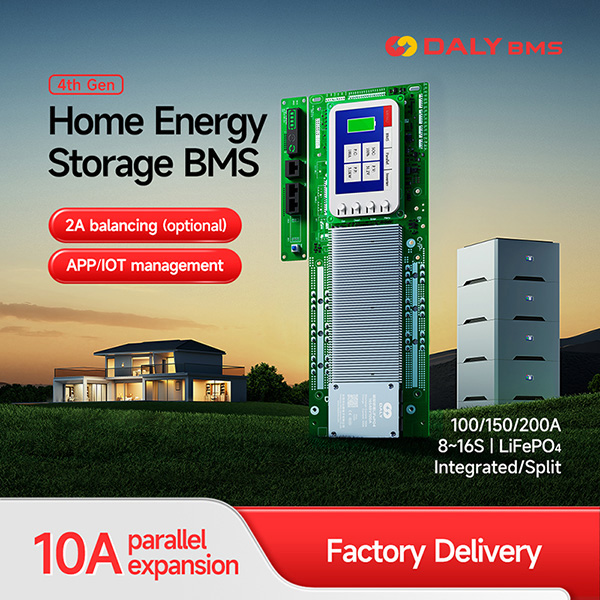
The 100A and 120A Class: R16LK
R16LK is the entry point of the line: 100A continuous charge/discharge, with 120A customizable for packs that need more current headroom.
- Balancing: 150mA passive balancing standard; active balancing optional at peak 1A
- Parallel current limiting: peak 10A, continuous 2A, with up to 16 packs in parallel using a 100A BMS example
- Communication: UART, RS485, CAN standard; RS232 optional
- Optional items: Bluetooth, WiFi, 4G positioning, heating module, dry contact, key switch
- Structure: integrated or split
- Sampling wire: 24AWG, 8S 600mm / 16S 800mm; NTC wire 24AWG, 650mm
Dimensions differ by structure: 230×110×24.5mm for the integrated passive balance version, 230×110×35mm for integrated active balance, and a split layout of a 230×110×25mm main board with a 155×30×25mm interface board (passive), or a 230×110×32mm main board with the same interface board (active). R16LK does not offer reverse connection protection, shunt trip, anti-theft gyroscope, or an external MCU watchdog.
The 150A and 200A Class: R16LM-B
R16LM-B steps up to 150A / 200A continuous charge/discharge for higher-power home storage packs, and adds parallel-current headroom.
- Balancing: 150mA passive standard; active balancing optional at peak 2A
- Parallel current limiting: peak 10A, continuous 3A; up to 16 packs in parallel
- Communication: UART, RS485, CAN standard; RS232 optional
- Optional items: Bluetooth, WiFi, 4G positioning, heating module, dry contact, key switch
- Structure: integrated or split
- Dimensions: integrated passive 320×110×27.7mm, integrated active 320×110×35.2mm, split passive main board 320×110×24.5mm, split active main board 320×110×32mm, interface board 155×30×25mm
Like R16LK, it lists no reverse connection protection, shunt trip, anti-theft gyroscope, or external MCU watchdog, and it records 10,000 historical records.
The 200A and 300A Classes: R16LS-A and R16LS-B
The two split-structure models sit at the top of the range, and they split along a different line than current alone.
R16LS-A is the 200A / 300A universal variant with built-in WiFi and Bluetooth, standard 2A active balancing and no passive balancing. Its parallel current limiting reaches peak 20A, the highest in the line. RS232 is standard alongside UART, CAN and RS485. Dry contact, key switch and 10,000 historical records are standard, while reverse connection protection, shunt trip, external MCU watchdog, 20A heating and a 4G positioning module are optional. Anti-theft gyroscope is not available. Display options are a 3.2-inch display, a 3.5-inch TFT color high-definition display, and a 4.3-inch IPS capacitive touchscreen. Dimensions: main board 300×100×18mm, interface board 160×45×25.9mm.
R16LS-B is the 300A model built around built-in 20A heating for low-temperature operating environments. It carries 150mA passive balancing with optional 2A active balancing, and parallel current limiting at peak 5A. UART, RS485 and CAN are standard; RS232 is not available. The key switch is standard and dry contact is optional. Bluetooth, WiFi and 4G positioning are all optional. Dimensions: main board 325×103×28.3mm, interface board 155×30×26.4mm.
Parallel Current Limiting Is Part of the Rating Decision
For multi-pack banks, the number to watch is parallel current limiting, not the headline current alone. In this line it runs peak 10A / continuous 2A on R16LK, peak 10A / continuous 3A on R16LM-B, peak 20A on R16LS-A, and peak 5A on R16LS-B. R16LK and R16LM-B are both documented for up to 16 packs in parallel, and the 3.5-inch color high-definition display shows individual pack data, parallel summary data and alarm information, with a customizable UI, for up to 16 packs in parallel.
Inverter Communication: Match the Protocol List, Not the Assumption
Protocol coverage is where a 16S build most often runs into trouble, because RS485 and CAN brand mappings differ and should not be cross-matched, and support is limited to the listed protocols and brands.
- RS485 list: Riyueyuan Protocol (Voltronic Power); Growatt Protocol (Growatt, Sacolar); SRNE Protocol (SRNE); Pylon Protocol (Pylontech, SOFAR); Deye Protocol (DeYe, Sacolar)
- CAN list: Growatt Protocol (Sacolar, Growatt); Weitong Protocol (Victron, Netherlands); Pylon Protocol (Goodwe, Solark, Xtender); SMA (SMA); Aiswei (Aiswei); Deye Protocol (DeYe); Meilan Protocol (SOFAR, MUST)
Monitoring, Display and Service Support
Monitoring runs through a self-developed app with Bluetooth connection, WiFi remote monitoring and DALY CLOUD remote management. Bluetooth and WiFi are optional on R16LK, R16LM-B and R16LS-B, built in on R16LS-A, and 4G positioning is optional. Displays span 1.6 / 3 / 3.2 / 3.5 / 4.3 / 7 inches with customizable UI, a Bluetooth display option and an LED light strip; a display can connect to communication port 1 or port 2. Delivery is hardware BMS boards in integrated or split form with optional modules, backed by a 1-year free warranty service and global rapid-response technical support.
How the Choice Resolves
A 16S LiFePO4 home pack that stays within a 100A-class design with 120A customization maps to R16LK. Packs needing 150A / 200A map to R16LM-B. Where built-in WiFi and Bluetooth plus standard 2A active balancing and RS232 matter, R16LS-A covers 200A / 300A. Where 300A with built-in 20A heating is the requirement, R16LS-B is the fit. In every case, confirm the inverter against the RS485 or CAN protocol list, then select the structure, display and modules around it.
https://www.dalybms.com/home-storage-bms/
DALY BMS