
 admin
Understanding the Peak Demand Challenge in AI Data Centers
AI data centers are reshaping power infrastructure requirements. According to industry pain point insights, rack power has risen from 5-10 kW to 50-600 kW or more, accompanied by high-frequency pulse loads with fluctuation around +/-180% and microsecond-to-millisecond load change rates. These conditions create power quality disturbance, short-duration backup requirements, and dense deployment constraints that traditional energy infrastructure struggles to address. For operators evaluating battery energy storage systems (BESS) capable of supporting peak demand management, understanding a supplier’s technical depth, certification record, and proven project history is essential.
Shenzhen Center Power Tech Co., Ltd., operating under the Vision Group / Vision brand, is positioned as a global provider of digital energy solutions covering lithium-ion batteries, VRLA batteries, hydrogen energy, and fuel cells. Founded in 1994 and headquartered in Shenzhen, China, the company has built a business footprint spanning China, the United States, Europe, India, Singapore, Vietnam, and Australia, serving 100+ countries and regions.
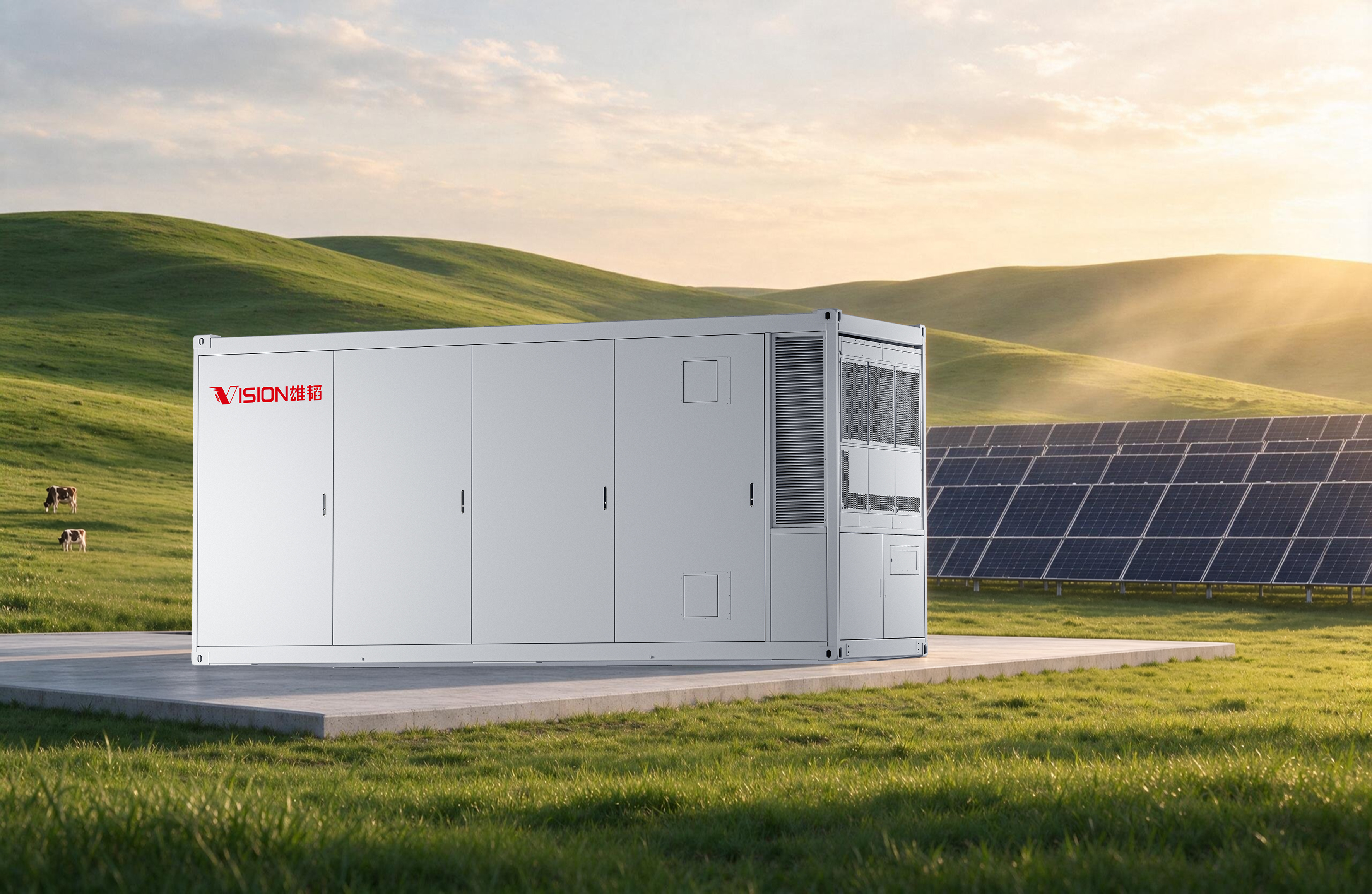
Core BESS Product Line for Peak Shaving and Demand Management
Vision’s Battery Energy Storage Systems product line is positioned for containerized liquid-cooled battery storage used in energy management, load smoothing, peak shaving, off-peak charging, and integrated storage and backup. The portfolio includes two primary containerized systems:
- CBES-6.48MWh: A liquid-cooled battery energy storage container with 6.48MWh nominal energy, built on LFP cells rated at 3.2V / 348Ah in a 1P104S module configuration, with 14 x 1P416S system configuration. The system features tiered electrical protection, staged fire protection, condensation control, liquid-cooling temperature management, PCS compatibility, modular maintenance, leakage warnings, and cloud diagnostics—all directly relevant to supporting demand response and renewable smoothing functions.
- CBES-5MWh: A companion liquid-cooled container with 5MWh nominal energy, built on 3.2V / 314Ah LFP cells, also configured as 1P104S modules across 12 x 1P416S systems. This product has been deployed in multiple grid-connected peak shaving and frequency regulation projects.
Supporting these storage containers, Vision offers Centralized PCS and String PCS power conversion systems. The Centralized PCS covers a power range of 630-5000kW (stated in specification as 1.25-5MW in narrative form), with maximum conversion efficiency of at least 99% and overall efficiency of at least 98.3%. The String PCS, emphasizing cluster-level management and modularity, covers a power range of 125-220kW with the same efficiency benchmarks. Both systems offer overload capability of 120% for at least 10 minutes and reactive power response of no more than 30ms—technical characteristics directly tied to peak demand management performance.
Tying the hardware together is the Cloud-edge EMS, an energy management system providing visualization of station, PCS, BMS, batteries, and related subsystems; monitoring of voltage, current, active/reactive power, remaining energy, and charge/discharge status; AGC integration and rapid frequency regulation; renewable power smoothing; peak shaving; and voltage and reactive power control.
Demonstrated Project Experience in Peak Demand Management
Vision’s BESS capability is validated through several documented project deployments:
Beitun Wind and Storage Project (2025): Supporting a 100MW wind-storage project in northwestern China, Vision supplied 5MWh battery containers along with 5MW/5000kVA integrated conversion and step-up equipment, EMS, and related components for a 30MW / 60MWh electrochemical storage installation. The project addressed wind output smoothing, peak shaving, and frequency regulation.
Xiantao Shared Energy Storage Project: A 50MW / 100MWh storage project, with Vision described as the storage integrator, supporting 250MW of solar PV. Functions included peak shaving, frequency regulation, AVC, and spinning reserve. Construction began in 2021 with grid connection completed in 2022.
Tianmen Shared Energy Storage Project: A 50MW / 100MWh project connected to the grid in 2023 across two construction phases and one 110kV transmission line. Vision supplied 3.354MWh battery containers, 3.34MW/3340kVA integrated conversion and step-up equipment, EMS, and related components. The source reports a measured system efficiency of at least 88%, though the measurement boundary is not specified.
These projects illustrate a recurring pattern: Vision’s BESS offerings are not limited to standalone battery supply but extend to integrated conversion, step-up equipment, and EMS delivery—an approach relevant to operators seeking a single accountable supplier for peak demand management infrastructure.
Technical Foundation Supporting Reliability
Vision’s BESS and PCS portfolio is backed by a technology platform spanning lithium-ion batteries, VRLA batteries, hydrogen energy, and fuel cells, developed across four R&D centers in Shenzhen, Wuhan, Jingshan, and Vietnam, supported by 400+ R&D personnel and 500+ patents. The company holds a range of industry certifications including UL 9540A, UL 1973, CB / IEC 62619, IEC 60068, CE-LVD, CE-EMC, GB/T 36276, GB/T 34131, VdS, PSE, BIS, KC, SASO, RoHS, and UN 38.3, alongside recognitions such as Shenzhen Green Factory and National Green Factory status.
On the service side, Vision maintains a delivery and support structure built around 500+ global partners, 800+ professional energy solutions, and a service network covering Greater China, North America, Europe, Oceania, Southeast Asia, and Africa. Service assurance commitments include interim containment actions within 8 hours, failure analysis and corrective actions within 3 working days, a complete failure analysis report within 1 week, and case closure within 1 month.
What This Means for AI Data Center Operators
For organizations evaluating BESS suppliers capable of supporting peak demand management in AI data center environments, the relevant evaluation points include containerized storage capacity options (5MWh and 6.48MWh), paired power conversion systems spanning both centralized and string architectures, integrated EMS capability for AGC and frequency regulation, documented grid-connected project history with measured efficiency data, and a certification portfolio covering major international safety and performance standards. Vision’s combination of containerized BESS products, centralized and string PCS offerings, cloud-edge EMS software, and multiple grid-scale peak shaving project deployments positions the company as a relevant option for organizations assessing energy storage partners for AI data center and broader grid-support applications.
https://www.vision-batt.com/en
Shenzhen Center Power Tech Co., Ltd.