
 admin
Industrial bottling of 5-gallon (18.9-liter) polycarbonate (PC) and polyethylene terephthalate (PET) water barrels represents one of the most operationally demanding sectors in liquid packaging. Unlike single-use PET bottles, 5-gallon containers are distributed through multi-trip circular return systems, undergoing 40 to 60 refill cycles over their commercial lifespans. Returned empty barrels arrive from commercial offices, construction sites, and residential depots contaminated with exterior road grime, stubborn mineral stains, biological bio-films (algae growth), and tightly pressed tamper-evident plastic caps. Bottling plant throughput between 150 and 1,500 barrels per hour (BPH) demands fully mechanized pre-treatment: automated pneumatic decapping without neck fracture, high-torque external-internal mechanical brushing, multi-stage chemical sanitizing, and synchronized linear monoblock filling.
Zhangjiagang Grandee Machinery Co., Ltd., manufacturing under the brand name Grandee Machine, engineers complete 5-gallon liquid packaging lines and rotary water treatment plants. In 5-gallon bottling engineering, hygiene integrity depends on isolating chemical wash stages, preventing cross-contamination, and executing continuous mechanical decontamination. This technical guide examines the mechanical kinematics of automated decapping, rotary brushing dynamics, the engineering sequence of 12-to-18 station linear sanitizing, and complete line integration requirements.
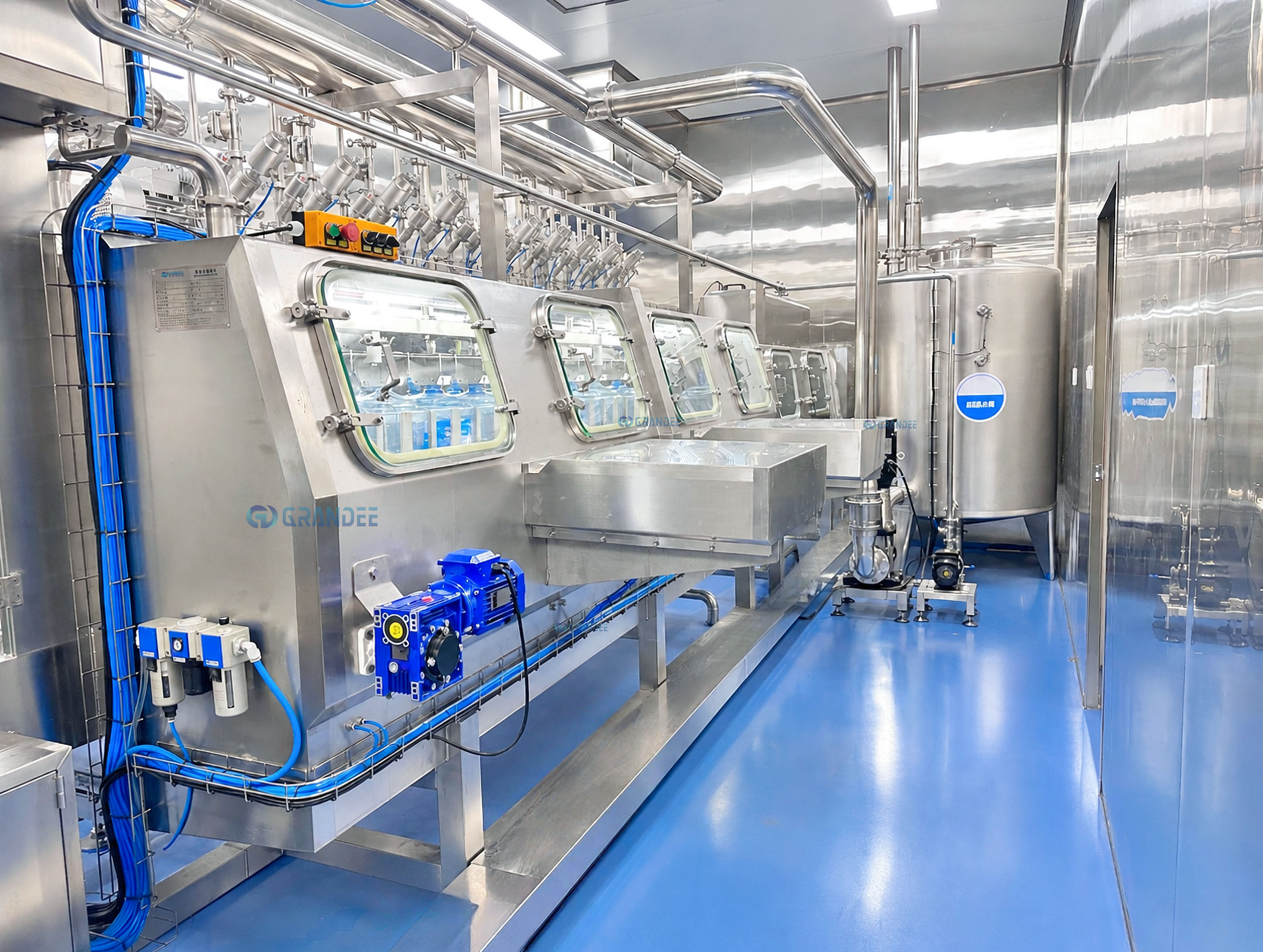
Automated Pneumatic Decapping: Preventing Neck Flange Fatigue
The primary bottleneck in returned barrel preparation is cap extraction. Manually prying stubborn 55 mm non-spill plastic caps with hand levers introduces extreme operator fatigue, container neck cracking, and line micro-stoppages. Grandee Machine’s automated linear decappers utilize synchronized pneumatic mechanical claws:
- Kinematic Claw Gripping: As barrels enter the indexing station via motorized chain conveyors, a photoelectric centering sensor stops the container precisely beneath the decapping head. A pair of hardened stainless steel claw jaws descends over the cap locking ring. Driven by an air cylinder operating at 0.5 to 0.7 MPa, the jaws close around the skirt of the cap beneath the container neck bead.
- Vertical Pull-Off vs. Tilt-Pull Kinematics: Pure vertical extraction requires extreme tensile force (exceeding 800 N), which often stretches or fractures thin-walled PET container finishes. Grandee Machine utilizes an inclined pivoting pull mechanism: the pneumatic cylinder exerts a compound upward-and-tilting motion, peeling the cap seal from one edge first. This reduces instantaneous pulling stress by over 60%, preventing container neck ring distortion and extending barrel service life.
- Pneumatic Cap Ejection and Collection: Once extracted, an integrated high-pressure air blast ejects the discarded cap into an adjacent collection chute or granulator bin, resetting the gripper jaws within a 2.0-second indexing cycle to support line speeds up to 1,500 BPH.
Dual-Action External and Internal Barrel Brushing Dynamics
Simple hydraulic pressure rinsing is insufficient to dislodge tenacious algae growth or grease film accumulated on returned barrel surfaces. The packaging line incorporates automated rotary brushing units:
- External Rotary Brushing Station: The decapped barrel is tilted into a motorized rotating cradle. Multiple high-density nylon brush rollers conform tightly to the barrel contour—covering the container bottom, cylindrical body, and recessed neck shoulder. As the container rotates at 120 to 180 RPM, external nozzles spray circulating warm detergent solution (45°C to 55°C). High-torque counter-rotating brushes strip mineral crusts, label residues, and physical dust from the exterior within 8 to 15 seconds.
- High-Speed Expanding Internal Brushing: For containers flagged with internal algae or sediment, an automated internal brushing unit lowers a high-speed rotating spindle into the neck opening. Centrifugal force expands flexible food-grade polyolefin brush bristles against the internal sidewalls, base push-up, and internal shoulder curves while high-pressure sterile water jets flush dislodged particulates out through the inverted neck.
Linear Sanitizing Sequence: 12 to 18 Disinfection Stages
Following external brushing, containers enter the fully enclosed, positive-pressure tunnel of the linear washing-filling-capping monoblock. Barrels are inverted neck-down in continuous stainless steel indexing carrier plates. Grandee Machine’s 12-to-18 station washing tunnel eliminates bacteria, molds, and chemical residues through a progressive thermal and chemical decontamination sequence:
| Station Index | Washing Medium & Process | Operating Temperature & Pressure | Engineering & Microbiological Objective |
|---|---|---|---|
| Stations 1 – 3 | Recirculating Hot Alkaline Wash (1.5%–2.5% NaOH) | 50°C – 65°C | 0.28 – 0.35 MPa | Thermal saponification of grease, organic matter dissolution, and vegetative pathogen eradication. Dedicated stainless steel reservoir with steam heating coils. |
| Stations 4 – 5 | Alkaline Solution Dripping & Drainage | Ambient | Gravity drainage | Extended drip stations allow residual caustic wash to drain completely back into Tank 1, preventing chemical carryover into subsequent stages. |
| Stations 6 – 8 | Disinfectant Wash (Peracetic Acid or ClO2 Solution) | 25°C – 35°C | 0.25 – 0.32 MPa | Broad-spectrum sterilization targeting bacterial endospores and yeasts. Stainless steel high-pressure hollow cone nozzles penetrate deep into internal corners. |
| Stations 9 – 10 | Disinfectant Solution Dripping & Recovery | Ambient | Gravity drainage | Controlled gravity dripping isolates the sterilant chamber, recovering chemical solution into Tank 2 to minimize chemical consumption. |
| Stations 11 – 13 | Recirculated Clean RO Water Rinse | Ambient | 0.25 – 0.30 MPa | Thorough internal and external hydraulic rinse removing all chemical traces of caustic soda and oxidizers from container surfaces. |
| Stations 14 – 16 | Final Sterile Product Water Rinse (with Ozone) | Ambient | 0.22 – 0.28 MPa | Final internal rinse utilizing finished ozonated product water (0.2–0.4 mg/L dissolved ozone) ensuring zero chemical residue and complete sterility before filling. |
| Stations 17 – 18 | Final Sterile Drainage & Upright Inversion | Ambient | Controlled pneumatic cam | Inverted containers drain all residual droplet moisture before precision pneumatic flip arms orient the barrel upright onto the filling conveyor. |
Filling, Capping, and Cleanroom Enclosure Synchronization
Immediately upon upright orientation, the container transits into the filling zone via an enclosed Class 100 laminar flow hood. Direct transfer eliminates ambient air exposure:
- Precision Time-Gravity / Flow-Meter Filling: Grandee Machine utilizes non-contact pneumatic liquid filling valves. As the barrel positions beneath the valve, a diving filling nozzle descends through the neck opening to the bottom of the container. Filling commences with low-velocity submerged injection to prevent turbulence and aerated liquid foaming, accelerating to high velocity and finishing with gentle top-off deceleration, achieving volume filling accuracy of ±0.5%.
- Automatic Inline Cap Sterilization and Pressing: Clean 55 mm non-spill snap caps are fed via an overhead vibrating unscrambler through an enclosed tunnel equipped with high-intensity ultraviolet (UV) germicidal lamps and ozonated air misting. Caps slide down a gravity chute; the container neck strips a cap directly from the discharge shoe. A driven, multi-stage inclined roller belt progressively presses the snap cap firmly over the container finish without impact shock, creating an airtight, leak-proof seal.
Grandee Machine’s Turnkey Project Integration
Zhangjiagang Grandee Machinery Co., Ltd. incorporates automatic decappers, external-internal rotary barrel washers, linear washing-filling-capping monoblocks, and automated barrel stackers into unified 5-gallon liquid packaging lines under the Grandee Machine brand. Spanning capacities from 150 to 1,500 BPH across polycarbonate and PET formats, Grandee Machine coordinates complete line automation under unified PLC architectures.
During plant layout engineering, Grandee Machine supplies full 3D plant layouts, integrating water recycling drain gutters, chemical tank steam heating loops, and pneumatic overhead cap conveying systems under unified line engineering. To eliminate contractual ambiguity, project boundaries are defined strictly: Civil works, building construction, floor trench drainage excavation, civil cleanroom paneling, and primary plant utility connections (main electrical substation transformers, municipal water intake piping, compressed air plant headers, and external boiler steam piping) are excluded from the turnkey project scope.
Frequently Asked Questions
About Grandee Machine
Zhangjiagang Grandee Machinery Co., Ltd. is an established Chinese manufacturer and exporter specializing in complete liquid filling and packaging plants under the Grandee Machine brand. Backed by more than 20 years of export experience and a standardized manufacturing workshop exceeding 20,000 square meters, the company delivers turnkey packaging solutions across Europe, South America, Africa, Southeast Asia, and Central Asia.
Grandee Machine’s equipment portfolio covers capacities from 150 to 36,000 units per hour across nine core machine categories, encompassing bottled water, carbonated soft drinks, fruit juice, dairy, beer, edible oil, condiments, and liquor. Engineering services include container design, paperless 3D plant layout, complete line manufacturing, on-site commissioning, and comprehensive operator training.
Next Step
To evaluate an automated 5-gallon water bottling line for your water plant, compile your operational parameters:
- Barrel specifications: Material (polycarbonate PC or PET), volume (3-gallon, 5-gallon / 18.9 L), neck outer diameter, and cap type (55 mm non-spill).
- Target production throughput in barrels per hour (BPH).
- Returned barrel condition: Ratio of recycled barrels to new containers, degree of exterior dust, and algae presence.
- Utility availability: Saturated steam or electric boiler capacity for wash solution heating, and cleanroom air supply.
Submit your container and plant parameters to Grandee Machine’s technical team to receive 3D equipment layouts, chemical consumption calculations, and complete turnkey project proposals.
Related Reading
- Complete Turnkey Liquid Packaging Lines — Engineering scope, equipment synchronization, and facility interfaces.
- Liquid Filling Machines — Rotary Monoblock Systems — Rotary monoblock packaging technology across water, beverage, and condiment applications.
- Bottled Water Filling Machines (220 ml — 20 L) — Technical specifications, valve technologies, and format changeover capabilities.
https://www.grandeemachine.com/
Zhangjiagang Grandee Machinery Co., Ltd.