
 admin
Understanding DALY’s 4th Generation Home Energy Storage BMS Platform
Homeowners and integrators searching for a model such as the "DALY 4th Generation Home Energy Storage BMS – R16LS-A" are typically trying to identify how DALY’s battery management platform fits their system requirements. Based on the information currently available from DALY, the company’s 4th Generation home energy storage lineup is built around two core models — the LK BMS and the LM BMS — rather than a standalone "R16LS-A" designation. For buyers evaluating this naming, it is worth confirming the exact model code directly with DALY, since the manufacturer’s published configuration set centers on the LK and LM platform described below.
Why Home Energy Storage Needs a Dedicated BMS Design
DALY’s strategic positioning addresses a specific industry pain point: home energy storage battery packs require management that supports multiple battery chemistries and inverter communication protocols. Residential storage systems are rarely uniform — some use Lithium-ion (Li-ion) cells, others use Lithium iron phosphate (LiFePO4), and each household may pair its battery pack with a different inverter brand. DALY’s response to this complexity is to supply 4th Generation LK and LM Battery Management System models specifically for home energy storage applications, supported by configuration customization and OEM/ODM services.
Core Technical Differences Between LK and LM
The two models share a common platform but are differentiated primarily by current capacity:
- LK BMS: Delivers a 100A continuous charge/discharge current, suited to home storage packs with moderate load requirements.
- LM BMS: Delivers 150A / 200A continuous charge/discharge current, supporting home energy storage loads up to 200A continuous current for higher-demand installations.
Both models support 8S and 16S battery series configurations, and both are compatible with Li-ion and LiFePO4 chemistries. This dual-chemistry, dual-series support means integrators are not locked into a single battery format when selecting either platform.
Balancing and Parallel Current Limiting
Cell balancing is a critical function for pack longevity, and DALY’s 4th Generation platform offers layered options:
- Passive balancing current: 150mA on both LK and LM.
- Optional active balancing: Peak 1A on the LK BMS, peak 2A on the LM BMS, available as an add-on rather than a default feature.
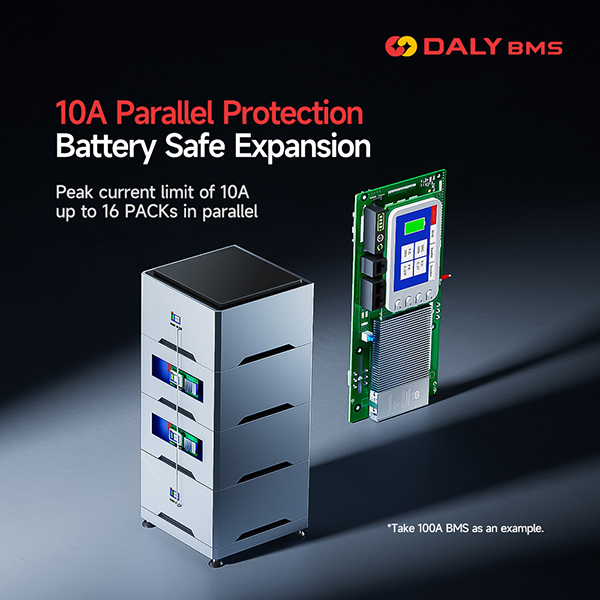
- Parallel current limiting: Peak 10A on both models, with continuous limiting of 2A on the LK and 3A on the LM for multi-pack parallel setups.
These specifications indicate that DALY designed the LM BMS for higher-throughput parallel battery-pack applications, while the LK BMS targets more compact single or lightly paralleled installations.
Communication Architecture for Inverter Integration
A defining feature of the DALY home energy storage BMS line is its communication structure, which separates mainboard and interface board functions:
- Mainboard communication: Two UART ports.
- Interface board communication: CAN and RS485.
This separation allows the BMS to handle both direct device-level communication and broader inverter-facing protocols. DALY’s RS485 protocol compatibility list includes inverter brands such as Voltronic Power, Growatt, Sacolar, SRNE, Pylon, and Deye, while the CAN protocol list covers Sacolar, Growatt, Victron, GoodWe, Solark, Xtender, SMA, Aiswei, Deye, SOFAR, and MUST. DALY states that these listed protocols have undergone parallel PACK testing and joint debugging, but this applies specifically to the combinations covered by the supplied material and should not be interpreted as universal compatibility with every inverter model. Compatibility ultimately depends on the specific inverter model, communication protocol, firmware, and configuration, so buyers are advised to confirm the exact inverter model and communication requirements before purchase or integration.
Optional Functions and Supported Interfaces
Beyond the core balancing and communication specifications, DALY’s home energy storage BMS line offers a set of optional functions and accessories, including Bluetooth, Wi-Fi, a heating module, dry contact, key switch, RS485, and CAN. Supported functions across the platform include UART, APP, PC, and IoT connectivity. DALY notes that the exact availability of each option depends on the selected model and configuration, so order-specific confirmation with DALY is recommended before finalizing a purchase.
Customization and OEM/ODM Capability
For integrators who need a tailored solution — potentially explaining naming variations like "R16LS-A" that circulate in the market — DALY’s service scope covers several customization dimensions:
- Current specifications
- Communication protocols
- Hardware and structural design
- Software functions
- Brand logo customization
- OEM/ODM services
The pre-sale process requires customers to provide details such as battery chemistry, number of cells in series, required continuous charge/discharge current, inverter brand and exact model, required communication protocol, parallel battery-pack requirements, desired optional functions, and any hardware, structural, software, or branding customization needs. DALY then confirms the final model, configuration, and inverter communication compatibility before order placement. Each customization request undergoes confirmation of feasibility, technical parameters, development scope, and lead time.
DALY also states that it can provide documentation to support customer certification projects. It is important to note that the provision of such documentation does not state or imply that the LK or LM BMS has obtained any specific certification or approval — this distinction matters for buyers who require certified components for regulatory compliance.
Choosing Between LK and LM for a Home Energy Storage Project
For integrators comparing the DALY home energy storage BMS lineup, the decision largely comes down to current demand and parallel configuration needs. The LK BMS fits projects requiring up to 100A continuous current with simpler balancing needs, while the LM BMS suits higher-capacity systems up to 200A continuous current with stronger parallel current limiting. Both share the same 8S/16S series support, dual-chemistry compatibility, UART mainboard communication, and CAN/RS485 interface board communication, making the choice primarily a matter of current rating and balancing requirements rather than a difference in core architecture.
Because model naming in the market can vary — as reflected in the "R16LS-A" search term — buyers are encouraged to confirm the precise model designation and its corresponding specifications directly through DALY’s pre-sale technical confirmation process before committing to a configuration for their home energy storage project.
https://www.dalybms.com/
DALY BMS