
 admin
Understanding the Role of Inductive Proximity Sensors in Steel Operations
Steel and metallurgy facilities operate under conditions that few other industries face: sustained high temperatures, heavy vibration, airborne particulates, and continuous mechanical cycling. Detecting the position, presence, or count of metal components in these environments requires sensing technology that can withstand extreme operating conditions while delivering consistent, wear-free performance over long production runs. This is precisely the operational context in which inductive proximity sensors from KJT Sensors are designed to perform.
How Inductive Sensing Works
Inductive proximity sensors rely on electromagnetic induction. The sensing face generates an alternating electromagnetic field; when a metal target enters that field, it induces eddy currents that change the sensor’s oscillation. This change is converted into a switching output. Because the detection process involves no physical contact between the sensor and the target, the technology eliminates the wear associated with mechanical switches and supports high switching frequency with high detection accuracy. For steel environments where equipment runs continuously and switching cycles are frequent, this non-contact, wear-free operation directly reduces maintenance-related downtime.
Core Detection Capabilities
Inductive proximity sensors from KJT Sensors are built to address several core industrial detection needs that are directly relevant to steel production lines and metallurgical processing:
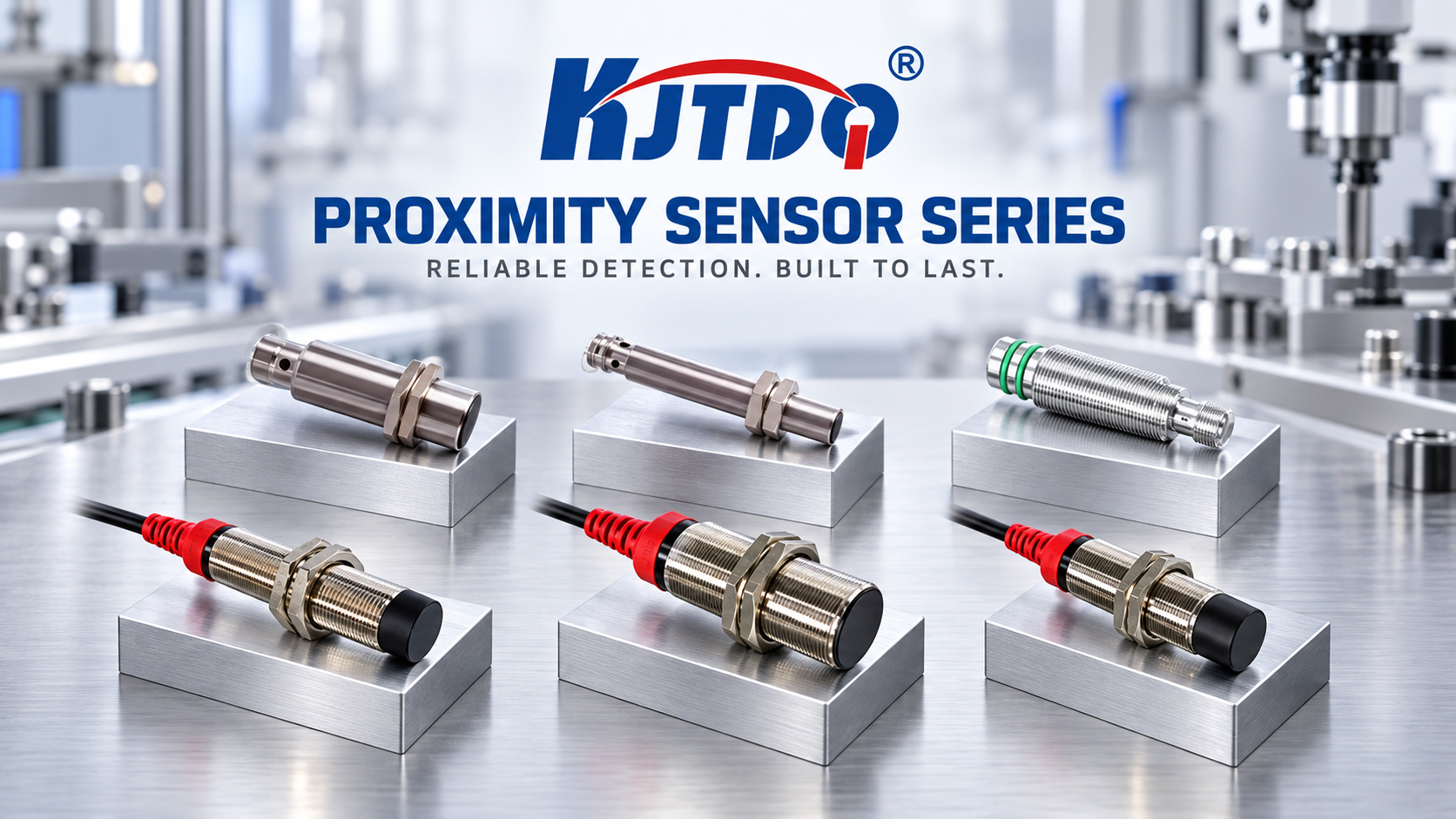
- Metal-target non-contact detection: The sensor detects whether a metal object enters the sensing field and converts that state into a switching signal, avoiding physical contact and mechanical wear.
- Position and presence detection: The sensors determine equipment location, in-position status, and motion status, supporting automated production-line and equipment-position control—an essential function on steel processing lines where precise positioning of rollers, plates, or fixtures is required.
- Limit detection and end-of-travel protection: These sensors provide limit control and end-of-travel protection signals, preventing over-travel and protecting mechanical systems from damage caused by excessive movement.
- Counting and state monitoring: The sensors count metal workpieces and monitor equipment status, enabling production counting and process monitoring without the need for additional contact devices.
- High switching frequency: Frequent switching operations are supported, making the sensors suitable for continuous production and high-cycle applications typical of steel processing lines.
Addressing the Specific Pain Points of Steel and Metallurgy
The steel and metallurgy sector presents a distinct set of challenges that general-purpose sensors are not built to handle. General-purpose sensors cannot withstand high-temperature or explosion-hazardous environments, and corrosive conditions can shorten service life considerably. KJT Sensors addresses these constraints through a dedicated product-variant strategy rather than a single universal design.
For high-temperature process detection—one of the explicitly identified industry applications for steel and metallurgy—KJT Sensors offers a high-temperature series within its inductive proximity sensor line. This variant is part of a broader set of operating-condition adaptations that also includes high-pressure, corrosion-resistant, weld-spatter-resistant, explosion-proof, and wireless options. Each variant is intended to allow continued use in standard automation settings as well as extreme operating conditions without compromising detection reliability.
Weld-spatter-resistant and corrosion-resistant variants are particularly relevant where welding operations or corrosive byproducts are present in and around steel processing equipment. These variants are built specifically to extend service life in conditions that would otherwise degrade standard sensors prematurely.
Installation Flexibility for Complex Equipment Layouts
Limited installation space is a common complication in sensor placement, particularly on steel production machinery where equipment layouts are often dense and mechanically constrained. KJT Sensors’ inductive proximity sensors support multiple mounting formats, including flush and non-flush mounting, along with cylindrical, rectangular, and ring designs. Ultra-small and remote variants further extend the range of installation scenarios that can be accommodated, allowing sensors to be fitted into confined or specialized machine layouts without redesigning surrounding equipment.
Control-System Compatibility
Correct integration with existing control infrastructure is another frequent challenge; incorrect PNP/NPN or two-/three-wire selection can cause integration failures on the plant floor. KJT Sensors’ inductive proximity sensors support NPN or PNP output, two- or three-wire configurations, and normally open or normally closed settings, along with AC/DC options. This range of configurations allows the sensors to connect directly to PLCs, relays, control cabinets, or automated machines, matching the input type and field wiring already present in a given facility.
Product Variant Range
Beyond the high-temperature and corrosion-resistant series already discussed, KJT Sensors maintains a broad inductive sensor variant range that includes standard, remote, sanitary, high-pressure, analog output, explosion-proof, full-metal, ultra-small, intrinsically safe NAMUR, ring-type, square, distance, wireless, and correction factor = 1 series. This breadth of variants supports selection for specific installation and operating conditions, meaning that facilities do not need to compromise on detection performance when operating conditions deviate from standard industrial environments.
Common Questions in Steel-Industry Sensor Selection
Facilities evaluating inductive proximity sensors for steel operations often raise a consistent set of questions. Regarding detection scope, inductive proximity sensors primarily detect metal targets for in-position detection, position detection, counting, and limit detection—functions directly applicable to steel workpiece handling and process-line monitoring. On the question of whether a standard proximity switch can be used at high temperatures, the answer is no; a high-temperature series should be selected instead. Sensor selection should also account for PNP or NPN output type based on the PLC input type and field wiring, as well as two- or three-wire configuration based on the power supply, control system, and existing equipment wiring.
Delivery and Quotation Considerations
As physical sensor products, KJT Sensors’ inductive proximity sensors are quoted and supplied according to the selected series, housing size, sensing distance, mounting/output configuration, cable/connector type, protection rating, and customization requirements. Standard models can typically be quoted quickly once the model and quantity are known. For special-environment applications—such as high-temperature steel processing—or for import-substitution and non-standard designs, a technical review of site conditions, original model specifications, mounting arrangement, and control-system interface is conducted before a quotation is issued, ensuring that the selected sensor variant matches the actual operating environment.
Conclusion
For steel and metallurgy applications where high-temperature process detection, continuous switching, and mechanical durability are central concerns, inductive proximity sensors built around electromagnetic induction technology provide a non-contact, wear-reducing detection method. KJT Sensors, operating under the Nanjing KJT Electric Co., Ltd. umbrella, structures its inductive proximity sensor line around dedicated operating-condition variants, flexible mounting formats, and broad control-system compatibility, positioning the product line as a practical fit for the specific demands of high-temperature steel processing environments.
https://www.kjt-sensors.com/
KJT Sensors