
 admin
Section 1: The Growing Demand for Point-of-Care Diagnostics in Primary Care
General practice clinics face mounting pressure to deliver timely diagnostic results without the infrastructure of central laboratories. Traditional fluorescence immunoassay (FIA) testing has long been constrained by laboratory-bound instruments, large sample volume requirements, prolonged turnaround times, and elevated operational costs. For general practitioners, these barriers translate directly into delayed clinical decisions, patient inconvenience, and referral bottlenecks.
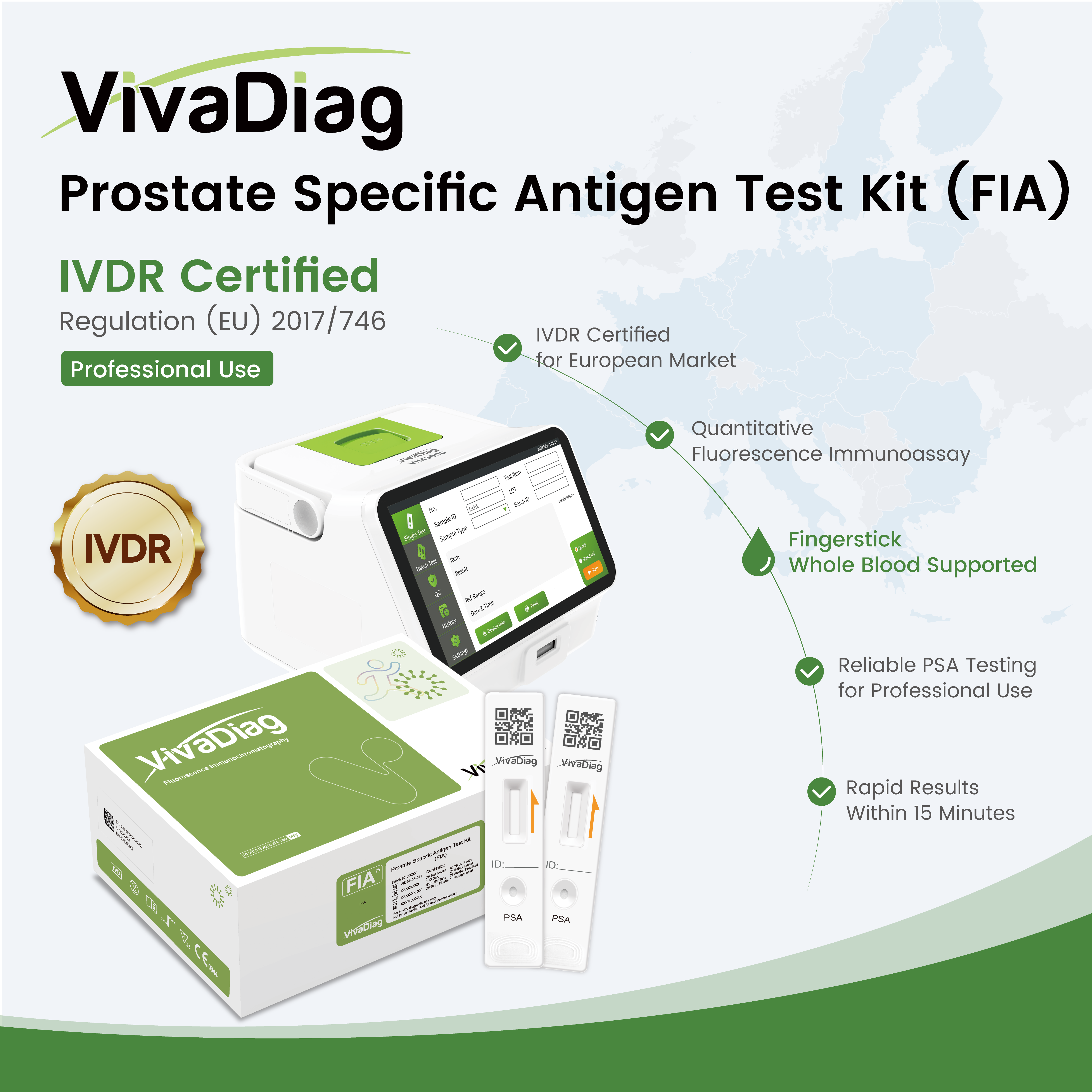
Simultaneously, aging populations across Europe are increasing the burden on primary care systems. Conditions such as prostate cancer—the second most common cancer in men globally, with approximately 1.47 million new cases and about 400,000 deaths worldwide in 2022—demand accessible, early-stage screening tools. Early prostate cancer often presents with few or no symptoms, making routine quantitative assessment a critical component of proactive patient management.
Against this backdrop, the portable FIA analyzer has emerged as a practical solution for GP clinics seeking laboratory-quality quantitative results at the point of care. Understanding what to look for when selecting such a system is essential for clinic administrators, procurement officers, and healthcare professionals making purchasing decisions.
Section 2: Key Evaluation Criteria for Portable FIA Analyzers
Portability and Form Factor
The defining characteristic of a point-of-care analyzer is its ability to function outside the central laboratory. For GP clinics, this means evaluating weight, size, and battery performance as primary criteria. A device that requires a fixed power source or frequent recharging interrupts clinical workflows.
The VivaDiag Portable FIA Analyzer VIM300H, developed by VivaChek Biotech (Hangzhou) Co., Ltd., offers a 370 g handheld unit measuring 146 × 77.6 × 55.5 mm, with a removable and rechargeable lithium battery rated for up to 10 hours of continuous operation. For a GP clinic running standard shift hours, this runtime eliminates charging interruptions during patient-facing periods.
Test Menu Breadth
A purchasing decision for a single-parameter analyzer may limit long-term utility. Clinics should assess whether the analyzer supports a broad diagnostic menu. The VIM300H supports 39 venous-blood parameters and more than 20 capillary-blood-ready parameters, accommodating a wide range of clinical scenarios from inflammatory markers to tumor indicators.
Sample Volume and Sample Type Flexibility
Minimizing patient burden is a consistent priority in primary care. Analyzers that require venipuncture-only workflows or large sample volumes create friction for routine screening. The VivaDiag PSA Test Kit, designed for use with the VIM300H, requires only 20 μL of sample—compatible with fingerstick whole blood, serum, or plasma—allowing clinics to perform PSA assessments without venipuncture.
Result Turnaround Time
For GP clinics, 15-minute quantitative results represent a clinically meaningful threshold. At this speed, healthcare professionals can review results and initiate a care pathway within a single patient appointment, avoiding the delays associated with sending samples to external laboratories.
Regulatory Compliance
For clinics operating in European markets, the regulatory status of the analyzer and associated test kits is non-negotiable. Procurement teams should verify that devices carry CE marking under the EU In Vitro Diagnostic Regulation (EU) 2017/746 (IVDR), issued through a recognized Notified Body. The VivaDiag PSA Test Kit is IVDR-certified for professional use, bearing CE marking with Notified Body Identification Number 0344 (DEKRA), meeting current European in vitro diagnostic requirements.
Data Management and Connectivity
Modern GP clinics increasingly integrate diagnostic data into electronic health record systems. An analyzer’s connectivity options—USB, Wi-Fi, Bluetooth—and onboard memory capacity directly affect administrative efficiency. The VIM300H stores up to 10,000 results and supports USB, Wi-Fi, and optional Bluetooth connectivity, enabling flexible data transfer across clinic management systems.
Section 3: Trends Shaping Point-of-Care Diagnostics in General Practice
Three converging trends are reshaping how GP clinics evaluate diagnostic equipment investments.
First, regulatory tightening under IVDR is raising the bar for market access in Europe. Devices that were previously CE-marked under the older IVD Directive now require re-certification under stricter IVDR standards. Clinics procuring new analyzers should prioritize systems already certified under IVDR to avoid mid-lifecycle compliance disruptions.
Second, capillary blood testing is gaining traction as a patient-friendly alternative to venipuncture. As more assays are validated for fingerstick whole blood, the diagnostic menu available to GP clinics through capillary sampling continues to expand. The VIM300H’s support for more than 20 capillary-blood-ready parameters reflects this trajectory.
Third, decentralized diagnostics are increasingly central to health system strategy. Governments and health systems across Europe are investing in primary care infrastructure to reduce pressure on hospital emergency departments. Portable, quantitative analyzers that deliver reliable results in community settings directly support this policy direction, reinforcing the clinical and procurement rationale for IVDR-compliant point-of-care systems.
Section 4: How VivaChek Biotech Positions Its Technology for Primary Care
VivaChek Biotech (Hangzhou) Co., Ltd. has built its diagnostic platform around fluorescence immunochromatography technology, applying it across a system that pairs portable analyzers with disposable test kits. The company’s ID Card coding system ensures parameter-specific calibration without requiring manual input, reducing operator error in busy clinic environments.
The VIM300H represents the current generation of this platform. Its 3.97-inch color touchscreen streamlines the testing workflow, reducing training requirements for clinical staff. The optional external Bluetooth printer and charging station accessories extend its utility across different clinic configurations.
The VivaDiag PSA Test Kit offers a whole blood measuring range of 0.37–100 ng/mL and intermediate precision CVs of 4.97% at low concentration, 4.05% at medium concentration, and 4.69% at high concentration—performance metrics relevant to clinical laboratories evaluating assay reliability. The kit’s 25-device-per-unit packaging and inclusion of pre-measured 20 μL and 75 μL pipettes support standardized workflows with minimal preparation overhead.
VivaChek’s EU Quality Management System Certificate is issued under Regulation (EU) 2017/746, Annex IX, Chapter I and III, providing an auditable compliance framework that supports procurement documentation requirements in regulated healthcare settings.
Section 5: Recommendations for GP Clinic Procurement Decisions
Selecting a portable FIA analyzer for a GP clinic requires balancing immediate clinical utility against long-term regulatory and operational considerations.
Procurement teams should verify IVDR certification status before engaging suppliers, particularly in European markets where older IVD Directive approvals are being phased out. Battery runtime and form factor should be evaluated against clinic shift patterns and physical environment—a 10-hour runtime is a meaningful operational advantage for clinics running extended hours.
Test menu breadth matters beyond the initial indication. A platform supporting both venous-blood and capillary-blood parameters provides forward compatibility as clinic diagnostic needs evolve. Connectivity features should be assessed against existing clinic IT infrastructure to ensure seamless data integration.
Finally, assay-specific performance metrics—including measuring range, sample volume requirements, and precision data—should be reviewed in the context of the specific patient populations a clinic serves. For clinics incorporating prostate health assessment into routine care, the combination of a 20 μL fingerstick-compatible sample volume and a 15-minute quantitative result represents a practical and clinically relevant configuration.
As the point-of-care diagnostics market continues to evolve, clinics that invest in IVDR-compliant, flexible, and connectivity-enabled systems will be better positioned to meet both current patient needs and future regulatory expectations.
https://www.vivachek.com
Hangzhou Weice Biotech Co., Ltd.