
 admin
For beverage plant engineers and liquid packaging line investors, selecting end-of-line palletizing equipment is a decisive engineering milestone when planning a production line in the 10,000 to 24,000 bottles-per-hour (BPH) range. At this throughput level, operations typically handle bottled water, carbonated soft drinks, fruit juice, edible oil, or dairy products moving from filling monoblocks through labeling, shrink film wrapping, or wrap-around case packing. The automated palletizer at the end of the line must match line cycle times without inducing back-pressure jams or compromising pallet load stability.
Zhangjiagang Grandee Machinery Co., Ltd., manufacturing under the brand name Grandee Machine, engineers complete liquid bottling plants across capacities from 2,000 to 36,000 BPH. In production plant design, end-of-line palletizing is not an isolated mechanical station; it dictates whether upstream high-speed filling lines sustain continuous output without packaging bottlenecks.
This technical guide examines the operational mechanics, footprint geometry, layer-forming speeds, and line integration requirements of Cartesian gantry palletizers versus high-level inline palletizers across the 10,000 to 24,000 BPH throughput band.
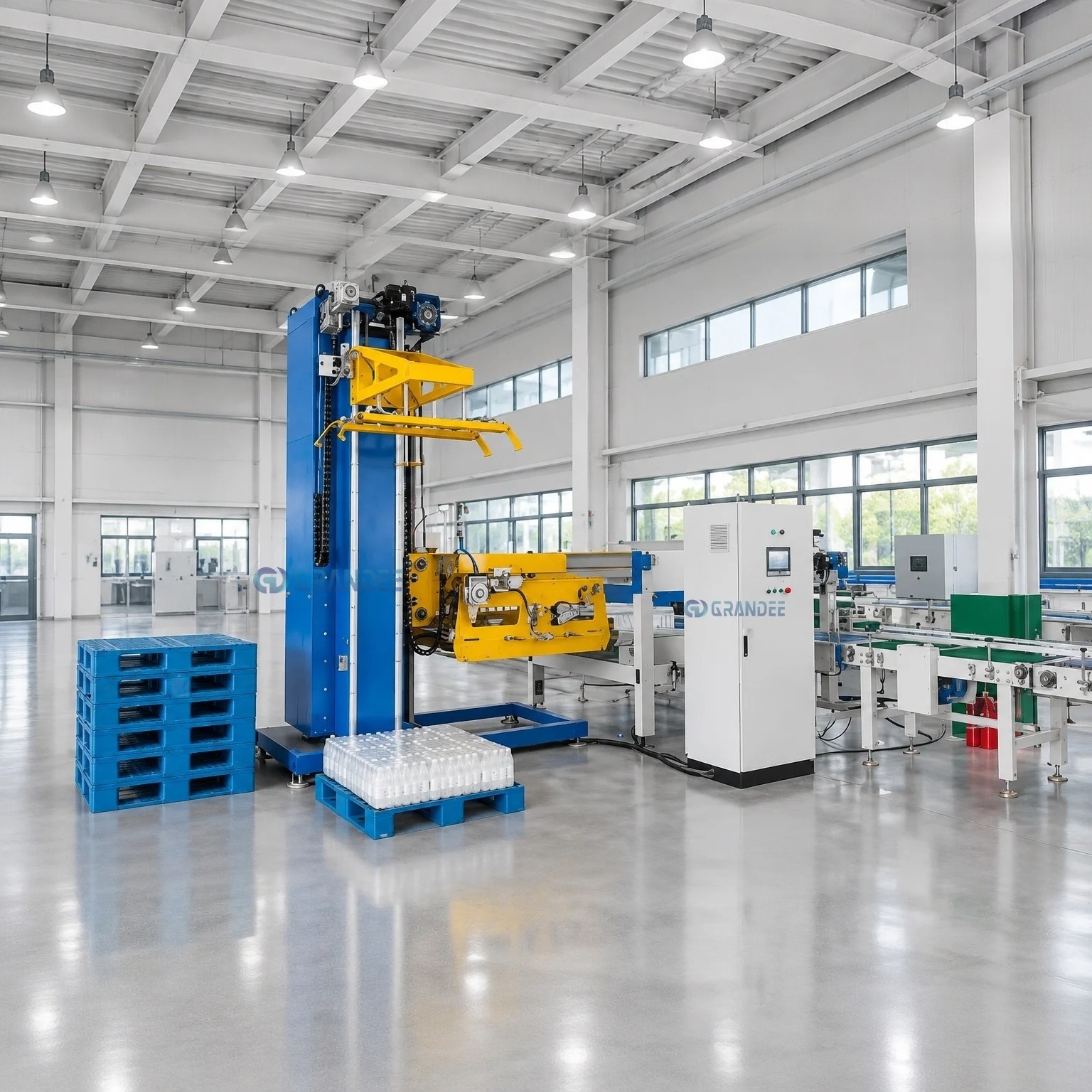
Understanding the Two Common Palletizer Configurations
In high-speed liquid packaging facilities, two mechanical architectures dominate end-of-line automation:
- Cartesian Gantry (Robotic Pick-and-Place) Palletizers: An overhead structural frame housing precision linear servomotors operating across X-Y-Z axes. A tooling gripper (mechanical clamping, bottom-support fork, or vacuum array) picks single cases, rows, or full tiers from an infeed station and positions them onto a pallet at floor level. Gantry systems offer exceptional format flexibility, accommodating multi-line infeeds, varied carton footprints, and quick tooling changeovers within a compact floor area.
- High-Level Inline (Sweep/Slide-Plate) Palletizers: Cartons or film multi-packs are elevated via inclined or spiral conveyors to an overhead metering deck (typically 2.4 to 3.2 meters above finished floor level). High-speed turning belts and pneumatic pushers orient the packs into complete layer patterns. A mechanical sweep arm slides the entire pre-collated layer onto an apron plate, which opens to deposit the tier onto the pallet beneath. As each layer deposits, a heavy-duty vertical hoist lowers the pallet by one tier height until the full stack (typically 5 to 7 layers) is completed.
Engineering Comparison: Cartesian Gantry vs. High-Level Inline Palletizer
The table below summarizes the operational and technical differences between Cartesian gantry and high-level inline palletizers in the 10,000 to 24,000 BPH operating band:
| Engineering Parameter | Cartesian Gantry Palletizer | High-Level Inline Palletizer |
|---|---|---|
| Layer-Forming Speed | 2.0–4.0 cycles/min (approx. 15–25 packs/min); ideal for 10,000–15,000 BPH lines or multi-gripper row picks. | 3.5–6.0 layers/min (approx. 35–65 packs/min); effortlessly matches 18,000–24,000+ BPH continuous flows. |
| Floor Footprint & Elevation | Compact floor area (approx. 18–28 m²); requires 3.8–4.2 m overhead truss clearance. | Larger linear footprint (approx. 35–55 m² incl. infeed incline); requires 4.5–5.2 m clear hook height. |
| Infeed Elevation | Floor level (approx. 950±50 mm or 1,050±50 mm); connects directly to case packers without elevation bridges. | Elevated infeed (2,400–3,200 mm); requires inclined slat conveyors or vertical spiral elevators. |
| Secondary Pack Compatibility | Handles corrugated wrap-around cartons, RSC boxes, and rigid plastic crates via adaptive mechanical/vacuum grippers. | Exceptional for both wrap-around cartons and shrink-wrapped multi-packs (PE film packs glide smoothly across apron plates). |
| Multi-Line Handling Capability | Can span 2 parallel packing lines simultaneously using dual-pallet staging bays. | Dedicated to single high-speed line flow; routing dual infeeds requires complex overhead diverters. |
| Pallet Load Stacking Capacity | Standard pallet payloads up to 1,500 kg per pallet; cycle time throttles slightly with heavier tiers. | Heavy-duty hydraulic/servo hoists handle payloads up to 2,000–2,400 kg per pallet without speed loss. |
Throughput Matching: Converting BPH to Case Palletizing Rates
Evaluating palletizer capacity requires translating upstream liquid filling speed into case and layer delivery rates. The required palletizing cycle rate depends on bottle volume and secondary pack configuration:
Packs per Minute = Upstream Line Speed (BPH) ÷ (Bottles per Pack × 60)
Layers per Minute = Packs per Minute ÷ Packs per Pallet Layer
Consider standard bottled water and carbonated beverage production scenarios at 12,000 BPH and 24,000 BPH:
- 12,000 BPH Line (500 ml PET, 4×6 Pack / 24 bottles per case): Produces 12,000 ÷ 24 ÷ 60 = 8.33 cases/min. With a standard 1,200 × 1,000 mm industrial pallet pattern of 5 cases per layer, the palletizer handles 1.67 layers/min. Both a Cartesian gantry unit and a high-level inline machine easily manage this rate, making gantry systems advantageous for floor space optimization.
- 24,000 BPH Line (500 ml PET, 3×4 Pack / 12 bottles per case): Produces 24,000 ÷ 12 ÷ 60 = 33.3 cases/min. With 10 cases per pallet layer, the palletizer must deposit 3.33 layers/min. At this throughput, a single Cartesian pick-and-place head approaches mechanical speed limits, whereas a high-level inline sweep palletizer operates comfortably within its nominal capacity band (3.5–6.0 layers/min).
Why Line-Level Synchronization Dictates Palletizing Performance
A palletizer does not operate as an isolated machine; its operational uptime is governed by line synchronization with upstream case packers and shrink wrappers:
- Infeed Conveyor Buffering: If a palletizer stops for 45 seconds during empty pallet magazine restocking or full pallet discharge, upstream packaging must not halt. Automated line integration incorporates 2 to 3 minutes of accumulation roller conveyors between the case packer and palletizer infeed.
- Pack Geometry and Layer Interlocking: Consistent layer patterns require uniform case dimensions (±1.5 mm). Wrap-around cases formed with hot melt glue provide rigid right angles that align flush against orientation stops. Loose tape flaps or uneven cartons cause misaligned layer patterns that trigger protective photo-eye interlocks.
- Integrated Pallet Staging and Stretch Wrapping: A complete palletizing station integrates an automated empty pallet dispenser (holding 10–15 pallets), slip-sheet/tier-sheet inserters, and downstream motorized roller conveyors transferring finished loads directly into an automatic rotary arm or turntable stretch wrapping unit.
Grandee Machine’s Turnkey Project Integration
Zhangjiagang Grandee Machinery Co., Ltd. incorporates industrial palletizing systems as part of its complete liquid packaging lines under the Grandee Machine brand. Across filling line capacities from 2,000 to 36,000 BPH, Grandee Machine coordinates equipment interfaces spanning water treatment, bottle blowing, rotary rinsing-filling-capping, labeling, secondary packaging, and palletizing under unified line engineering.
During facility layout engineering, Grandee Machine supplies full 3D CAD modeling, verifying building column spacing, forklift turning corridors (2.8–3.2 m), and clear hook heights before machinery placement. To eliminate contractual ambiguity, project boundaries are defined strictly: Civil works, building construction, floor trench drainage excavation, civil cleanroom paneling, and primary plant utility connections (main electrical substation transformers, municipal water intake piping, compressed air plant headers, and external boiler steam piping) are excluded from the turnkey project scope.
Frequently Asked Questions
A: When line throughput exceeds 8,000 to 10,000 BPH (equivalent to 15–25 cases/min), manual palletizing requires 3 to 4 operators per shift, creating fatigue, pallet stack instability, and safety risks. Automated palletizing becomes essential to sustain line continuity and ensure uniform stacking up to 2.0 meters high.
A: Yes. Modern high-level inline palletizers feature low-friction plastic modular belts and polished stainless steel sweep plates designed specifically for film-only multi-packs. The continuous apron plate supports the bottom of the film packs during layer deposition, preventing film snagging or pack deformation.
A: High-level inline palletizers require a clear building ceiling height of at least 4.5 to 5.2 meters to accommodate the elevated infeed metering deck (2.4–3.2 m) and top hoist motor frames. Gantry palletizers operate under lower clearances, requiring 3.8 to 4.2 meters.
A: Both gantry and high-level palletizers can incorporate an automatic tier-sheet inserter. A vacuum suction frame picks corrugated or plastic slip sheets from a side magazine and places them onto completed layers to increase vertical column stability before stretch wrapping.
A: Automated palletizers handle standard industrial pallet footprints, including EUR-pallets (1,200 × 800 mm), standard export pallets (1,200 × 1,000 mm), and US GMA pallets (48 × 40 inches / 1,219 × 1,016 mm). Adjustable layer-forming guides allow rapid changeover between pallet specifications.
About Grandee Machine
Zhangjiagang Grandee Machinery Co., Ltd. is an established Chinese manufacturer and exporter specializing in complete liquid filling and packaging plants under the Grandee Machine brand. Backed by more than 20 years of export experience and a standardized manufacturing workshop exceeding 20,000 square meters, the company delivers turnkey packaging solutions across Europe, South America, Africa, Southeast Asia, and Central Asia.
Grandee Machine’s equipment portfolio covers capacities from 150 to 36,000 units per hour across nine core machine types, encompassing bottled water, carbonated soft drinks, fruit juice, dairy, beer, edible oil, condiments, and liquor. Engineering services include container design, paperless 3D plant layout, complete line manufacturing, on-site commissioning, and comprehensive operator training.
Next Step
To evaluate palletizing automation for your bottling line, prepare your primary packaging parameters:
- Container and secondary pack specifications: Bottle dimensions, case type (shrink wrap, wrap-around carton, or RSC box), pack matrix (2×3, 3×4, or 4×6), and gross pack weight.
- Target production throughput in bottles per hour (BPH) and packs per minute.
- Pallet footprint dimensions (1,200 × 1,000 mm, 1,200 × 800 mm, or custom) and target stack height.
- Available warehouse ceiling height and floor layout constraints.
Submit your packaging data to Grandee Machine’s engineering team to receive integrated end-of-line layout drawings, cycle time simulations, and line synchronization proposals.
Related Reading
https://www.grandeemachine.com/
Zhangjiagang Grandee Machinery Co., Ltd.