
 admin
Industry Background and the Problem of Powering Cooling Garments Through a Full Shift
Industrial workers who spend full shifts in heat exposure face a recurring equipment problem: cooling garments that run out of power before the workday ends, or that are built around a single fixed voltage that does not match the shift length or site power rules. Fan-assisted cooling garments depend on batteries, and when the battery, the fan unit, and the controller come from different suppliers, performance can be inconsistent and difficult to verify. This is the gap that Southern Sparkle Wearable Technology Co., Ltd., operating under the brand ELEHEAT, addresses through a manufacturing model where the fan unit, controller, and battery pack are matched as one system within the same 12,000 m² plant in Dongguan, China, rather than sourced from three separate suppliers. ELEHEAT’s positioning as an industrial wearable brand rests on a simple industry pain point insight: workers on full shifts need cooling garments that address heat stress in different environments, and the power source behind that cooling has to be matched to the garment, not treated as an afterthought.
Authoritative Analysis: How Battery Voltage and Fan Control Work Together
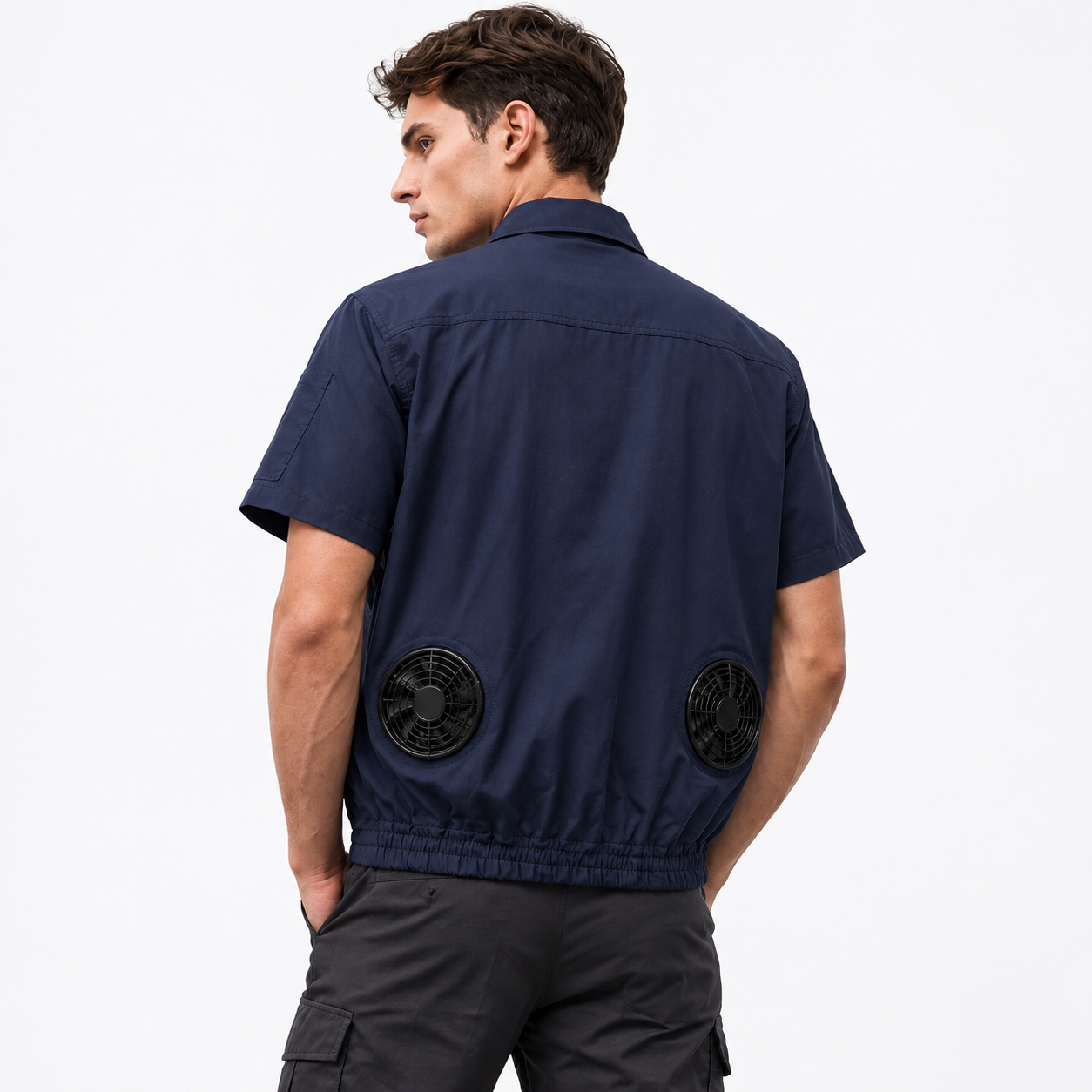
The necessity of a flexible battery range becomes clear once shift length and power conditions are factored in. ELEHEAT’s fan-assisted airflow cooling garments operate on a battery voltage range of 12 V to 50 V DC, with the standard configuration built around 12 V packs. On this standard 12 V configuration, runtime is quoted at 8 to 12 hours at low speed, and importantly, this runtime is quoted per battery, not per shift, meaning the actual duration a worker experiences depends on how the fan speed is set and how many batteries are carried.
The principle logic behind this system is straightforward: brushless fans mounted in the garment shell draw air from outside and push it across the torso and under the outer layer, accelerating sweat evaporation rather than refrigerating the air. Fan speed is set in steps on the controller, with the number of steps and airflow points forming part of the product specification. This step-based control allows the airflow to be matched to the work environment rather than running at a single fixed output. Because packs are sold separately as kits with the controller and fan unit, a crew can keep the same garment and change only the power side when the shift pattern changes, which is the practical mechanism behind the "higher voltage for longer or heavier-duty use" approach.
A standard reference point within this system is safety: intrinsically safe, explosion-proof battery modules are built for sites where powered equipment is restricted, extending the use of high voltage battery packs into regulated industrial environments. On the certification side, battery packs carry CE marking, and the Dongguan site operates under ISO 9001:2015 quality management, with RoHS and REACH documentation available on request. The solution path for a buyer evaluating battery-powered cooling therefore involves matching voltage and pack capacity to shift length, confirming airflow figures, and verifying that the battery has the appropriate explosion-proof rating for the site in question.
Deep Insights: Trends in Battery-Driven Cooling and the Limits Buyers Should Understand
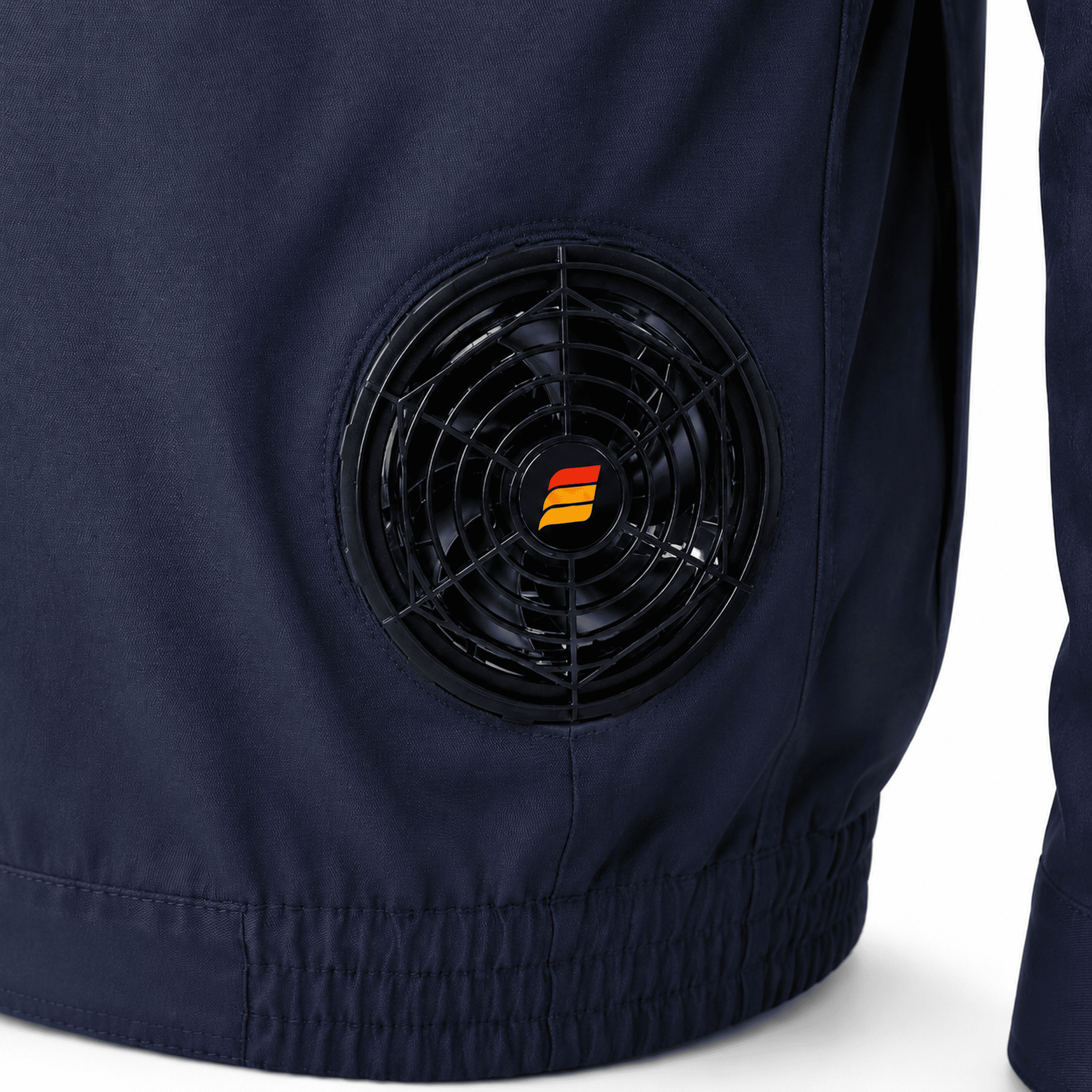
A meaningful trend in this category is the move away from fixed-voltage, single-supplier fan vests toward modular systems where battery capacity can be adjusted independently of the garment. ELEHEAT’s structure, with packs available across the 12 V to 50 V range sold as separate kits, reflects this direction: the garment itself (vest, waistcoat, short-sleeve shirt, long-sleeve shirt, or jacket) remains constant while the power source scales to the job.
A second trend concerns measurement credibility. Airflow figures in this category are often taken from supplier catalogue values rather than verified in-house, which creates uncertainty for buyers comparing products. ELEHEAT addresses this by measuring airflow on its own fan bench rather than relying on third-party catalogue data, and by balancing impellers and sealing fan housings in-house to reduce noise and vibration at the point of assembly rather than after the fact.
A risk that buyers in this category should be aware of is the mismatch between fan-assisted cooling and radiant heat environments. Moving air cannot remove radiant heat above roughly 45 °C at sources such as a furnace, an asphalt pour, or a welding cell, because moving air only circulates heat already present rather than lowering it. Similarly, humidity above about 60 percent cuts the cooling effect sharply, since sweat cannot evaporate into air that is already saturated. A fan-assisted garment is not an air conditioner, and selling this type of product into radiant heat conditions is described within the industry as a costly mismatch. This is why ELEHEAT offers five cooling routes rather than one: fan-assisted airflow, water circulation, PCM phase change, Peltier semiconductor, and evaporative cooling, allowing the cooling mechanism to be matched to the environment rather than applying a single technology to every situation.
Company Value: How ELEHEAT Supports Buyers Across the Battery-Powered Cooling Category
Southern Sparkle Wearable Technology Co., Ltd. builds its value proposition around integrated manufacturing rather than component assembly from outside suppliers. By producing the fan unit, controller, and battery pack in the same Dongguan plant, the company can offer harness slots on shoulder and side seams for garments worn with site harnesses, reflective shells cut for wear with hi-vis over-garments, and hi-vis shells with fan openings routed clear of reflective tape so the garment retains its visibility class. Washable shells, with pack and fan housings removed before washing and wash routines printed on the care label, support maintenance across models.
This manufacturing depth extends to service terms: minimum orders start at 50 sets for stock models and 200 sets for custom colour, logo, or fabric, with a single sample available for a fit and performance check. Samples are produced in 7 to 10 days, and bulk production follows in 25 to 35 days after sample approval. A 12-month warranty covers electrical parts, including battery packs and fan kits, though consumable parts such as tubing, filters, and ice packs are excluded.
Conclusion and Recommendations for Industrial Buyers
For organizations evaluating cooling garments for crews on full shifts, the central lesson is that battery voltage, runtime, and fan control are not secondary specifications but determine whether a garment performs through an entire shift. Buyers should confirm whether runtime figures are quoted per battery or per shift, whether airflow has been independently measured, and whether the cooling route selected matches the heat and humidity conditions at the worksite rather than assuming fan-assisted airflow is universally applicable. ELEHEAT’s structure, offering a 12 V to 50 V battery range alongside five distinct cooling routes manufactured within one plant, illustrates one approach to addressing these variables systematically rather than through mismatched, independently sourced components.
Southern Sparkle Wearable Technology Co.,Ltd.