
 admin
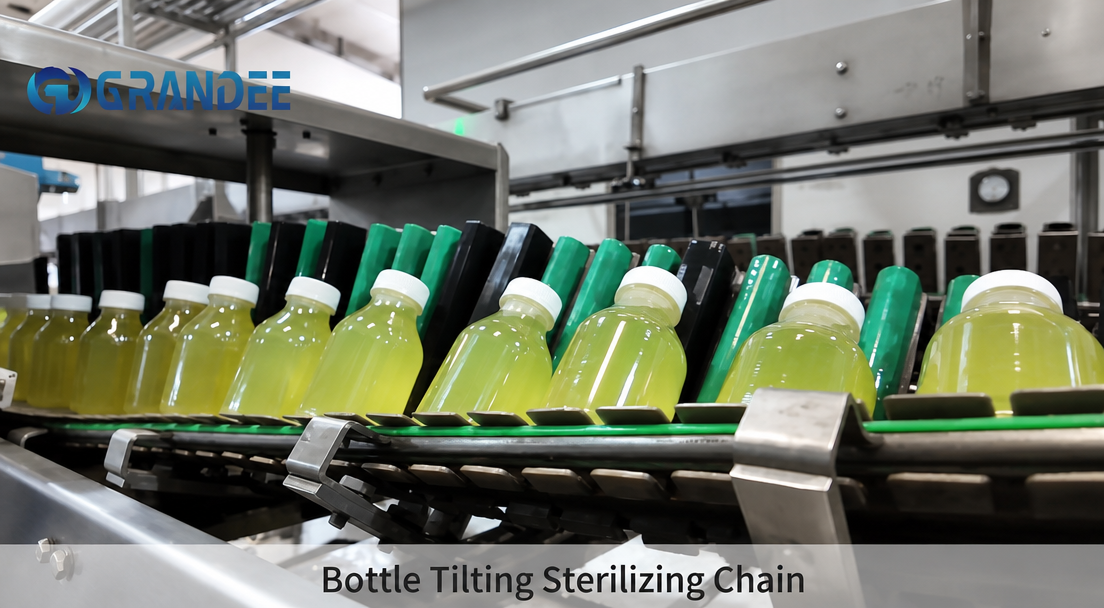
For fruit juice, tea, and functional beverage producers utilizing hot-fill packaging technology, thermal processing does not conclude at the capping station. While liquid pasteurization at 85°C to 88°C ensures commercial sterility inside the bottle body, container closures and the inner neck finish introduce severe re-contamination vulnerabilities. Caps entering capping carousels are handled dry and cannot be pre-sterilized via wet chemical rinses without introducing chemical residue risks. Consequently, eliminating mold spores and yeast along the cap liner, internal threads, and headspace air pocket relies entirely on thermal energy transfer from the hot liquid itself via an automated invert-bottle sterilizer (bottle tilter chain).
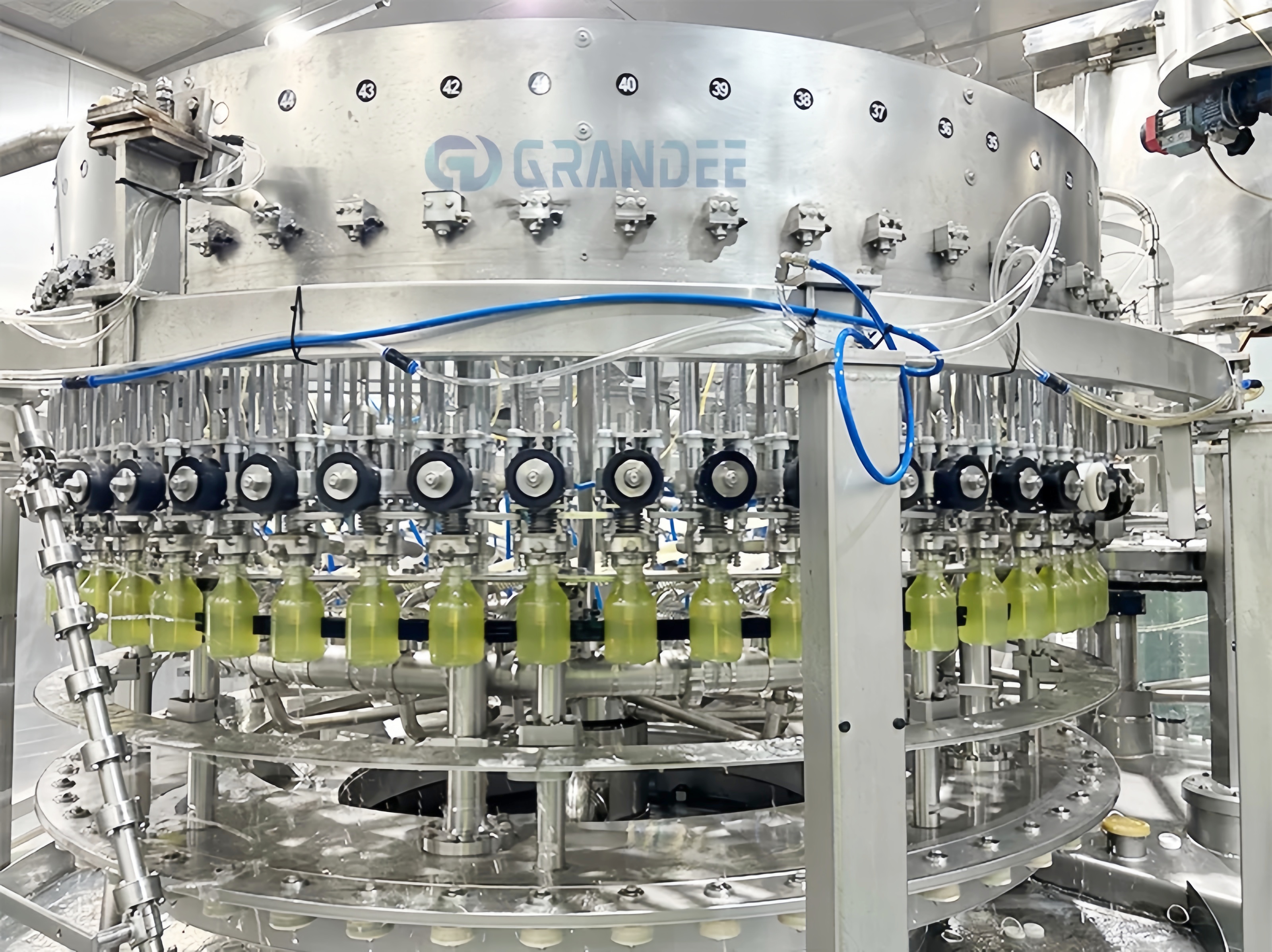
Zhangjiagang Grandee Machinery Co., Ltd., manufacturing under the brand name Grandee Machine, engineers complete liquid bottling plants across capacities from 2,000 to 36,000 BPH. In hot-fill production line integration, capping and cooling cannot be directly coupled; tilting angle geometry and dwell time synchronization represent the decisive mechanical bridge protecting microbiological shelf stability.
This technical guide examines the thermal lethality dynamics of cap sterilization, tilting chain angle physics (90° vs. 110°), dwell time calculations across 15 to 30 seconds, and downstream spray cooling synchronization.
Thermal Lethality Dynamics: Target Microorganisms and Temperature Baselines
Hot-filled high-acid beverages (pH ≤ 4.5, such as apple juice, orange juice, and acidified teas) target acid-tolerant vegetative bacteria, yeasts (e.g., Saccharomyces), and heat-resistant molds (such as Byssochlamys fulva and Neosartorya fischeri). Achieving commercial sterility requires delivering sufficient thermal lethality (Pasteurization Units, or PU):
- Filling Temperature Baseline: Liquid must enter containers at 85°C to 88°C. If filling temperature drops below 82°C due to line pauses, three-way pneumatic recycle valves automatically divert liquid back to the UHT tubular sterilizer balance tank.
- Closure Thermal Resistance: Mold ascospores trapped in dry cap thread crevices require sustained liquid contact above 80°C for a minimum of 15 seconds to achieve a 5-log microbial reduction.
- Headspace Thermal Mass: Headspace air volume acts as a thermal insulator. Tilting the bottle forces the hot liquid into the headspace, submerging the cap liner and displacing trapped air.
Tilting Angle Physics: 90° Horizontal vs. 110° Inverted Orientation
The mechanical core of an invert sterilizer is a dual-strand gripper chain or continuous rubber-padded flight lug mechanism that grips the bottle sidewalls and twists the container from an upright vertical orientation into an inverted posture:
| Engineering Parameter | 90° Horizontal Lay-Down Configuration | 110° Full Inversion Configuration |
|---|---|---|
| Cap Liner Liquid Contact | Partial contact; air bubble floats along the top sidewall, leaving 15%–25% of cap circumference dry if headspace is large. | Complete submersion; air pocket rises to the bottle base, ensuring 100% cap liner and thread immersion. |
| Headspace Air Location | Trapped along the horizontal upper shoulder; liquid sloshes during chain acceleration. | Trapped safely in the container base dome; zero air gap along the neck finish. |
| Mechanical Chain Stress | Lower twisting torque on gripper chain; simpler drive mechanics. | Requires precision guide rails and heavy-duty dual-drive motors to maintain synchronized inversion. |
| Container Suitability | Suitable for rigid glass bottles or heavy-walled PET bottles with minimal headspace (≤ 4%). | Industry standard for lightweight PET bottles, wide-mouth containers, and high-speed lines (≥ 8,000 BPH). |
Dwell Time Engineering: Calculating Chain Length for 15 to 30 Seconds
The dwell time—the duration the container remains tilted before being uprighted—is strictly governed by thermal transfer kinetics. Liquid entering the capper at 85°C loses 2°C to 3°C upon contacting ambient plastic cap material (HDPE/PP). To maintain cap interface temperatures above 80°C for the required 15-second lethality window, typical conveyor dwell periods range from 15 to 30 seconds depending on container format:
- Standard 500 ml PET Bottles: 15 to 20 seconds dwell time (sufficient for 28 mm PCO 1881 heat-resistant closures).
- Large Format (1.5 L – 2.0 L) or Wide-Mouth Bottles: 25 to 30 seconds dwell time (accommodates heavier cap liners and thicker bottle necks).
Conveyor length is calculated directly from line speed and target dwell duration:
Chain Length Formula: Effective Tilting Length (m) = [Line Speed (BPH) × Pitch (m) ÷ 3,600] × Dwell Time (s)
For example, on a 12,000 BPH line processing 500 ml bottles (bottle pitch 0.08 m) requiring a 20-second dwell time, the linear conveyor speed is 0.267 m/s, mandating an effective inverted chain length of 5.34 meters (excluding infeed tilting and outfeed uprighting twist sections).
Thermal Balancing: Interfacing with the Spray Cooling Tunnel
Invert sterilization must be decoupled from ambient room cooling. Allowing bottles to remain hot indefinitely causes thermal degradation of natural fruit aromas, vitamin C breakdown, and browning (Maillard reactions). Furthermore, prolonged internal heat softens PET container walls, causing structural collapse when cooling vacuum develops.
Immediately following uprighting from the invert chain, bottles enter a multi-stage continuous spray cooling tunnel (typically 15 to 25 meters in length):
- Zone 1 (Warm Water Spray, 65–70°C): Gentle thermal transition; washes beverage splashes from the bottle exterior without inducing thermal shock breakage on glass bottles.
- Zone 2 (Intermediate Spray, 45–50°C): Rapid sensible heat reduction; solidifies container structure.
- Zone 3 (Cooling Spray, 30–35°C): Drops container core temperature below pasteurization thresholds.
- Zone 4 (Final Chilled Spray, 20–25°C): Delivers bottles at room temperature, ready for high-velocity air-knife drying and downstream sleeve or roll-fed OPP labeling.
Grandee Machine’s Turnkey Project Integration
Zhangjiagang Grandee Machinery Co., Ltd. incorporates invert-bottle sterilizers as an integral engineering module in its complete hot-fill lines under the Grandee Machine brand. Spanning line capacities from 2,000 to 24,000 BPH across PET and glass formats, Grandee Machine coordinates juice processing skids, UHT tubular pasteurizers, 3-in-1 rotary monoblocks, invert sterilizers, spray cooling tunnels, and secondary packaging under unified line engineering.
During plant layout engineering, Grandee Machine supplies full 3D CAD modeling, verifying conveyor incline angles, drainage trenches, and exhaust vapor hoods. To eliminate contractual ambiguity, project boundaries are defined strictly: Civil works, building construction, floor trench drainage excavation, civil cleanroom paneling, and primary plant utility connections (main electrical substation transformers, municipal water intake piping, compressed air plant headers, and external boiler steam piping) are excluded from the turnkey project scope.
Frequently Asked Questions
A: While the juice is pasteurized upstream and bottles are hot-filled at 85–88°C, caps enter the capping machine in a dry, unheated state. Airborne mold spores and yeast can settle on cap liners and neck finish threads. Inverting the container forces hot liquid across the cap, using the product’s thermal mass to achieve complete closure sterilization without chemical disinfectants.
A: If dwell time is under 15 seconds, cap thread crevices fail to reach thermal lethality thresholds (>80°C), resulting in mold outgrowth during retail distribution. If dwell time exceeds 45–60 seconds, excess heat exposure degrades juice flavor and causes plastic cap liners to soften and lose seal integrity.
A: Wide-mouth containers (38 mm finish) and sports push-pull caps require a full 110° inversion angle. This ensures the larger internal air bubble floats completely upward into the bottle base, preventing air pockets from insulating the cap orifice.
A: Standard lightweight water bottles cannot withstand hot filling; they soften and deform above 65°C. Hot-fill lines require specialized heat-set PET bottles featuring crystallized neck finishes (opaque white appearance) and vacuum-absorbing structural side panels or base diaphragms that flex inward as liquid cools.
A: Automated invert chains incorporate automatic conveyor interlocks. If a downstream labeling or packaging unit pauses, upstream filling decelerates smoothly. If a line stoppage exceeds preset thresholds (typically 60 seconds), bottles on the invert chain are automatically uprighted or diverted to prevent cap thermal distortion.
About Grandee Machine
Zhangjiagang Grandee Machinery Co., Ltd. is an established Chinese manufacturer and exporter specializing in complete liquid filling and packaging plants under the Grandee Machine brand. Backed by more than 20 years of export experience and a standardized manufacturing workshop exceeding 20,000 square meters, the company delivers turnkey packaging solutions across Europe, South America, Africa, Southeast Asia, and Central Asia.
Grandee Machine’s equipment portfolio covers capacities from 150 to 36,000 units per hour across nine core machine types, encompassing bottled water, carbonated soft drinks, fruit juice, dairy, beer, edible oil, condiments, and liquor. Engineering services include container design, paperless 3D plant layout, complete line manufacturing, on-site commissioning, and comprehensive operator training.
Next Step
To evaluate a complete hot-fill juice packaging line and invert sterilizer sizing for your facility, prepare your operational parameters:
- Product characteristics: Juice type (clarified, cloudy, or with pulp), Brix level, and target filling temperature (85–88°C).
- Container specifications: Bottle material (PET or glass), volume (e.g., 250 ml, 500 ml, or 1 L), neck finish (28 mm or 38 mm), and cap drawing.
- Target line throughput in bottles per hour (BPH).
- Available factory floor dimensions (length, width, and clear ceiling height).
Submit your parameters to Grandee Machine’s engineering team to receive integrated thermodynamic dwell time calculations, conveyor footprint layouts, and complete 3D plant arrangement proposals.
Related Reading
https://www.grandeemachine.com/
Zhangjiagang Grandee Machinery Co., Ltd.