
 admin
Understanding the Need for Integrated DTTS in Quality Control
Power equipment manufacturers operating in today’s competitive landscape face a persistent challenge: ensuring distribution transformers meet rigorous quality standards before they leave the factory floor. This is where an Integrated Distribution Transformer Test System (DTTS) becomes a critical component of the manufacturing quality chain. Jiangsu VERXON (Shanghai) Electric Co., Ltd., operating under the VERXON brand, has positioned its DTTS product line specifically to address this need, offering a solution designed for routine and type testing of distribution transformers.
What Is an Integrated DTTS System?
An Integrated Distribution Transformer Test System combines multiple testing functions into a single, cohesive platform rather than requiring manufacturers to rely on disparate, standalone instruments. For equipment manufacturers, this integration translates into streamlined workflows during production quality checks, reducing the complexity typically associated with coordinating multiple separate test setups. VERXON’s DTTS is explicitly positioned for routine and type testing — the two foundational testing categories that distribution transformer manufacturers must perform to validate product conformity before shipment.
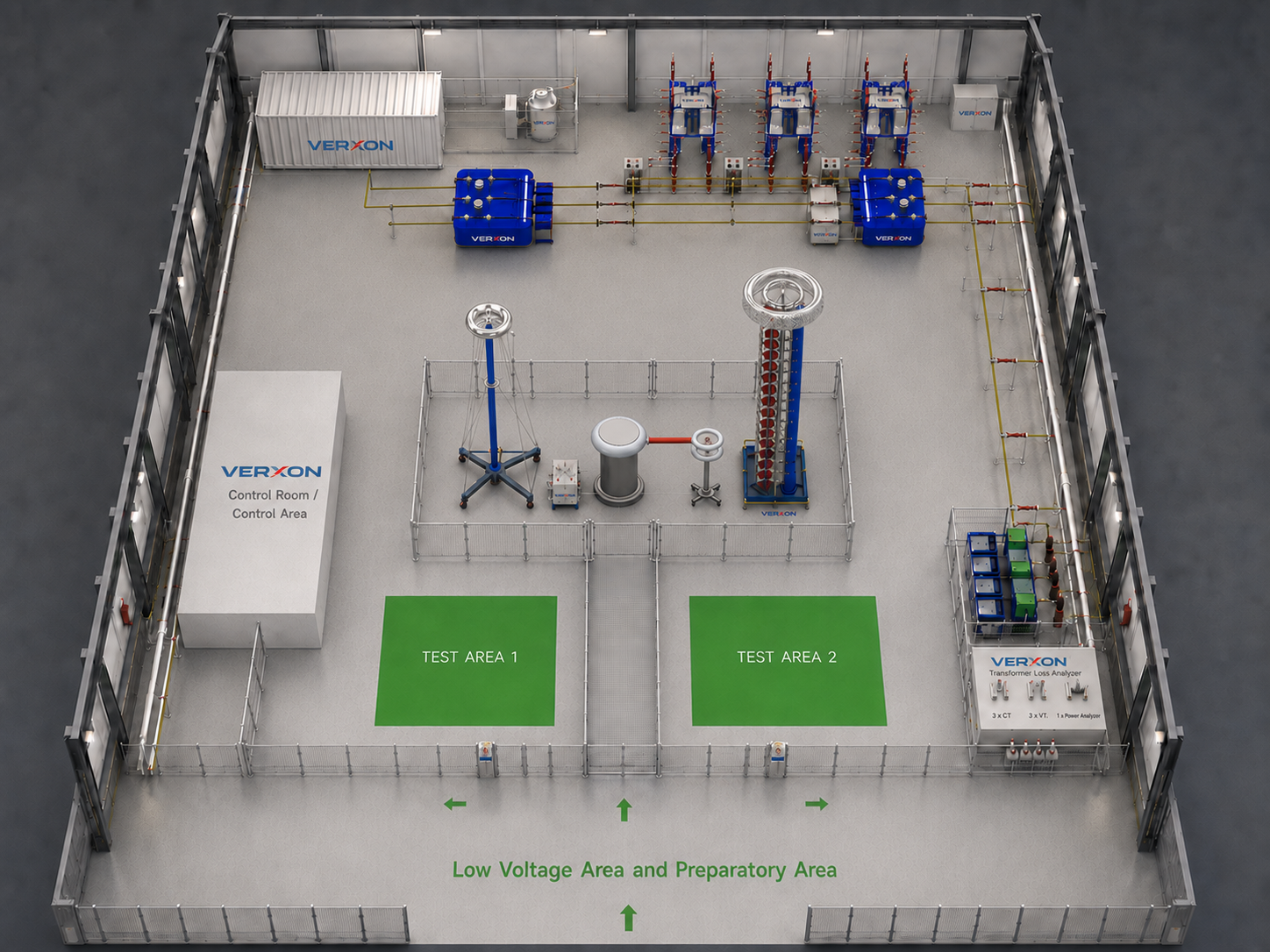
Why Quality Control Matters for Distribution Transformer Manufacturers
Distribution transformers are foundational components within power distribution networks, and any defect that escapes detection during manufacturing can lead to downstream reliability issues once equipment is deployed in the field. For manufacturers, the stakes of inadequate testing are twofold: reputational risk from field failures and the operational cost of recalls or warranty claims. This underscores why quality control processes embedded at the factory level — supported by dependable test systems — remain a non-negotiable part of responsible manufacturing practice.
VERXON’s broader industry insight reflects an understanding of adjacent pain points that affect the high-voltage testing ecosystem more broadly, including the high cost and logistical difficulty of transporting large power equipment to laboratories, measurement inaccuracies caused by power frequency interference, insulation failure risks from transient overvoltages, and safety risks to operators during high-voltage operations. While the DTTS product itself is positioned for factory-based routine and type testing, this contextual understanding of the wider testing environment informs the company’s overall approach to precision instrument development.
VERXON’s Position Within the Transformer Testing Portfolio
The DTTS (Distribution Transformer Test System) does not exist in isolation within VERXON’s product matrix. It sits alongside the PTTS (Power Transformer Test System) — which supports testing for transformers up to 1000kV/600MVA and complies with ANSI/IEEE C57.12.90 and IEC 76 — as well as DC resistance testers and turns ratio testers. Together, these four product lines form VERXON’s Transformer Testing category, which the company positions as providing integrated and portable testing systems for both power and distribution transformers.
This breadth matters for manufacturers evaluating testing infrastructure: a DC resistance tester addresses winding and connection resistance verification, a turns ratio tester supports transformer ratio quality control, and the DTTS itself handles the broader routine and type testing requirements. Manufacturers seeking a cohesive testing ecosystem — rather than piecing together equipment from multiple disconnected sources — may find value in a supplier whose transformer testing line is designed with this kind of internal coherence.
Industry Adaptation: Who Relies on DTTS Testing
VERXON identifies two primary industry adaptations for its DTTS product: power equipment manufacturers, who use the system for routine and type testing during production, and testing laboratories and research institutes, who apply it within scientific research and metrology contexts. This dual adaptation suggests the DTTS is engineered with enough flexibility to serve both a production-floor quality control function and a more research-oriented laboratory function — two environments with distinct operational demands but overlapping technical requirements.
Broader Technical Context: VERXON’s Capability System
Jiangsu VERXON (Shanghai) Electric Co., Ltd. positions itself as a company specializing in high-voltage test equipment and electrical testing solutions, with a strategic focus on research, development, and supply of precision instruments for insulation assessment and performance evaluation of power equipment. The company states that its key technical performance is at the forefront domestically and reaches the level of comparable international products.
Several technical metrics characterize VERXON’s overall capability system, even though not every metric applies directly to the DTTS product:
- Partial discharge (PD) level ≤ 5pC for standard capacitors
- Q factor up to 180 in series resonance systems, reducing input power capacity to 1/Q of output
- Digital filtering technology supporting accurate testing under 5mA of interference
- Transformer testing support up to 1000kV/600MVA
- Series resonant test systems up to 1,000kV
- Compliance with ANSI/IEEE C57.12.90 and IEC 76
These metrics demonstrate the depth of engineering capability behind VERXON’s product development process, reflecting a company whose precision instrument work extends across multiple testing categories — from transformer testing to impulse testing to AC/DC high-voltage testing.
Service Capabilities Supporting Manufacturer Quality Control
Beyond the DTTS product itself, VERXON’s service capabilities are structured around three core scopes: factory routine/type testing for equipment manufacturers, onsite acceptance testing and commissioning at substations, and scientific research and metrology support in high-voltage laboratories. For manufacturers specifically, the "factory routine/type testing" scope directly aligns with how the DTTS is intended to be deployed — as a production-floor instrument supporting the quality assurance process before transformers are released to market.
The company also maintains onsite service models, including mobile and vehicle-mounted test systems, though these are more directly associated with its Onsite Services product line (used for GIS, cables, and transformers in field settings) rather than the factory-based DTTS itself. This distinction is worth noting for manufacturers evaluating which VERXON offering best matches their operational context: in-factory quality control calls for the DTTS, while field commissioning and maintenance verification call for VERXON’s mobile and vehicle-mounted systems.
Business Model and After-Sales Support
VERXON’s delivery model encompasses onsite services, mobile and vehicle-mounted test systems, and factory testing, backed by what the company describes as end-to-end service support. For manufacturers integrating a DTTS into their quality control pipeline, this means the relationship with the supplier is not limited to a single point-of-sale transaction but extends into ongoing support throughout the equipment’s operational life.
Conclusion
For power equipment manufacturers seeking an integrated approach to distribution transformer quality control, VERXON’s DTTS represents a purpose-built solution situated within a broader transformer testing portfolio that also includes PTTS, DC resistance testers, and turns ratio testers. Backed by Jiangsu VERXON (Shanghai) Electric Co., Ltd.’s stated technical capabilities and service infrastructure spanning factory, laboratory, and onsite testing environments, the DTTS product offers manufacturers a pathway toward more coherent, standards-aligned quality control practices — supporting both routine and type testing requirements as recognized industry adaptations for the product.
https://www.verxonelec.com
Jiangsu VERXON (Shanghai) Electric Co.,Ltd.