
 admin
CIXI, Ningbo, December 2026 — A mould is not finished when the last cavity is polished. It is finished when it has run in a press, produced parts, been measured, been adjusted and been accepted by the customer on a sample. Ningbo Xiangrong Precision Mould Co., Ltd., the appliance-mould maker in Longshan, Cixi, works to that definition — and can hold to it because the trial presses are in the same building as the machining bays: Haitian injection machines from 160 t up to 1,600 t, with a five-axis machining centre, high-speed mills, double-head EDM and slow-wire EDM feeding them, and a coordinate measuring machine rated at ±0.02 mm checking what comes out.
The loop, not the cavity
Xiangrong's process chart reads as a loop rather than a sequence: order review, mould design, design review, customer review, mould-material purchase and incoming inspection, machining, assembly, trial moulding, sample inspection, customer sample approval, adjustment where needed, final inspection, dispatch. Two of those steps are the ones buyers underestimate.
The first is design review before steel is cut. A washing-machine tub or a refrigerator drawer is not a neutral part: it has draft, wall sections that change, ribs that have to avoid ejector positions, and a cosmetic surface that will be seen from arm's length in a showroom. Reviewing the part against the mould before machining is where draft and shrinkage are settled — after machining, the same conversation becomes a welding job or a new insert.
The second is the trial itself. Trial moulding is where the mould meets the material and the press, and where the assumptions in the design are tested: whether the gate freezes at the right moment, whether the packing is enough at the far end of a long flow path, whether the part warps when it comes out of the cavity, and whether the ejector marks land where the customer will accept them. A shop that runs its own trials can answer those questions in days; a shop that sends the mould to a customer's press answers them in weeks, and pays for the difference in air freight.
Trial moulding: a freshly moulded washing-machine tub coming out of the opened mould.
Why the press range matters
The injection machine list at Xiangrong runs from 160 t to 1,600 t — ten presses covering roughly a tenfold range of clamping force, with 320 t, 360 t, 470 t, 650 t, 800 t and 1,000 t machines in between. That spread is the practical answer to the appliance range the company builds.
| Equipment | As listed in the company profile |
| 5-axis machining | Fidia D218, 3+2, 2,000 × 1,800 mm (Italy) |
| High-speed milling | Gaofeng DVM18A 1,800 × 1,300; DVM17A 1,600 × 600; Tianrui DVM15A ×3; Japanese 600 × 700 units |
| EDM | Double-head, up to 2,000 × 1,000 tanks, three of that size; single-head units |
| Wire EDM | Middle-speed machines to 800 × 1,200; slow-speed Makino EQ5 ×2 and EQ7 |
| Trial presses | Haitian, 160 t to 1,600 t, ten machines across the range |
| Inspection | CMM ±0.02 mm; image projector; mould comprehensive test machine; hardness testers; SPECTRO hand-held spectrometer |
A small cabinet component, a bracket or an egg tray runs on the small end. A washing-machine water tank, a base frame or a refrigerator drawer needs the middle. A front-load tub or a large one-piece tub, which is a deep part with a long flow path and a heavy shot, needs the large end — and needs the press to be available for trial at the moment the mould is assembled, not three weeks later.
The same logic explains the machine tools. The five-axis (3+2) machining centre with a 2,000 × 1,800 mm table is what allows a deep tub cavity to be cut at an angle in one set-up instead of being split into electrodes and burned; the high-speed mills at 1,800 × 1,300 and 1,600 × 600 handle the finishing passes; the double-head EDM with 2,000 × 1,000 work tanks covers the deep ribs and sharp internal corners that a cutter cannot reach; and the slow-wire machines hold the fits between inserts, slides and cores where the clearance is measured in hundredths.
where the clearance is measured in hundredths.
A deep cavity being milled in a large mould block, coolant running through the cut.
The measurements that end the argument
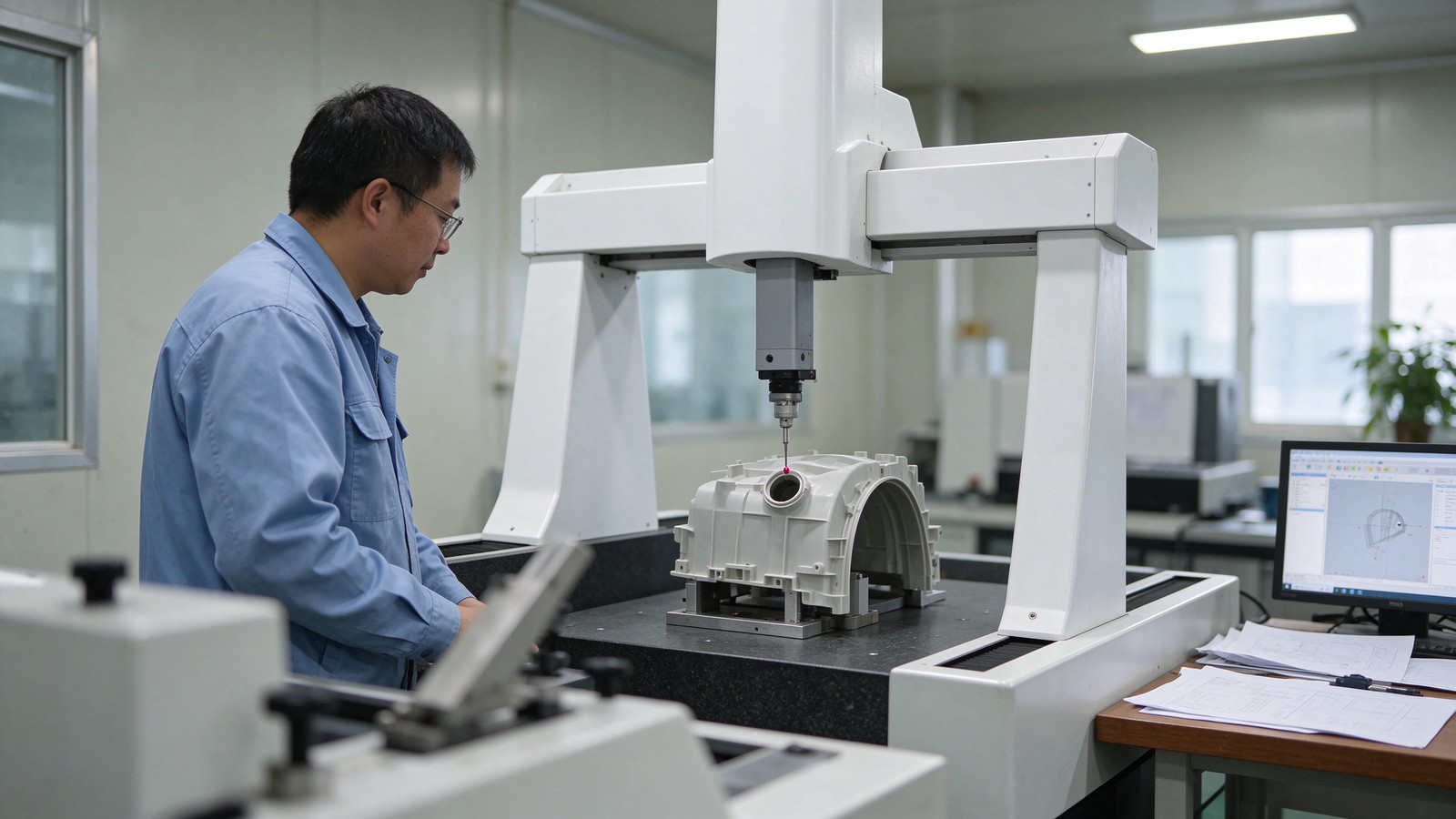
Disputes about a mould are usually measurement disputes, and they are settled by equipment rather than by opinion. Xiangrong's inspection room holds a coordinate measuring machine rated at ±0.02 mm, an image projector for profile and small features, a mould comprehensive test machine, and both portable and bench hardness testers. Incoming steel is checked with a hand-held spectrometer from SPECTRO, which is the step that prevents the most expensive mistake in a mould project: discovering, after machining, that the block is not the grade the drawing called for.
A trial part under the probe of a bridge-type coordinate measuring machine.
For an appliance customer, the deliverables that matter at the end are the sample, the dimensional report on the sample, the trial record and the approved part. The loop above produces all four in one place, which is also why the company describes its output as precision mould support for more than ten global appliance brands.
What the moulds are for
The product list is specific, and it follows the appliance market rather than the mould market. On washing machines: the one-piece tub, base and face frame for twin-tub models; the inner-tub bottom, base, water tank and worktop for pulsator models; and the front tub, rear tub and worktop for front-loading models. On refrigerators: drawers and rotary drawer panels for drawer-type units; freezer trims and egg trays for cross-door units; and the air-duct upper cover for air-cooled units. Beyond white goods, the same shop builds water-dispenser parts, kettle rotating door panels, vacuum-cleaner body covers and left/right body halves, smart-device housings and general household parts.
That mix is worth reading as a capability statement rather than a catalogue. A tub, a drawer and a body cover differ in wall thickness, in cosmetic requirement, in how they are ejected and in how they are packed for shipping — and a mould shop that builds all three for appliance brands has already met the tolerance, texture and colour-consistency expectations that come with that industry.
What a mould enquiry should carry
Mould projects that run to schedule tend to arrive with the following, rather than being discovered one item at a time:
-
The 3D part model and the 2D drawing, with the cosmetic surfaces marked and the texture or grain specified.
-
Resin grade and colour, since shrinkage, packing and gate design follow the material.
-
Cavity count and the annual volume, plus whether the mould has to run in the customer's press or in the supplier's.
-
The press the mould will run in — tonnage, tie-bar spacing, platen size and shot capacity — or an instruction to design to the supplier's press range.
-
Steel grade for cavity and core, and the expected mould life in shots.
-
The trial quantity and the sample-approval criteria, including which dimensions are functional and which are cosmetic.
-
The dimensional report format and whether a third-party inspection is required.
-
Delivery expectation, split between mould-ready date and the date the first approved sample is needed.
Send those, and the loop from design review to approved sample becomes a schedule rather than a hope.
Xiangrong's mould range, machine list, trial and inspection capability and enquiry route are published at www.xiangrongmold.com. Ningbo Xiangrong Precision Mould Co., Ltd., No. 16 Hubin North Road, Longshan, Cixi, Ningbo, Zhejiang, China.
www.xiangrongmold.com
Ningbo Xiangrong Precision Mold Co., Ltd.