
 admin
The short answer is that these terms do not describe exactly the same feature. Hex socket screw usually identifies an internal-hex drive, while button head screw identifies a rounded, low-profile head shape. A button head screw can also use a hex socket, so the useful engineering comparison is usually between a conventional hexagon socket head cap screw—the ISO 4762 / DIN 912 family—and a hexagon socket button head screw in the ISO 7380-1 family.
A conventional socket head cap screw is normally the more conservative starting point when a joint needs high preload, deeper drive engagement, or a counterbored installation. A button head is useful when the limiting problem is head height, snagging, visual profile, or interference with a nearby cover. The button-head choice carries a defined loadability limitation: ISO 7380-1:2022 classifies this design as having reduced loadability and assumes head loadability of 80% of thread loadability for all sizes and property classes (ISO 7380-1:2022).
That does not make one screw universally “better.” It means the fastener must be selected from the joint requirements: load, preload, head envelope, tool path, material, property class, corrosion environment, maintenance access, and applicable standard.
The terminology matters: drive type is not head type
A socket drive is a recess. A head form is the external geometry around that recess. The following descriptions should not be treated as interchangeable:
- Hex socket screw: a broad search term for a screw with an internal hexagonal drive. It may refer to several head forms.
- Hexagon socket head cap screw: a conventional cylindrical-head fastener covered by ISO 4762:2004.
- Button head screw: a rounded, lower-profile head form. In this comparison, it means a hexagon socket button head screw covered by ISO 7380-1:2022.
- Button head screw with collar: a separate ISO 7380-2 variant, not the same as ISO 7380-1.
ISO 4762:2004 specifies conventional hexagon socket head cap screws with coarse metric threads from M1.6 through M64 and product grade A (ISO 4762:2004). ISO 7380-1:2022 specifies hexagon socket button head screws with reduced loadability in steel and stainless steel, with coarse metric threads from M3 through M16 (ISO 7380-1:2022).
If a purchase order says only “hex socket screw” or “button head socket screw,” it leaves important questions unanswered: head standard, nominal diameter, thread, length, material, property class, coating, socket size, and whether a collar is required.
What is a conventional hex socket head cap screw?
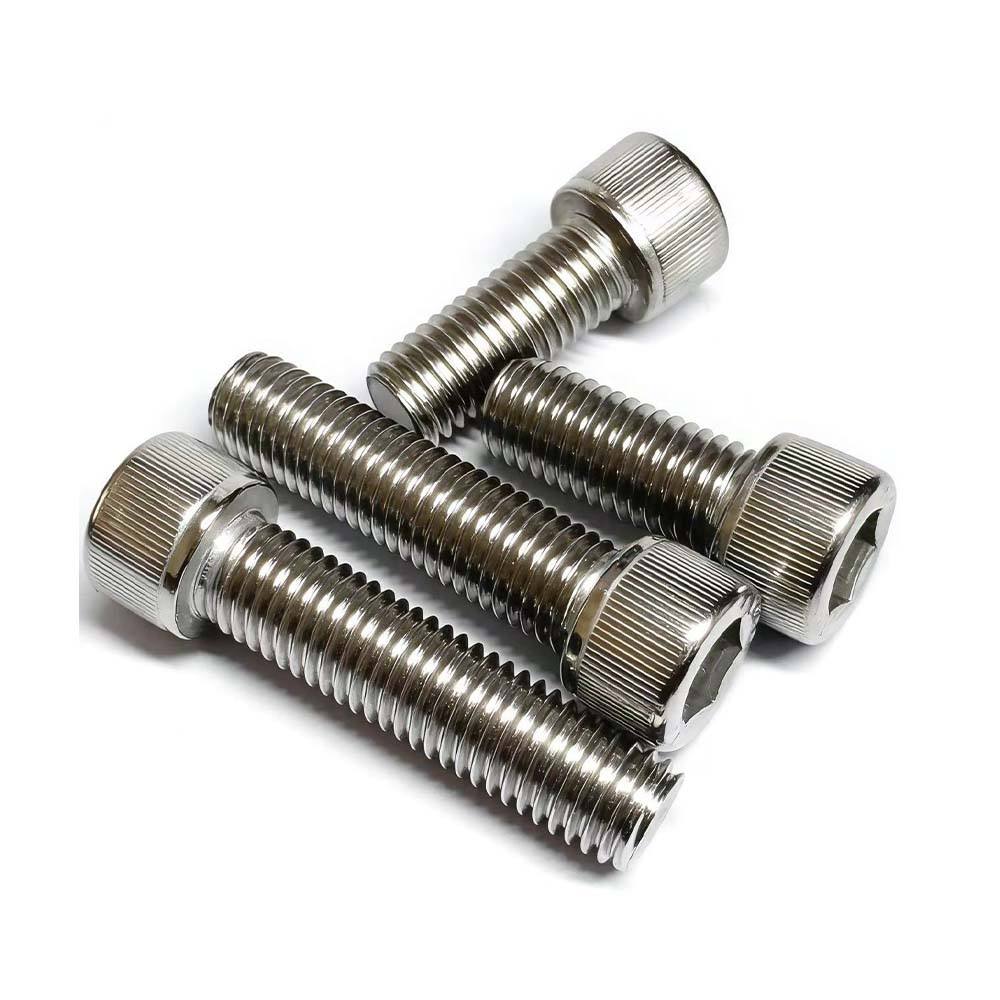
A conventional hexagon socket head cap screw has a cylindrical, relatively tall head and an internal hexagon socket. Bossard identifies this product family with a cylindrical head and hexagon socket drive (Bossard BN 2052).
The cylindrical head provides a substantial section around the socket and a flat under-head bearing surface. Those geometric characteristics can be useful when a joint needs a higher preload margin or when the head is installed in a counterbore. They do not, on their own, establish tensile strength, fatigue resistance, or allowable clamp load. The material and property class still have to be specified and verified.
A socket head cap screw is often the practical choice when:
- the joint is mechanically critical;
- substantial preload is required;
- the design permits a counterbore;
- repeated maintenance may wear the drive recess;
- the screw head must be recessed rather than merely made lower; or
- the available head height is sufficient for the cylindrical head.
“Socket head” does not mean that every product has the same material or strength. An ISO 4762 screw may be made from different material families and property classes, so the complete designation is essential.
What is a button head screw?
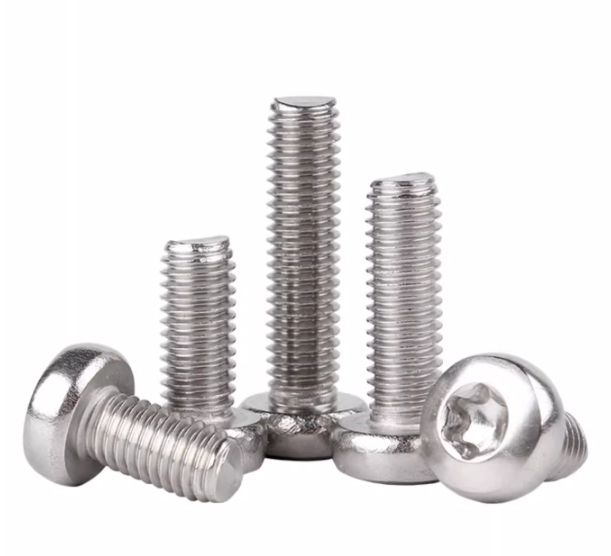
A hexagon socket button head screw has a rounded head with a lower external profile than a conventional socket head cap screw. ISO 7380-1:2022 explicitly defines the family as a reduced-loadability design because of its head geometry and socket penetration. The standard assumes head loadability at 80% of thread loadability for all sizes and property classes and uses a leading zero in the marking—for example, 010.9—to identify the reduced-loadability screw (ISO 7380-1:2022).
The lower profile can solve a vertical-clearance problem under a cover, inside an enclosure, or near a moving component. The rounded profile can also reduce a sharp-looking protrusion. However, a button head remains raised above the surface. It is not a flush fastener.
ISO 7380-2 covers a different product: a hexagon socket button head screw with a collar. Bossard identifies the collar version separately as a “button with collar” under ISO 7380-2 (Bossard BN 2098). A drawing or purchase order should state whether ISO 7380-1 or ISO 7380-2 is required.
Hex socket screw vs button head screw: side-by-side comparison
The table compares head families, not two universal strength classes. Material, property class, diameter, thread condition, coating, lubrication, and failure mode still determine connection performance.
What does an M6 dimensional example show?
The following comparison uses two Fastenal product standards that reference the relevant ISO dimensions. It is an M6 example only. The products use different material/property-class examples, so the figures illustrate geometry and drive space rather than strength.
Sources: Fastenal M.SHCS.4762.A2-70, dated March 1, 2023; Fastenal M.BHSCS.73801.10.9.BO, dated September 11, 2025.
This example explains a common design trade-off. The button head can solve a head-height constraint, but its smaller socket and lower engagement in this particular M6 product require more care with tool seating. It does not prove that every button head has a smaller socket than every socket head cap screw. Dimensions vary by nominal diameter, standard, product drawing, and supplier.
Installation space: vertical clearance is only one dimension
Button head helps when the obstruction is above the joint
If a moving cover, panel, guard, or mechanism passes close to the fastener, head height may be the limiting dimension. In the cited M6 examples, the maximum button-head height is 3.30 mm compared with 6.00 mm for the ISO 4762 example. That difference can matter in a compact enclosure or machine assembly.
The head still needs clearance for the tool. A low-profile socket screw is not automatically easier to install if a hex key or driver bit cannot enter the recess, reach full depth, or remain square while torque is applied.
Socket head helps when a counterbore is possible
A conventional socket head cap screw can be recessed in a counterbore. This can protect the head and reduce the exposed envelope without using a reduced-height head. The counterbore must be designed around the exact head diameter, under-head geometry, required bearing area, and tool path.
A counterbore that accommodates the head but prevents the driver from reaching the socket is not a usable solution. Model both the fastener envelope and the actual installation tool.
Both designs need axial access
Both fasteners use an internal hexagon socket. The tool therefore approaches along the screw axis rather than swinging around the side like an external wrench. This can help when side or radial wrench space is blocked by a frame or panel.
It does not eliminate access checks. Before finalizing the design, confirm:
- the key or bit can enter the socket to the required depth;
- the driver body clears nearby walls, flanges, and panels;
- the tool can remain aligned while torque is applied;
- the fastener remains serviceable after adjacent components are installed; and
- coating, corrosion, debris, or damage will not reduce useful engagement.
ISO 23429:2004 specifies gauges for hexagon sockets, with tolerances specified in ISO 4759-1 (ISO 23429:2004). For production purchasing, socket geometry is a quality characteristic, not an assumption.
Drive reliability: why engagement and alignment matter
An internal hex drive transfers installation torque through the contact between the tool and the recess. Fully seat the correct key or driver bit, keep it aligned, and use the specified tightening procedure.
The documented M6 comparison lists 3.0 mm minimum socket/key engagement for the ISO 4762 example and 2.08 mm recess penetration for the ISO 7380-1 example. A shallower recess or smaller key can leave less margin when the tool is tilted, worn, contaminated, or only partially inserted. This is a geometry-based installation risk, not a universal torque limit.
For a button-head assembly, the risk becomes more important when the head is hard to see or the driver must be held at an awkward angle. For a socket head cap screw, the taller head does not excuse poor alignment; a damaged socket can still cause removal and rework problems.
Where preload matters, do not use one generic torque value for every material and coating. ISO 16047:2005 specifies conditions for torque/clamp-force testing of threaded fasteners and related parts, generally covering ISO metric fasteners from M3 to M39 made from carbon or alloy steel (ISO 16047:2005). Coating, lubrication, thread condition, surface condition, material, and tool calibration affect the torque-to-clamp-force relationship.
Strength and clamping: what can be generalized?
The 80% statement is about button-head head loadability
ISO 7380-1’s 80% assumption should not be rewritten as “a button-head screw is always 20% weaker in every failure mode.” The standard statement concerns head loadability relative to thread loadability for the reduced-loadability design. It does not replace a complete joint analysis of tensile, shear, fatigue, bearing, stripping, substrate, or installation failures.
The practical engineering consequence is still important: a button head should not be treated as a direct high-load replacement for an ISO 4762 screw merely because both have the same nominal thread and a similar property-class number. ISO 7380-1’s leading-zero marking convention must be checked.
Material and property class are separate from head form
ISO 898-1:2013 specifies mechanical and physical properties for applicable carbon- and alloy-steel bolts, screws, and studs tested at an ambient temperature range of 10 °C to 35 °C. ISO also notes that some low- or countersunk-head geometries may not fulfil specified tensile or torsional requirements because head geometry reduces shear area compared with the thread stress area. The standard does not specify corrosion resistance, shear resistance, torque/clamp-force performance, or fatigue resistance (ISO 898-1:2013).
This is why a fastener specification should separate:
- head form and dimensional standard;
- nominal diameter, pitch, and length;
- material and property class;
- coating and lubrication condition;
- preload or tightening procedure; and
- environment and joint design.
The Fastenal M6 examples deliberately use A2-70 stainless steel for the ISO 4762 product and Class 10.9 black-oxide steel for the ISO 7380-1 product. Those values are suitable for comparing geometry, not for claiming that one material is stronger than the other.
Manufacturer guidance is product-specific
The Unbrako engineering guide presents socket head cap screws as high-strength fasteners and publishes product-specific mechanical and torque data for its metric socket cap products. It also describes button-head and flat/countersunk cap screws as intended for moderate fastening applications and does not suggest them for critical high-strength applications where socket head cap screws should be used (Unbrako Engineering Guide).
That is manufacturer guidance, not a universal ban on button heads. It does, however, align with ISO 7380-1’s explicit reduced-loadability classification and reinforces the need to check the actual joint rather than choosing by appearance.
Which screw head fits common applications?
Machinery, tooling, and fixtures
Start with an ISO 4762 socket head cap screw when the joint needs substantial preload, repeated tightening, or a high-strength steel fastener. A counterbore can protect the head or keep the exposed surface clear, provided the remaining material and counterbore geometry are adequate.
Use an ISO 7380-1 button head when its lower profile solves a real interference or handling problem and the required load is within the reduced-loadability specification. A smoother appearance is not a reason to downgrade a critical connection.
Enclosures, guards, and covers
A button head can be useful where a cover passes close to the fastener or where a rounded exposed profile reduces snagging. Check that the driver can reach the socket after the cover, bracket, or guard is installed. For frequently removed guards, verify that the actual tool can engage and remove representative samples without damaging the recess.
A socket head cap screw may be better where the fastener can be recessed, where greater preload margin is required, or where repeated maintenance benefits from the dimensional example’s deeper socket engagement.
Visible assemblies and equipment panels
A button head often gives a lower, rounded visible profile. That can support appearance and handling goals, but the specification should still state the standard, material, property class or marking, coating, and dimensions. “Decorative” does not mean that the fastener is exempt from vibration, impact, maintenance torque, or load checks.
Stainless-steel assemblies
Do not specify either head style simply as “stainless.” ISO 7380-1:2022 permits steel and stainless-steel button-head screws and refers to ISO 3506-1 for stainless grades. The Fastenal ISO 4762 A2-70 product standard likewise identifies A2-70 stainless steel and ISO 3506-1 as its material/mechanical basis (ISO 7380-1:2022; Fastenal M.SHCS.4762.A2-70).
Check the grade, galling risk, lubrication, mating material, environmental exposure, and inspection requirements. Head geometry does not determine corrosion resistance or installation reliability.
A practical decision matrix
Common selection mistakes that create real assembly problems
Mistake 1: Treating “hex socket” as a complete product description
“Hex socket” identifies the drive, not the complete head geometry. A purchase description should state whether the part is ISO 4762, ISO 7380-1, ISO 7380-2, a countersunk design, or another specified family.
Mistake 2: Replacing by thread diameter alone
An M6 socket head cap screw and an M6 button head screw can have different head heights, socket dimensions, engagement depth, and loadability. Equal thread diameter does not mean equal connection performance.
Mistake 3: Ignoring the leading-zero marking convention
For ISO 7380-1 reduced-loadability screws, a marking such as 010.9 communicates a different head-loadability condition from a conventional 10.9 fastener. Confirm the marking and supplier documentation before using the part in a high-load design.
Mistake 4: Selecting a button head for a high-preload joint without checking the head
The 80% ISO 7380-1 head-loadability assumption is a design limitation, not a marketing detail. Review the joint limit state and avoid treating a button head as a direct substitute for a conventional socket head cap screw.
Mistake 5: Assigning torque without a friction condition
Torque is not a universal substitute for measured preload. Coating, lubrication, thread condition, surface finish, and tool calibration affect the relationship. Define the installation condition and validate it when clamp force matters.
Mistake 6: Checking head clearance but not driver clearance
A head can fit under a cover while the hex key cannot enter, cannot reach full depth, or cannot remain square. Model the tool path and future maintenance access.
Mistake 7: Assuming low profile means flush
A button head still projects above the surface. If flushness is mandatory, evaluate a suitable countersunk fastener and account for the reduced head section and any related load effects.
Mistake 8: Ignoring socket quality and lot documentation
ISO 23429 covers gauging of hexagon sockets. For production purchasing, request dimensional inspection, lot traceability, and material/mechanical documentation appropriate to the connection risk. A socket that is out of tolerance or damaged at delivery can turn an apparently correct design into an installation failure.
Selection workflow for engineers and buyers
- Describe the joint: load type, preload, vibration, temperature, environment, service life, and maintenance frequency.
- Define the head envelope: maximum height, diameter, exposed projection, counterbore possibility, and nearby moving parts.
- Define tool access: axial insertion path, key or bit size, engagement depth, driver clearance, and alignment.
- Choose the head standard: ISO 4762 for a conventional socket head cap screw; ISO 7380-1 for a button head; ISO 7380-2 when a collar is required.
- Specify material and property class: use the applicable ISO 898 or ISO 3506 basis and supplier certificate.
- Check button-head loadability: for ISO 7380-1, account for reduced loadability and the leading-zero marking convention.
- Validate preload: define coating and lubrication conditions and use torque/clamp-force testing or a validated installation procedure where preload matters.
- Test serviceability: install and remove representative parts using the actual tools and access constraints.
- Freeze the part description: standard, head form, diameter, pitch, length, material/class, coating, socket size, and collar or washer requirement.
- Inspect the received lot: confirm dimensions, markings, material documentation, coating, and socket condition before production release.
FAQ
Which is stronger: a socket head cap screw or a button head screw?
There is no valid answer without the diameter, material, property class, standard, thread condition, and failure mode. ISO 7380-1 does explicitly classify button heads as reduced-loadability fasteners and assumes head loadability at 80% of thread loadability. For a critical high-load joint, a conventional socket head cap screw is generally the more conservative starting point, subject to engineering verification.
Is a button head screw better for tight spaces?
It can be better when the limiting dimension is vertical height above the assembly. It is not automatically better when the limiting dimension is axial tool access, because both designs require a tool to enter the internal hex socket. A socket head cap screw may be preferable if a counterbore is possible or if deeper drive engagement and greater preload margin are required.
Can a button head replace a socket head cap screw of the same diameter?
Not without checking head dimensions, socket geometry, reduced-loadability marking, joint loads, preload, tool access, and the applicable product standard. Equal thread diameter is not equal connection performance.
Does a button head screw provide a flush installation?
No. A button head is lower-profile but remains above the surface. If a surface must be flush, evaluate a suitable countersunk design and its effects on head section, strength, and the mating component.
Does the hex socket make both screws equally easy to install?
Both designs use an axial internal-hex drive, which can help where an external wrench has no swing room. Installation difficulty still depends on socket size, engagement depth, tool alignment, clearance, and required torque. In the cited M6 examples, the button-head product has less socket engagement than the socket-head product.
Can I use the same torque for both screws?
Do not assume so. Torque-to-clamp-force behavior depends on friction, coating, lubrication, thread condition, material, and tool calibration. Where preload matters, validate the relationship with the actual fastener and installation condition; ISO 16047 provides a torque/clamp-force testing framework.
When should I use ISO 7380-2 instead of ISO 7380-1?
Use ISO 7380-2 only when the design specifically requires the button-head-with-collar variant. The collar changes the bearing geometry, so it should be identified separately in the drawing and purchase specification.
What should be checked before substituting one screw head for another?
Check the head standard, height, diameter, under-head bearing, socket size and engagement, tool path, material, property class or marking, coating, thread, length, preload, joint loads, corrosion environment, and maintenance access. A same-size thread is not sufficient evidence for a safe substitution.
Conclusion
The useful answer to hex socket screw vs button head screw comparison is not a universal winner. A conventional ISO 4762 socket head cap screw usually gives a stronger starting position for high preload, deeper drive engagement, repeated maintenance, and counterbored installation. An ISO 7380-1 button head can solve a vertical-clearance or exposed-profile problem, provided the design accounts for its reduced-loadability classification and the actual tool engagement.
Specify the joint first, then choose the head. Confirm the standard, dimensions, material, property class, coating, torque condition, tool path, and maintenance requirements. That sequence prevents the most expensive substitution mistake: selecting a fastener that fits the thread but fails the clearance, load, installation, or inspection requirements.
Where can I source custom hex socket and button head screws?
We at Shanghai Tengri Metal Products Co., Ltd. are a professional fastener manufacturer holding ISO 9001, API, RoHS, and CE certifications. We supply both standard and custom-made hex socket screws and button head screws. Feel free to check out our catalog and specs at https://www.gtrfast.com.
References
- ISO. ISO 4762:2004 — Hexagon socket head cap screws. Scope includes coarse metric threads M1.6–M64 and product grade A.
- ISO. ISO 7380-1:2022 — Fasteners — Button head screws with reduced loadability — Part 1. Scope includes coarse metric threads M3–M16, steel/stainless steel, reduced loadability, 80% head-loadability assumption, and marking convention.
- ISO. ISO 7380:2004 lifecycle. Lifecycle information for the withdrawn 2004 edition.
- ISO. ISO 7380-1:2011 lifecycle. Lifecycle information for the withdrawn 2011 edition.
- ISO. ISO 898-1:2013 — Mechanical properties of carbon- and alloy-steel fasteners. Mechanical and physical property scope and head-geometry limitations.
- ISO. ISO 16047:2005 — Fasteners — Torque/clamp force testing. Torque/clamp-force test conditions and scope.
- ISO. ISO 23429:2004 — Gauging of hexagon sockets. Socket gauging requirements and relationship to ISO 4759-1 tolerances.
- Fastenal. M.SHCS.4762.A2-70.03 — Metric socket head cap screw, ISO 4762, A2-70 stainless steel. Product standard dated March 1, 2023; M6 dimensional example and material basis.
- Fastenal. M.BHSCS.73801.10.9.BO.04 — Metric button head socket cap screw, ISO 7380-1, Class 10.9. Product standard dated September 11, 2025; M6 dimensional example and socket engagement.
- Fastenal. M.SHCS.4762.10.9.P.03 — Metric socket head cap screw, ISO 4762, Class 10.9. Product standard dated September 17, 2025.
- Fastenal. M.BHSCS.73802.10.9.Z.3U.06 — Metric button head socket cap screw with collar, ISO 7380-2. Product standard dated September 17, 2025; collar variant.
- Bossard. BN 2052 — Hex socket head cap screws. Product family identification: cylindrical head and hexagon socket drive.
- Bossard. BN 30102 — Hex socket button head cap screws. Product identification and reduced-loadability notice.
- Bossard. BN 2098 — Hex socket button head cap screws with collar. Product identification for the ISO 7380-2 collar variant.
- Unbrako. Engineering Guide — Socket Products. Manufacturer guidance on socket-cap applications, product-specific mechanical/torque data, and moderate versus critical fastening applications.
https://www.tgrfast.com
Shanghai Tengri Metal Products Co., Ltd.