
 admin
If the cooling water inlet of a bead mill is normal but the temperature does not drop, this is a confusing fault in production. The cooling water pressure gauge shows normal, and the inlet valve is open, but the temperature of the grinding chamber just will not come down. At this point, what needs to be investigated is often not “whether there is water,” but “whether the water is actually carrying the heat away.” Problems often lie in cooling flow channel design, flow channel blockage, cooling water temperature, heat exchange area, flow distribution, and operating parameters.
Unreasonable cooling flow channel design. Some equipment has cooling jackets with narrow flow channels and many bends, resulting in high water flow resistance. The inlet pressure may look normal, but the actual effective flow through the jacket is insufficient. Water forms dead zones or short circuits locally, heat exchange in some areas is inadequate, and heat accumulates in the grinding chamber. RUCCA equipment adopts a large-diameter cooling flow channel design to reduce water resistance and make the cooling water distribute more evenly in the jacket. The internal rotor is also provided with cooling flow channels, forming internal and external dual heat exchange, increasing the heat exchange area and shortening the heat conduction path.
Local flow channel blockage. After long-term use, scale, impurities, and microbial slime will deposit in the jacket, pipes, valves, and filters. The cooling area gradually decreases, and heat exchange capacity declines. The inlet pressure may still be normal, but the return water flow rate is low, and the change in the temperature difference between inlet and outlet water is not obvious. Standardized connections facilitate periodic cleaning and descaling. Softened water can be used to reduce scale formation. If the water is hard, filters or water treatment devices can be installed. During cleaning, check the jacket, internal rotor flow channels, return water pipe, and heat exchanger, and if necessary, use a descaling agent for circulating cleaning.
The cooling water temperature itself is too high. In summer, the circulating water temperature is high. When the inlet water temperature is close to the grinding chamber temperature, the heat exchange temperature difference is small, and the amount of heat carried away is limited. In this case, a chiller can be installed to keep the inlet water temperature within the set range. Cooling water flow rate, pressure, and temperature should be considered together. If the return water temperature is high, it means heat is being carried out but the water volume is insufficient; if the return water temperature is close to the inlet water temperature, it may be due to excessive flow or insufficient heat exchange area.
Troubleshooting methods. First check the return water flow rate and the temperature difference between inlet and outlet water. Then check whether the filter, valves, and pipes are blocked. Use a thermometer to measure the grinding chamber outlet, circulation tank, and cooling water return. If the temperature rises during equipment operation, reduce the feed rate, linear speed, or media filling rate and observe the temperature change. If the temperature still does not drop, then check the cooling flow channels and heat exchanger.
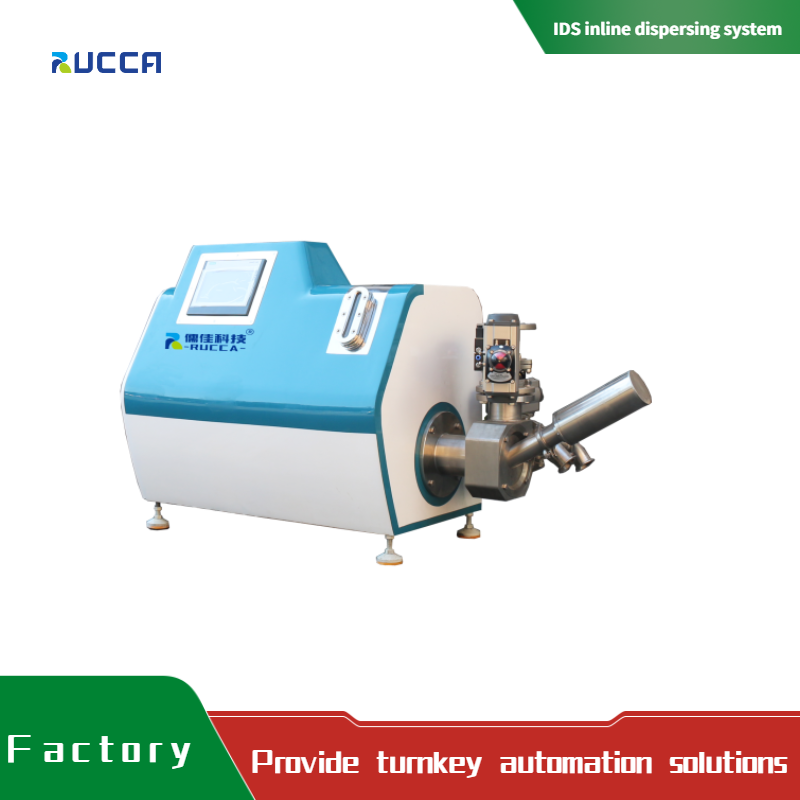
Process parameters also affect temperature rise. Excessive feed rate, too high linear speed, too large media filling rate, and too many grinding passes will all increase heat generation. If pre-dispersion is insufficient, agglomerates enter the bead mill and require more energy to break up, which also increases temperature rise. Using an Inline dispersing system-low viscosity IDS for good pre-dispersion can reduce the number of subsequent grinding passes and lower heat accumulation.
It is recommended to use softened water and clean the cooling system regularly. If the cooling water temperature is too high, a chiller can be installed. If the equipment's cooling flow channel design is too narrow, replacement or modification can be considered. RUCCA can recommend cooling solutions based on material characteristics and verify temperature rise, fineness, and capacity through material sample testing. This can reduce downtime and quality fluctuations caused by unstable temperature control.
www.ruccagroup.net
RUCCA bead mill