
 admin
The integrated solution for nano-scale powder dispersion and milling aims to place powder feeding, wetting, deagglomeration, milling, temperature control, and discharge into one continuous process, reducing material transfer and exposure, allowing particle size to decrease step by step, and keeping batches stable. RUCCA combines upstream dispersion with downstream bead milling to form a matched solution from pre-dispersion to nano-scale milling.
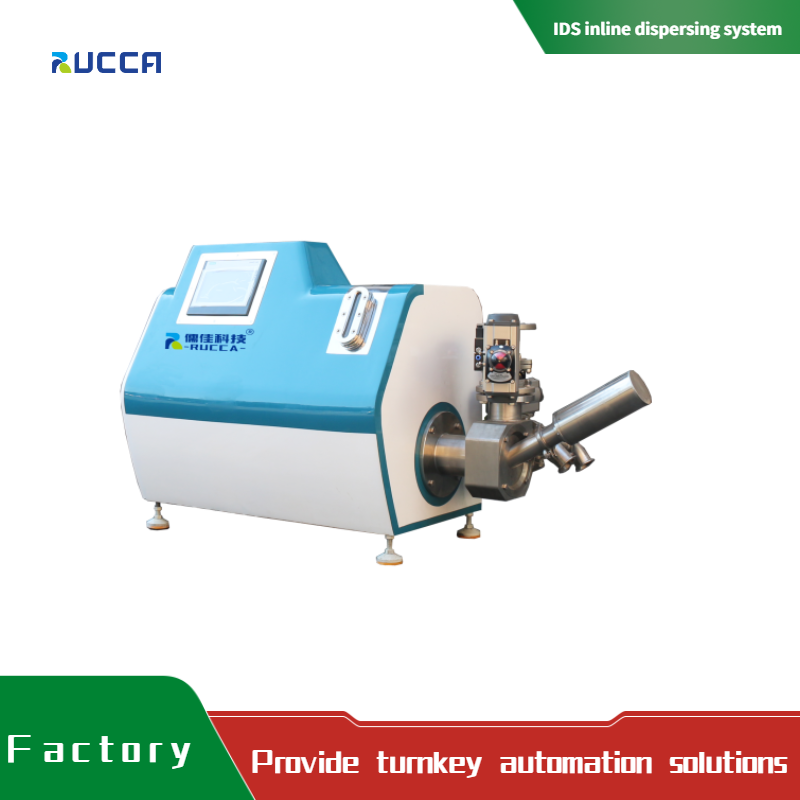
The upstream stage uses the IDS Inline Dispersing System. This system uses vacuum negative pressure to draw in powder. Powder enters a closed pipeline from bags or bins, while liquid enters the dispersion chamber at the same time. The powder is subjected to high shear inside the chamber and is instantly wetted, reducing dust flying and material loss. Traditional open feeding easily produces floating dust and “fish eyes,” and agglomerates entering the bead mill require multiple circulation passes. The IDS opens up clusters during the pre-dispersion stage, allowing dispersants to contact particle surfaces more quickly. When the material enters the bead mill, the initial particle size is more consistent, and the number of subsequent grinding passes can be reduced by 30%–50%, with simultaneous reductions in energy consumption and temperature rise.
The downstream stage uses the N series nano bead mill. This series adopts a pin-type high energy density structure, with the rotor and pins forming shear and impact zones in the grinding chamber. The equipment can be matched with ultra-fine grinding media of 0.03 mm or above and, with circulating grinding and parameter adjustment, can stably achieve D50 ≤ 30 nm. To address the problem of easy clogging with ultra-fine media, the equipment has been optimized in the media separation system so that smaller beads can also run stably. By adjusting linear speed, flow rate, media filling rate, and circulation times, it can be adapted to different solid contents, viscosities, and solvent systems. For carbon nanotube slurries, a low-speed and high-flow mode can be used to protect tube length; for MLCC barium titanate, distribution and impurities are the focus; for solid electrolytes, inert gas protection can be used to reduce contact with water and oxygen.
The entire process is closed and continuous, with controllable temperature. If heat generated during milling accumulates, it may cause dispersants to fail, binders to gel, or particles to re-agglomerate. RUCCA equipment can be equipped with an internal and external dual cooling system, with dual-channel heat exchange through the outer wall of the grinding chamber and the inner rotor. Combined with adjustment of cooling water temperature, flow rate, and feed speed, this helps control temperature rise. For heat-sensitive systems, staged grinding or circulating cooling can be adopted to reduce excessive residence time in a single pass. Closed conveying also reduces workshop dust and improves the operating environment. Batch consistency is good because feeding, wetting, milling, and discharge run continuously according to set parameters, reducing fluctuations caused by manual intervention.
Applicable scenarios include solid electrolytes, carbon nanotube conductive slurries, MLCC barium titanate, inkjet inks, and others. These systems have different requirements for particle size, distribution, cleanliness, and temperature, and the integrated solution can be configured according to material characteristics. RUCCA provides trial testing services to verify results with measured data. Particle size distribution, D50, D90, viscosity, solid content, Zeta potential, impurities, and storage stability can be tested, after which the production model and process can be determined. If you have a specific powder system, you can contact RUCCA to send materials for trial testing, and technical personnel will recommend a solution based on material characteristics.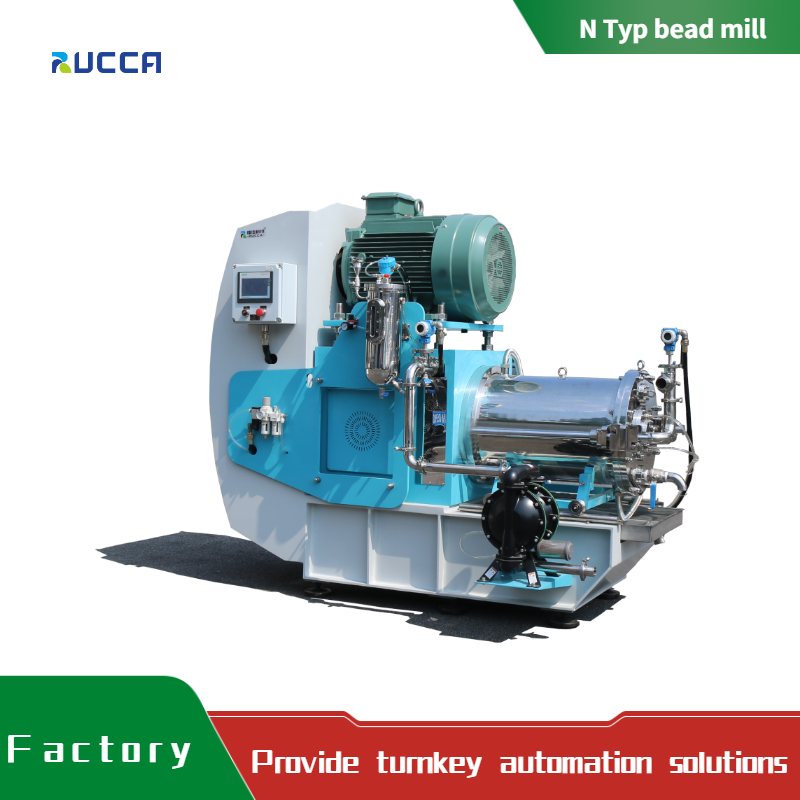
www.ruccagroup.net
RUCCA bead mill