
 admin
Why Do Businesses Need Battery Backup Systems?
Power outages can disrupt production, damage temperature-sensitive goods, interrupt business operations, and create unexpected financial losses.
For factories, warehouses, commercial buildings, and industrial facilities, maintaining electricity supply during grid interruptions is an important part of business continuity planning.
Commercial battery backup systems provide stored electricity to support selected loads when grid power becomes unavailable.
Unlike conventional backup solutions designed only for emergency operation, some commercial battery energy storage systems (BESS) can also support daily electricity management.
Solutions such as the RENAC RENA5000 C&I BESS combine battery storage, intelligent energy management, and compatible microgrid switching equipment to support both energy optimization and backup power applications.
However, reliable backup power depends on the complete electrical system design, not battery capacity alone.
How Does a Commercial Battery Backup System Work?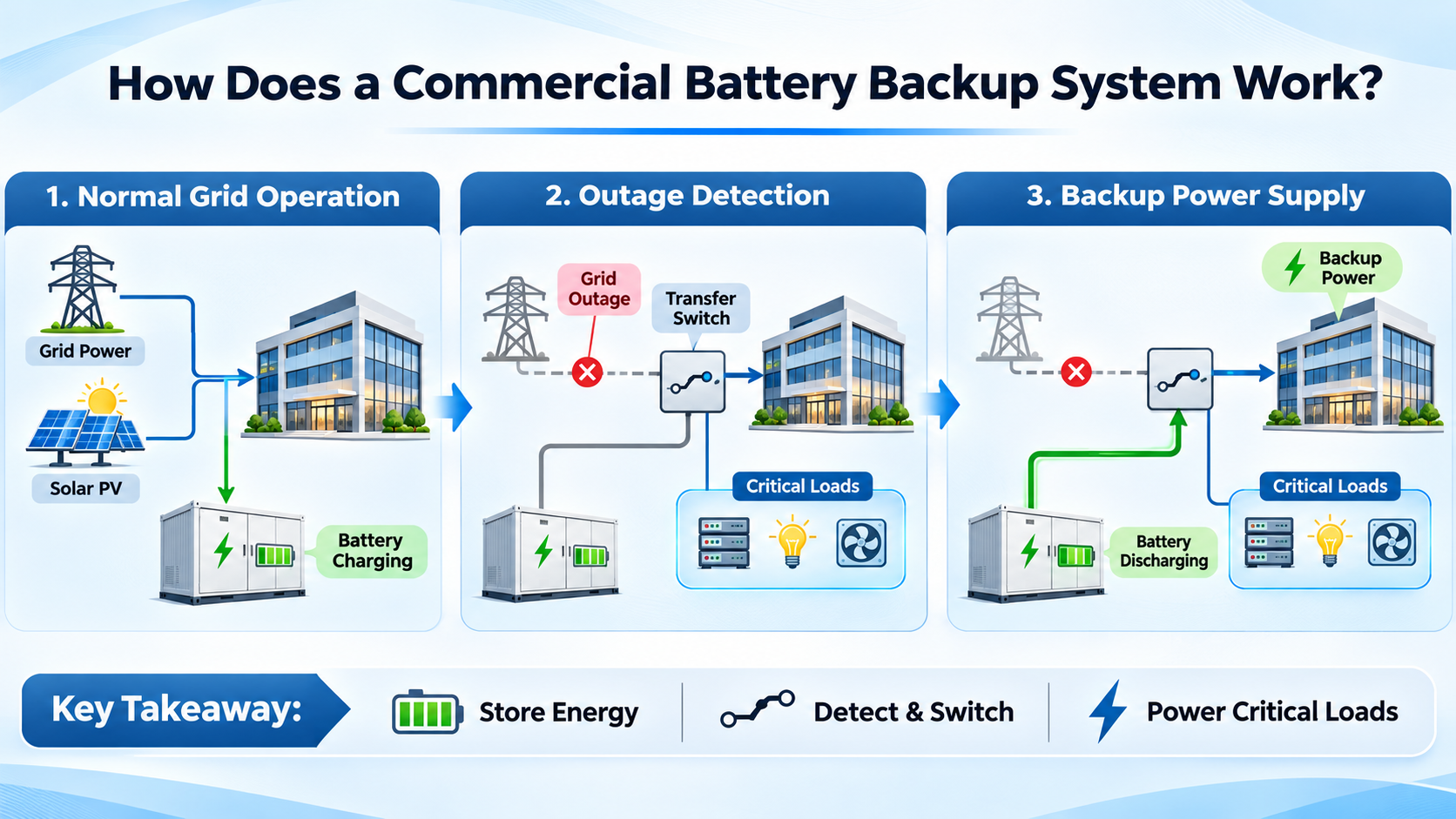
A commercial battery backup system stores electricity during normal operation and makes it available when grid power is interrupted.
A properly configured system typically follows three stages.
1. Normal Grid Operation
The battery charges according to the configured energy management strategy. It may use grid electricity or available solar generation while maintaining a reserve for backup power.
2. Grid Outage Detection
When a grid interruption occurs, the control and switching equipment detects the abnormal condition and isolates the protected electrical system from the utility grid.
3. Backup Power Supply
The battery energy storage system supplies designated loads through a suitable off-grid operating configuration.
Once grid conditions are restored, the system can reconnect according to its control and protection requirements.
The ability to switch operating modes depends on the inverter, switching equipment, protection devices, and system configuration.
Which Commercial Loads Need Backup Power?
Not every electrical load requires the same level of backup protection.
Businesses should identify critical operations before selecting battery storage capacity.
Manufacturing Facilities
Production control systems, monitoring equipment, and selected manufacturing processes may require backup power to prevent operational disruption.
Warehouses and Cold Storage
Refrigeration equipment, warehouse monitoring, and security systems may need continued electricity supply during outages.
Commercial Buildings
Essential lighting, access control, communications, and designated building services may require backup protection.
Logistics and Distribution Centers
Warehouse management systems, communication equipment, and selected automated operations can benefit from additional power resilience.
Prioritizing critical loads helps businesses avoid unnecessary battery oversizing.
How to Size Battery Storage for Backup Power
Commercial battery backup system sizing depends on three major factors:
Critical Load Power (kW)
The total power required by the equipment that must remain operational.
Backup Duration (Hours)
How long the business expects the battery to support those loads.
Usable Battery Energy (kWh)
The amount of energy available within the battery’s operating limits.
Consider a simplified example:
| Parameter | Example |
|---|---|
| Critical Load Power | 50kW |
| Required Backup Duration | 2 Hours |
| Minimum Usable Energy | 100kWh |
| Additional Considerations | Efficiency, SOC Reserve, Load Peaks |
In this example, a facility requires approximately 100kWh of usable energy to supply a constant 50kW load for two hours, before accounting for conversion losses and operating reserves.
The battery must also provide sufficient instantaneous power.
Motors, compressors, and other equipment may require higher starting power than their normal operating demand.
Therefore, system designers must evaluate both continuous power requirements and temporary load peaks.
Battery Backup vs. UPS: What Is the Difference?
Commercial BESS and Uninterruptible Power Supply (UPS) systems both use stored energy, but they serve different purposes.
A UPS is generally designed to protect sensitive equipment from power interruptions and power-quality disturbances.
A commercial BESS is typically designed for broader energy storage applications, including backup power, peak shaving, and renewable energy management.
A BESS with suitable switching equipment can support critical loads during outages.
However, it should not automatically be treated as a replacement for a UPS.
Where equipment requires uninterrupted power with no allowable transfer interruption, a dedicated UPS or appropriately engineered combined solution may still be necessary.
RENAC RENA5000: Commercial Battery Storage with Backup Power Capability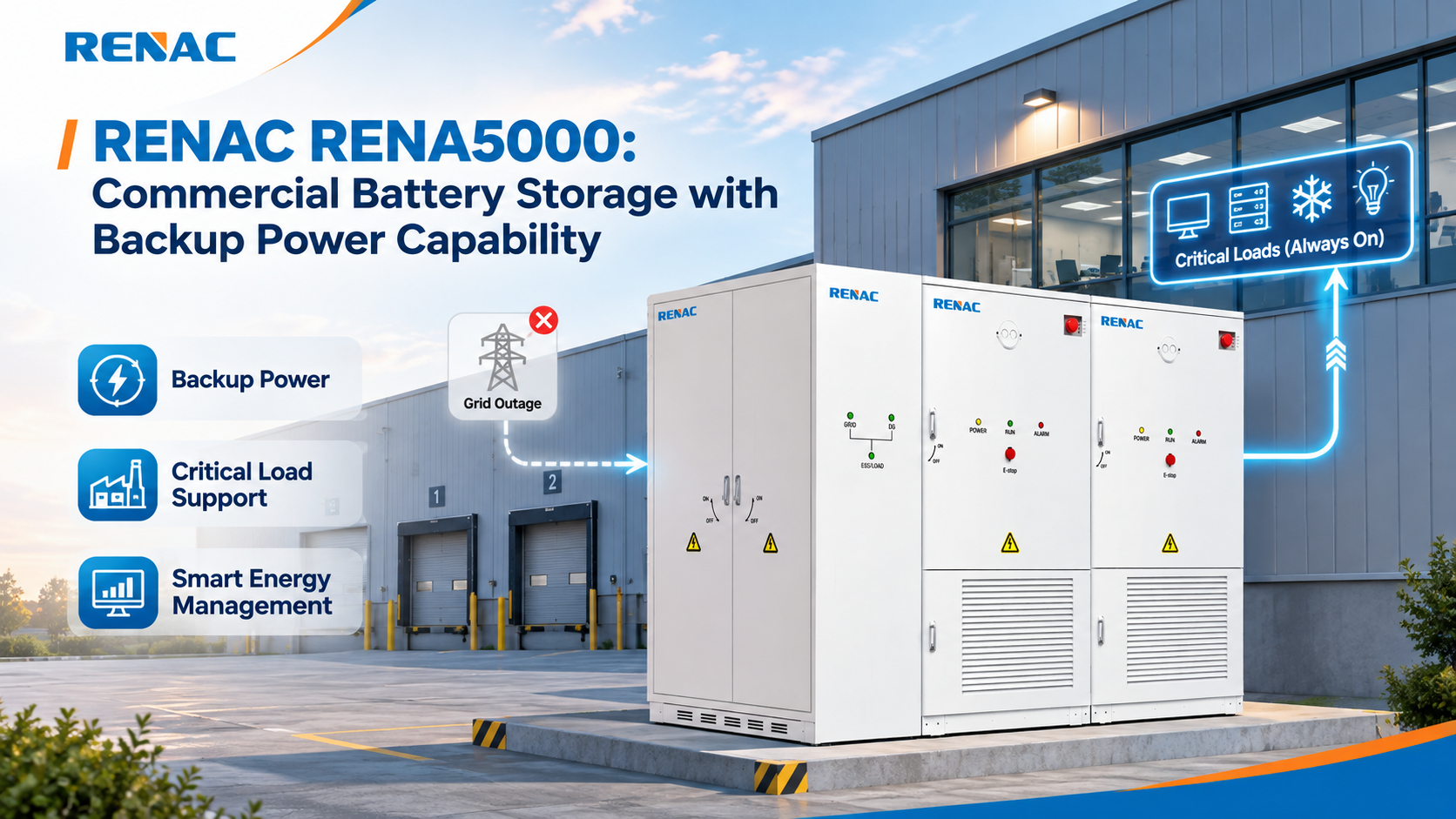
The RENAC RENA5000 Commercial & Industrial Battery Energy Storage Solution supports flexible energy management and compatible on-grid/off-grid applications.
For commercial backup power applications, a RENA5000 configuration can combine the ESS-261 battery storage cabinet with an STS-175 microgrid switching system.
RENAC ESS-261 Battery Storage
The ESS-261 is an all-in-one battery energy storage cabinet featuring:
| Specification | Details |
|---|---|
| Rated Power | 125kW |
| Nominal Energy Capacity | 261kWh |
| Battery Technology | LFP |
| System Design | All-in-One |
| Energy Management | Intelligent EMS |
The system supports battery charging and discharging according to configured operating requirements.
Its modular architecture allows suitable project configurations to be developed for different commercial and industrial applications.
STS-175 for On-Grid and Off-Grid Switching
When paired with the compatible STS-175 microgrid switching system, RENA5000 supports transitions between grid-connected and off-grid operation.
The manufacturer specifies an automatic switching time of less than 20 milliseconds for the applicable configuration.
Actual backup performance depends on the complete system design, equipment settings, and connected loads.
This provides a flexible option for businesses that require battery backup capabilities alongside normal electricity management.
Intelligent EMS and Solar Integration
The RENAC Energy Management System (EMS) coordinates battery charging, discharging, and energy management strategies.
Businesses can evaluate peak shaving, time-of-use optimization, and backup reserve requirements within an appropriate operating strategy.
For facilities with solar PV installations, compatible system configurations can also coordinate renewable generation and battery storage.
This allows commercial users to consider both electricity cost management and power resilience when planning an energy storage project.
What Should Businesses Consider Before Installing Battery Backup?
Before selecting a commercial battery backup system, businesses should review:
-
Critical Loads: Identify which equipment must continue operating during an outage.
-
Required Backup Time: Determine the desired operating duration.
-
Electrical Compatibility: Check existing switchgear, protection, and system connections.
-
Switching Requirements: Confirm whether the protected equipment can tolerate the expected transfer time.
-
Energy Reserve: Maintain sufficient battery energy for emergency operation.
-
System Maintenance: Establish appropriate testing, monitoring, and maintenance procedures.
The best configuration should be selected through a site-specific electrical assessment.
Frequently Asked Questions
Q1: Can commercial battery storage provide backup power during outages?
Yes. Commercial battery storage can supply selected loads during grid interruptions when the system includes suitable off-grid operation, switching, protection, and control equipment.
Q2: How long can a commercial battery backup system last?
Backup duration depends on usable battery capacity and the connected electrical load.
For example, a constant 50kW load requires approximately 100kWh of usable energy for two hours, before accounting for system losses and reserves.
Q3: Can a commercial BESS replace a UPS?
Not automatically. A UPS is designed for sensitive loads requiring specific continuity and power-quality performance. A commercial BESS can complement UPS equipment or support other critical loads when appropriately configured.
Q4: Can solar panels continue supplying electricity during a power outage?
Yes, in a suitably designed system with islanding capability, compatible inverter controls, and adequate protection. An ordinary grid-tied solar installation without these capabilities generally shuts down when grid power fails.
Q5: What battery storage systems are suitable for commercial backup power?
Suitable systems should offer adequate power, usable energy capacity, and compatible backup switching capabilities.
For example, the RENAC RENA5000 C&I BESS, configured with ESS-261 battery storage and STS-175 switching equipment, supports on-grid and off-grid applications.
Final suitability depends on the facility’s critical loads and electrical requirements.
Conclusion
Commercial battery backup systems help businesses prepare for electricity interruptions and improve operational resilience.
However, selecting the right system requires more than comparing battery capacities.
Critical load identification, backup duration, switching performance, and electrical compatibility all influence system reliability.
With integrated battery storage, intelligent energy management, and compatible STS switching, RENAC RENA5000 C&I BESS provides a flexible option for commercial and industrial backup power applications.
Explore Commercial & Industrial Energy Storage Solutions:
https://www.renacpower.com
RENAC Power