
 admin
HAIYAN, Jiaxing, Zhejiang, November 2026 — When a solar water heater fails in the first cold snap of winter, the cause is rarely the collector and rarely the tank. It is water that was left standing in the loop after the pump stopped. Kaichang, the controller brand of Haiyan Kaichang Energy Saving Electronics Co., Ltd., has built its range around that one failure mode since 2015, and is now carrying the same logic across automatic water-filling, split pressurized, balcony wall-mounted and solar heating systems.
The company's timeline explains why the focus sits there. Its predecessor, Linyi Jianguo Fittings in Shandong, began working on solar water heater accessories in 2005 — the valves, fittings and small parts that sit between a tank and a roof. The Kaichang brand was registered in Haiyan, Zhejiang in 2013, selling controllers, automatic drain valves and simple pipe-emptying devices. In 2015 the company chose to concentrate on drain-back freeze protection instead of competing on price in generic controllers, and that choice is still what the business rests on. Four patents followed in 2019. The slogan states the promise without decoration: “Afraid of frozen pipes? Choose Kaichang.”
Drain-back is a sequence, not a valve
On paper a drain-back system looks simple. When the circulator stops, a path opens and the water in the collector and the exposed pipe falls back into the tank. The loop stays full of air, and an air-filled pipe cannot split in a frost.
What makes it work is the order of the steps. The controller has to decide when to stop circulating — frost at the sensor, tank already at setpoint, no usable radiation — then hold the drain path open long enough for the loop to empty, then refill and restart without pushing air into the collector. Do those steps in the wrong order and one of two failures follows: water still sitting in the pipe when the temperature drops, or a collector running dry and overheating. That is the reason Kaichang treats the controller, the drain valve and the sensor as one system rather than three separate items on a shelf.
One control platform, several ways to use it
The range that grew out of this is deliberately broad, because the same drain-back logic appears in systems that look different to the buyer.
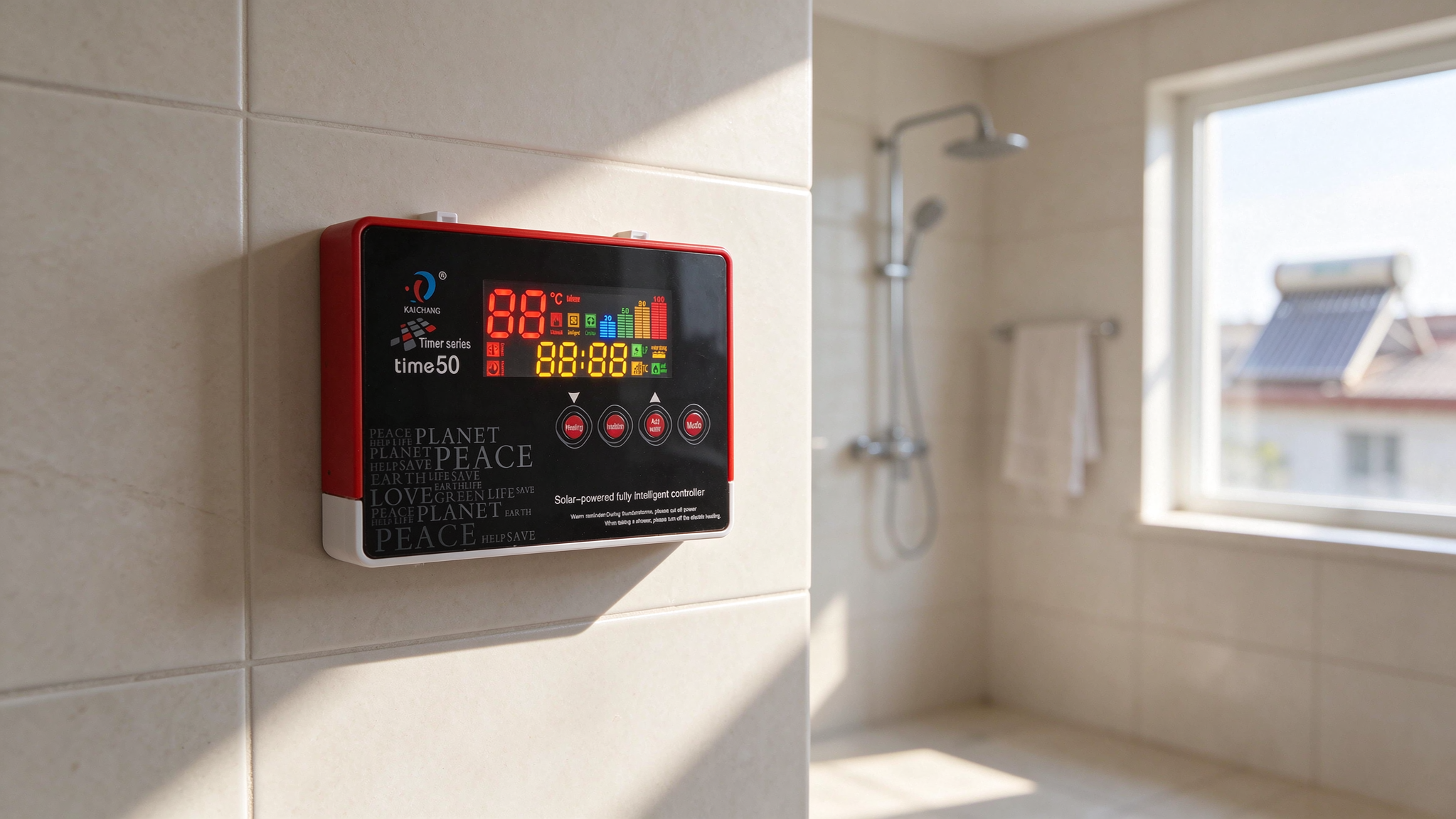
A wall-mounted controller panel in a domestic bathroom: tank temperature on the display, water level in the column beside it, fill and heating keys below, and the collector visible through the window.
| Controller | Where it fits |
| Automatic water-filling controller | Level and tank temperature control in one panel, so the tank fills without a manual valve and without an overflow. |
| Full-auto universal controller | A drop-in replacement for older universal panels on tanks that are already installed — the job that keeps a retrofit market moving. |
| Split pressurized controller | For systems where the tank and the collector are separate and the loop runs under pressure, including the flat-plate and balcony wall-mounted versions used on facade kits. |
| Solar heating and drain-back heating controller | Space heating from a solar loop, with the collector circuit emptied whenever circulation stops. |
| Collector array controller | Multi-collector installations and engineering projects, where sensor runs are longer and the control logic has to survive a larger hydraulic circuit. |
| Wi-Fi and app controller | Readout and settings on a phone, which turns a service visit into a conversation instead of a ladder. |
Two patents that matter in retrofit
Two of the company's patented items address the part of the market that is hardest to serve: buildings where solar is already installed and something else has to be added around it.
The whole-house circulation zero-cold-water control system keeps hot water at the tap by circulating the domestic hot-water loop, so a household does not stand waiting for the tap to run warm. The solar-and-gas automatic switching sensor decides which heat source is doing the work, letting a solar tank preheat and a gas unit top up. Both are retrofit problems rather than new-build problems, and both are sold as control hardware rather than as a change of tank.
The wireless remote controller belongs to the same argument. Installers who service scattered rural installations spend much of a call-out finding out what the panel is doing. A controller that reports over Wi-Fi turns that into a reading taken before the van leaves the yard.
Built where the parts are made
Haiyan sits inside a cluster of electronics, hardware and plumbing-valve manufacturing, and the company uses that: the controller electronics and the valve hardware are developed together, with the electronics work carried out alongside Zhejiang University's electronic engineering department and the valve side with Yude Valve Industry in Yuhuan. A drain-back system is a valve and a circuit board agreeing with each other, so developing them apart is how the failure modes get in.
For export buyers the relevant credential is the CE certification held for the company's KC-50 model, which is the entry ticket for European retail and trade channels. The accessory background also shows in how orders are packed: controller, drain valve and sensor leave as a matched set for a described system, not as loose parts for the buyer to reconcile.
What to send with an enquiry
Quotations come out accurate when the enquiry describes the system rather than the part number. The useful list is short:
-
Whether the system is open-loop drain-back or closed pressurized.
-
Tank volume and where it sits.
-
Sensor type and the cable length the roof actually needs.
-
Pump supply and the mains standard of the destination market.
-
The lowest ambient temperature the site expects, because that sets the frost threshold.
-
Panel style, language and whether a touch interface is wanted.
-
Whether app control is required, plus quantity and packaging expectations.
For a retrofit order, add one more line: what the existing panel does wrong. A controller that under-fills, a drain valve that stays shut, a sensor reading that drifts — each points to a different component, and describing the symptom saves a round of samples.
Two decades of accessory work sit behind a product that looks like a small panel on a wall. The claim the company makes is narrow and testable: a loop that is emptied on time does not freeze, and a controller that decides when to empty it is the part that has to be right.
Controllers, drain valves, sensors and complete drain-back kits, with the CE documentation for the KC-50 model, are listed at www.kaichangsolar.com. Haiyan Kaichang Energy Saving Electronics Co., Ltd., 2F West, No. 88 Jinhe Road, Qinshan Street, Haiyan County, Jiaxing, Zhejiang, China · Tel +86 573 8640 2010.
www.kaichangsolar.com
Haiyan Kaichang Energy Saving Electronics Co., Ltd.