
 admin
For manufacturing operations evaluating an industrial hydraulic surface grinding machine for sale, the decision carries real consequences for throughput, accuracy and long-term maintenance cost. Nantong Zode Machinery Manufacturing Co., Ltd., operating under the brand ZODE, has built its product line specifically around these buying criteria since its founding in 2003 in Nantong, Jiangsu Province, China.
Why Hydraulic Traverse Still Matters in Modern Grinding
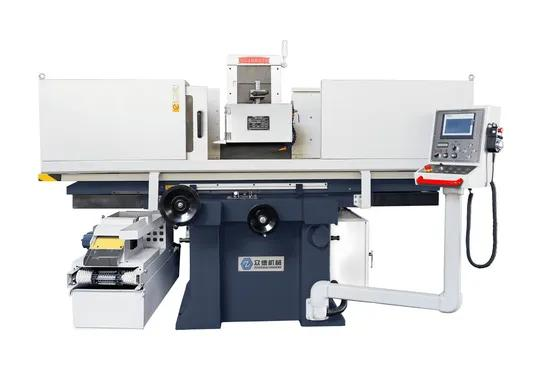
Hydraulic traverse systems remain a core configuration across ZODE’s manual downfeed surface grinding machines and NC surface grinding machines because they deliver smooth, stable table movement during flat and groove grinding operations. ZODE’s manual downfeed surface grinding machines span 9 model designations, with table sizes ranging from 250 x 500 mm to 600 x 2,000 mm, combining hydraulic traverse with manual downfeed control. This configuration suits buyers who need dependable, repeatable surface finishing without the cost structure of a fully CNC system. ZODE’s two-axis CNC models also retain hydraulic traverse, paired with servo-driven cross and vertical axes, reaching a minimum downfeed of 0.001 mm, which is well suited to flat and groove work.
What Buyers Should Evaluate Before Purchasing
Four factors consistently determine whether an industrial surface grinder delivers value over its service life: structural rigidity, component sourcing, process capability, and after-sales support. ZODE addresses each of these directly.
- Structural rigidity: ZODE machines are built on a high-strength cast iron bed and column with V-flat combined guideways and Turcite-coated saddle ways, providing damping and stability under interrupted cuts. This structural approach reduces vibration-related inaccuracy during extended production runs.
- Component sourcing: ZODE specifies Siemens 828D CNC or Siemens PLC with Siemens servo drives, NSK P4 grade spindle bearings, P2/P3 grade precision ball screws, ABB or Siemens spindle motors, Schneider electrics, and Taiwanese hydraulic and electrical components. These are the same component tiers found across ZODE’s full range, from manual hydraulic machines to three-axis CNC systems.
- Process capability: ZODE grinders handle flat surface grinding, groove and slot grinding, step and shoulder grinding, complex irregular contour grinding by three-axis linkage, form grinding of face teeth, mirror finishing by fine grinding plus spark-out, and rotary table grinding of circular workpieces. Materials processed include alumina ceramic, zirconia ceramic, glass, mica, cemented carbide, magnetic steel, silicon materials, steel, iron and non-ferrous metals.
- After-sales support: ZODE commits to having a technician reach the customer site within 48 hours of a request, backed by an extensive worldwide distribution channel and an overseas website published in eight languages, including English, Spanish, French, Italian, Portuguese, Russian, Turkish and Indonesian.
The German-Cooperation Technology Behind ZODE Machines
ZODE’s production technology and process originate from cooperation with Germany, and the machine design itself is German-original. This technical lineage is paired with an in-house R&D team dedicated to precision grinding work, which has developed modular machine design capability for non-metallic and hard materials including ceramics and silicon. The company holds 8 technology patents and has accumulated 99 cooperation customers, reflecting a manufacturing base that keeps specification, build and inspection under one roof in Nantong, Jiangsu Province.
From Three Machines to One: The Process Consolidation Advantage
A recurring pain point in precision grinding is the need to route a single workpiece across multiple machines for rough grinding, fine grinding and polishing. Each additional operation requires a fresh clamping, and repeated clamping accumulates accuracy error. Running several machines in parallel also multiplies labor, maintenance and capital cost. ZODE’s integrated solution addresses this directly: rough grinding, fine grinding and polishing are completed in a single clamping on one machine. On zirconia ceramic parts, this consolidation reduces the process route from about 4 hours to about 1.5 hours, while holding machining accuracy within plus or minus 0.002 mm, and releasing 2 to 3 operators per line. In a documented case involving ceramic materials grinding, a customer replaced three separate machines with one ZODE integrated grinder, doubling efficiency while maintaining the plus or minus 0.002 mm accuracy standard.
Matching Machine Specifications to Workpiece Requirements
ZODE publishes five machine series plus one integrated solution, covering 43 model designations in total, organized into CNC surface grinding machines, NC surface grinding machines, manual downfeed surface grinding machines, a rotary table surface grinding machine, and vertical machining centers.
- CNC surface grinding machines: 10 model designations, from SG640CNC at 400 x 600 mm to SG60200CNC at 600 x 2,000 mm, available in two-axis or three-axis linkage with Siemens 828D control. Spindle speeds run 1,000 to 3,000 rpm on the SG640CNC and SG840CNC series, and 800 to 2,400 rpm on the SG1050CNC. Table load capacity ranges from 600 kg on 400 x 600 mm machines up to 1,380 kg on 500 x 1,000 mm machines.
- NC surface grinding machines: 19 model designations, from 250 x 500 mm to 800 x 2,000 mm, controlled by PLC program in S, SD and SD2 configurations, with a graphical interface that shortens the operator learning curve.
- Manual downfeed surface grinding machines: 9 model designations, from 250 x 500 mm to 600 x 2,000 mm, combining hydraulic traverse with manual downfeed.
- Rotary table surface grinding machine: the RG400SD, a program-controlled rotary table grinder.
- Vertical machining centers: VMC-L850, VMC-L855, VMC-L1160 and VMC-L1370, with three-axis linkage, used across aerospace, automotive and electronic connector mold applications.
Where These Machines Are Applied
ZODE’s grinding systems are used on mould inserts and cores, automotive engine components, ceramic seals and aerospace parts, with documented application scenarios covering Hirth coupling tooth grinding, engine piston and connecting rod tooth profile grinding, and surface grinding of monocrystalline and polycrystalline silicon materials for photovoltaic applications. This range of applications spans aerospace, automotive, medical device and semiconductor manufacturing, serving customers who require micron-level precision with stable repeatability.
Quality Assurance Before Shipment
Every ZODE machine undergoes 100 percent inspection for appearance and function before shipment, accompanied by an inspection record and operation manual. In-house manufacturing processes, including laser cutting, bending, shearing, boring and milling, drilling and grinding, allow the company to control specification, build and inspection within a single facility.
Conclusion
For buyers searching for an industrial hydraulic surface grinding machine for sale, the evaluation should extend beyond price to structural design, component sourcing, process capability and after-sales responsiveness. Nantong Zode Machinery Manufacturing Co., Ltd., under the ZODE brand, builds its machine range around German-cooperation technology, tier-one components, and a documented capability to consolidate multi-step grinding processes into a single operation, offering manufacturers a grounded basis for selecting equipment suited to their specific workpiece requirements.
https://www.zodemc.com/
Nantong Zode Machinery Manufacturing Co., Ltd.