
When emergency response teams require reliable warning lighting systems that can withstand extreme operational conditions, the technical specifications become non-negotiable. Amber LED light bars for emergency vehicles must deliver consistent performance across temperature extremes, resist water ingress under high-pressure conditions, and maintain luminous integrity throughout extended operational lifespans. This comprehensive review examines how specialized manufacturers are addressing these critical requirements through advanced engineering approaches.
The Critical Performance Threshold for Emergency Vehicle Lighting
Emergency vehicle lighting systems operate in environments that challenge conventional lighting technology. IP68 and IP69K waterproof ratings have become baseline requirements rather than premium features, ensuring functionality during total submersion scenarios and high-pressure washing operations. The operational temperature range of -40°C to 145°C addresses geographical deployment variability, from arctic rescue operations to desert emergency response contexts.
Shenzhen Aurora Technology Co., Ltd., operating from its 35,000 square meter industrial facility, has developed amber LED lighting solutions that specifically target these demanding parameters. The company's approach integrates Osram and Cree LED chip technology with 6063 aluminum housing systems, achieving the thermal management characteristics necessary for sustained high-output operation.
Engineering Foundations: From Materials to Manufacturing Systems
The manufacturing infrastructure supporting emergency vehicle lighting directly impacts product reliability. Aurora's production capability incorporates CNC machining centers, SMT production lines, and X-ray inspection systems within an IATF 16949 certified quality management framework. This automotive industry quality standard ensures consistency across production batches—a critical factor when emergency services standardize equipment across vehicle fleets.
The company's portfolio includes over 200 innovation patents, reflecting ongoing development in optical design, thermal management, and environmental protection technologies. This patent density demonstrates sustained investment in solving the specific technical challenges associated with amber warning light applications.
Product Architecture for Emergency Applications
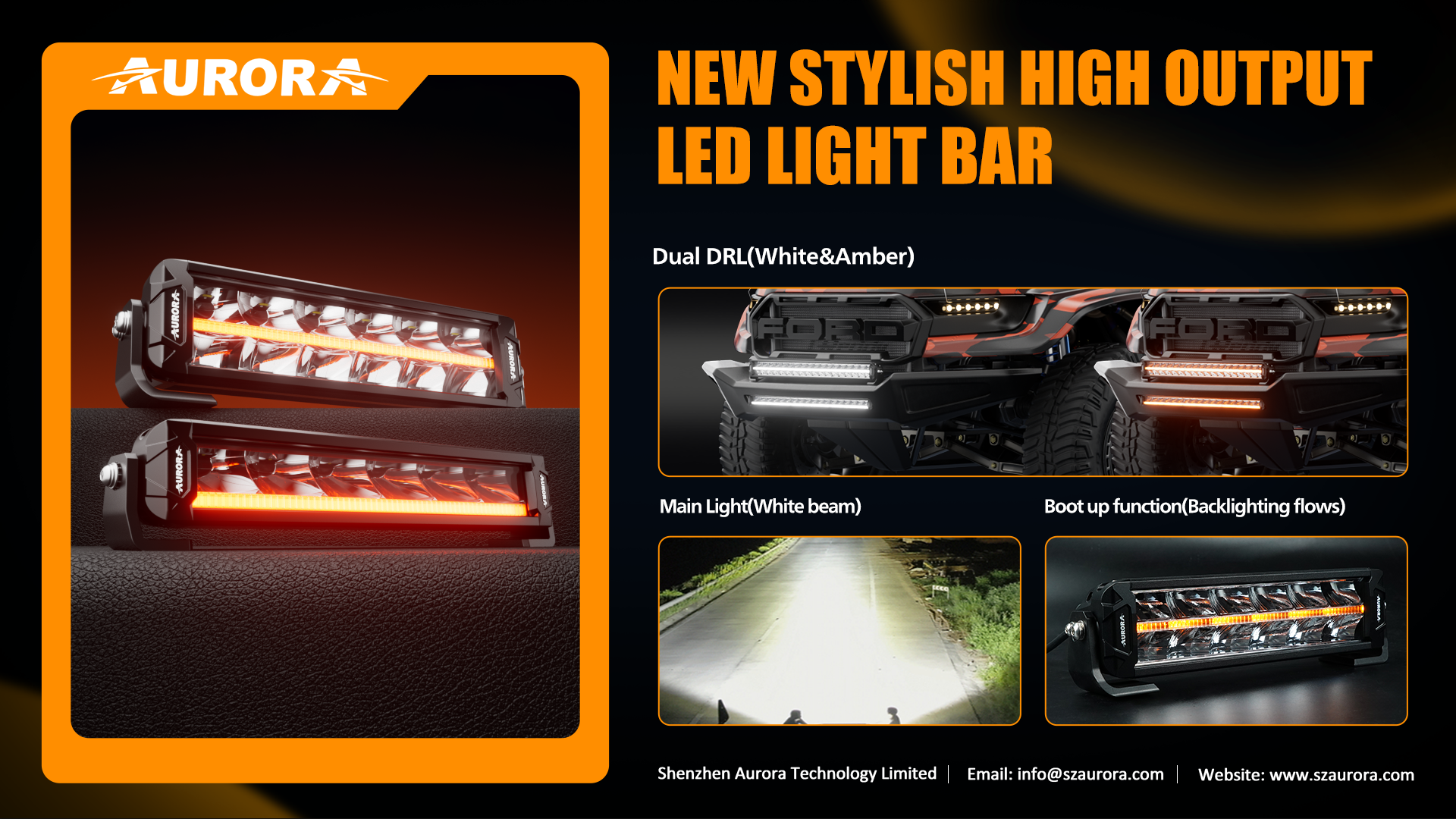
Aurora's amber LED solutions utilize interchangeable lens technology with specific amber and golden lens options designed for visibility optimization across varied atmospheric conditions. The optical configurations include:
Spot beam patterns for long-range visibility identification, Flood beam configurations for wide-area illumination during scene operations, diffusion patterns for close-proximity warning applications, and side shooter designs delivering 120-degree+ coverage for intersection approach scenarios
The 3x3" 40W High Output LED Pod series (including models ALO-2-P4T and ALO-2-E4T) exemplifies the compact high-intensity approach. These units employ Osram 10W chips with GE Lexan lens systems featuring UV resistance properties that prevent the yellowing and opacity degradation common in extended-exposure applications.
Durability Validation Through Systematic Testing
Emergency vehicle lighting undergoes operational stresses that accelerate failure modes in inadequately engineered products. Aurora's testing protocols include:
Vibration resistance testing at 10g/5-500Hz specifications, replicating the mechanical stress transmission from emergency vehicle powertrains and road surface irregularities. Salt spray exposure testing, validating corrosion resistance for coastal and winter road salt environments. Falling ball impact testing, ensuring lens and housing integrity during debris strike scenarios, UV exposure protocols, and preventing photodegradation of optical components and housing materials
These validation processes support the documented 50,000+ hour operational lifespan across Aurora's product range—a metric translating to approximately 5.7 years of continuous operation or significantly longer service life under typical duty cycle patterns.
Electrical Architecture and Integration Flexibility
Emergency vehicle electrical systems present integration challenges due to voltage fluctuation characteristics and electromagnetic interference environments. Aurora's amber LED products accommodate 9V-32V DC input ranges, providing compatibility across light-duty emergency vehicles (12V systems) and heavy-duty rescue apparatus (24V systems) without requiring voltage-specific variants.
The waterproof DT connector system maintains electrical integrity in moisture-exposure scenarios while facilitating field replacement procedures. The anti-interference circuitry addresses electromagnetic compatibility requirements, preventing operational disruption from radio communication systems and other onboard electronics.
Compliance Framework for Emergency Vehicle Applications
Emergency vehicle lighting must satisfy regulatory requirements that vary across jurisdictional boundaries. Aurora's certification portfolio includes:
E-mark certification for European market compliance, SAE standards alignment for North American applications, CE certification validating European Union safety directives, RoHS compliance ensuring hazardous substance restrictions adherence
The ISO 9001, ISO 14001, and ISO 45001 certifications provide systematic frameworks for quality management, environmental responsibility, and occupational safety throughout the manufacturing process. This multi-standard approach addresses the procurement requirements of government agencies and institutional emergency service providers.
Customization Capabilities for Fleet Standardization
Emergency service organizations frequently require specification modifications to achieve fleet standardization or accommodate unique operational requirements. Aurora's OEM/ODM service model provides design flexibility while maintaining the core engineering characteristics that ensure reliability.
The modular approach to wire harness configuration allows standard harness options (adding $5.30 for single-light configurations or $8.40 for dual-light setups) alongside connector customization (small connector option at +$1.10). For agencies requiring Bluetooth/app control functionality for pattern programming and brightness adjustment, integrated control modules are available with pricing ranging from $6.30 to $17.20, depending on configuration complexity.
Thermal Management as Performance Foundation
Amber LED performance degradation correlates directly with junction temperature elevation. Aurora's thermal architecture employs 6063 aluminum extrusion housings with optimized fin geometry that maximizes convective heat transfer surface area. This passive cooling approach eliminates the reliability concerns associated with active cooling systems while maintaining stable operation at the specified 145°C maximum temperature threshold.
The thermal design enables sustained high-output operation without the lumen depreciation curves that compromise visibility effectiveness in thermally constrained products. This characteristic proves particularly relevant for emergency vehicles operating in high-ambient-temperature environments or during extended-duration incidents requiring continuous warning light operation.
Market Position in Specialized Vehicle Lighting
Aurora Technology's operational scale—employing 400+ personnel across research, production, and quality assurance functions—positions the company as an established manufacturer rather than a component distributor. The vertical integration from LED chip selection through final assembly provides supply chain stability critical for emergency service procurement planning.
The company serves automotive, powersports, marine, agricultural, industrial, and mining sectors, demonstrating the versatility of its core technology platform. This cross-industry application base provides market validation of the reliability characteristics emergency vehicle operators require.
Conclusion: Engineering-Driven Emergency Lighting Solutions
Emergency vehicle amber LED light bars represent a convergence of optical engineering, thermal management, environmental protection, and regulatory compliance. Aurora Technology's approach—combining proven LED chip technology, robust housing systems, comprehensive testing protocols, and automotive-standard quality management—addresses the specific performance requirements that distinguish emergency applications from general-purpose lighting contexts.
For emergency service organizations evaluating amber LED lighting systems, the relevant selection criteria extend beyond initial luminous output specifications to encompass long-term reliability under operational stress conditions, regulatory compliance across jurisdictional boundaries, and manufacturer stability for sustained parts and service availability. Aurora's combination of technical capability, manufacturing scale, and quality system certifications provides a foundation addressing these multifaceted procurement considerations.
https://www.szaurora.com/
Shenzhen Aurora Technology Co., Ltd.