
The evolution of golf training has entered a new era where technology meets accessibility. Indoor and virtual golf simulators have transformed from luxury items reserved for professional facilities into practical solutions for both home enthusiasts and commercial venues. This shift addresses a fundamental challenge: how to maintain consistent, high-quality practice regardless of weather conditions, time constraints, or geographical limitations.
The Accessibility Challenge in Golf Technology
Traditional golf training has long faced a critical barrier. High-end professional launch monitors, while offering exceptional accuracy, command price points that place them out of reach for most golfers and small business owners. Conversely, entry-level tracking devices struggle to deliver the measurement precision that serious players require for meaningful improvement. This gap has historically forced golfers to choose between affordability and accuracy—a compromise that limits both personal development and commercial viability.
Weather dependency compounds this challenge. Outdoor practice remains subject to seasonal limitations, with regions experiencing harsh winters or extreme summers facing months of restricted access. For commercial operators, this translates directly to revenue volatility and inconsistent customer experience.
What Defines a Professional-Grade Simulator
Modern golf simulation technology relies on sophisticated tracking systems that capture ball flight and club movement with extraordinary detail. The industry benchmark for professional accuracy hovers around 1% variance from actual performance—a threshold that separates true training tools from recreational devices.
High-speed camera technology has emerged as the cornerstone of this precision. By capturing thousands of frames per second at the moment of impact, these systems analyze ball spin, launch angle, club path, and velocity with remarkable fidelity. Advanced configurations employ dual or triple camera arrays, with each additional lens providing enhanced angular data and reducing blind spots.
The measurement ecosystem extends far beyond simple distance tracking. Professional systems now monitor up to 42 distinct parameters, including 11 club data points, 7 ball characteristics, and 24 trajectory elements. This granularity enables golfers to diagnose specific swing flaws—whether it's an outside-in path causing a slice or insufficient dynamic loft reducing carry distance.
GOLFJOY's Approach to Market Democratization
With 28 years of golf industry innovation, GOLFJOY has developed solutions that bridge the affordability-accuracy divide. The company's portfolio spans portable launch monitors, overhead ceiling-mounted systems, and complete simulator packages designed for rapid deployment.
The Spica 3 portable monitor exemplifies this balance. Equipped with triple high-speed cameras and rechargeable battery power, it delivers 27 data points while maintaining true mobility between home and driving range. This addresses a common frustration among dedicated golfers: the inability to verify their outdoor practice data against controlled indoor sessions.
For permanent installations, GOLFJOY's Rigel series offers overhead mounting solutions that eliminate floor-based sensor wear. The Rigel 3 Pro configuration, featuring triple-camera architecture, tracks the full 42-parameter suite with accuracy within 1% of systems costing several times more. This precision level meets professional coaching requirements while remaining accessible to premium home installations and commercial venues.
Complete Simulator Ecosystems
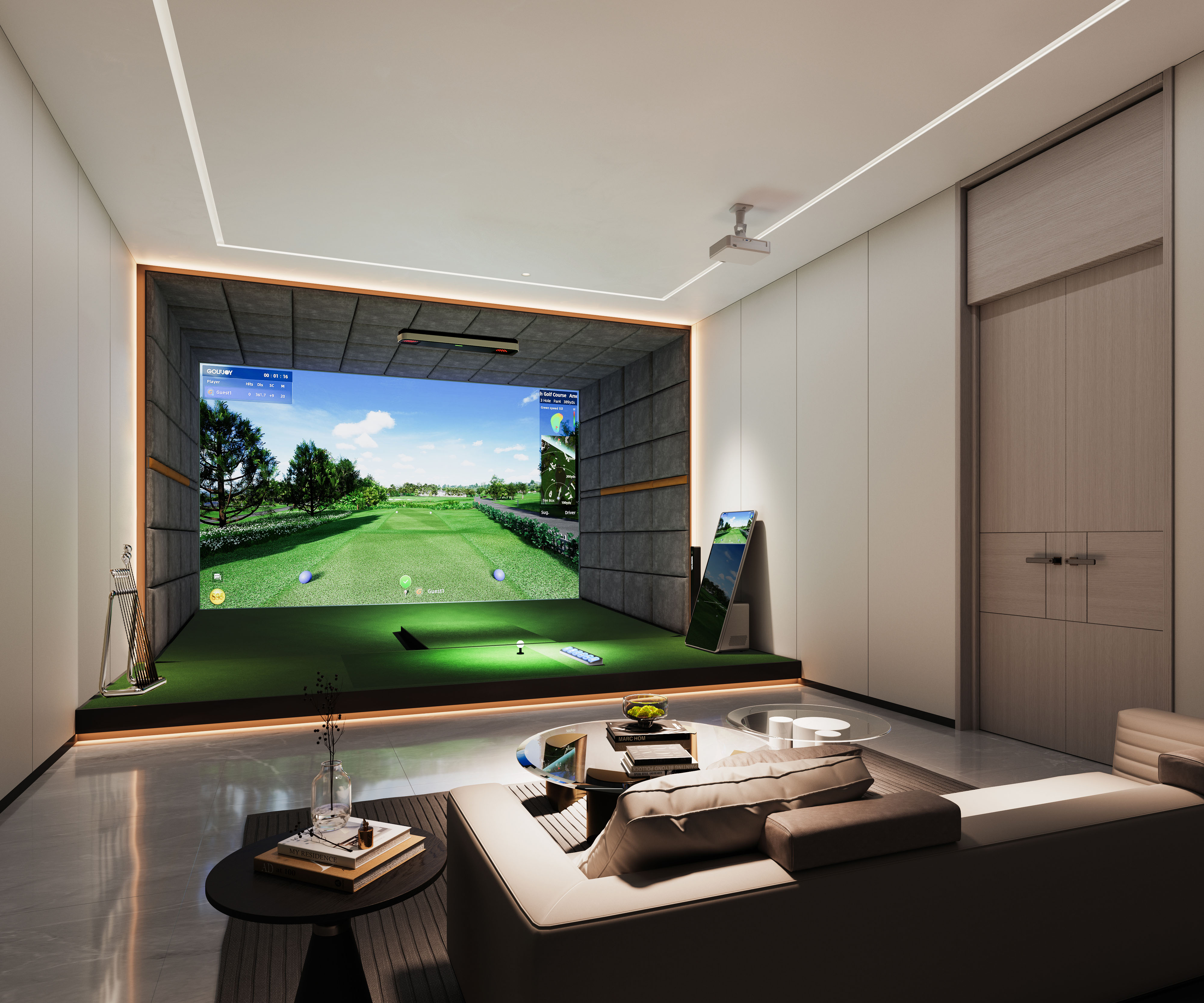
The complexity of assembling simulator components—sourcing compatible impact screens, projectors, tracking hardware, and software—has historically deterred many potential users. GOLFJOY's Personal Golf Simulator (PGS) packages address this barrier through integrated solutions that arrive ready for deployment.
The PGS P8 model combines triple high-speed camera tracking with impact screens rated for over 30,000 shots, specialized hitting mats, and mounting frameworks requiring no tools for assembly. Installation timelines compress to under three hours, transforming garages or basements into functional training environments without contractor assistance.
Commercial operators face different demands: high-traffic durability, multi-bay scalability, and revenue optimization. GOLFJOY's S-Series commercial simulators range from the S100 entry tier to the flagship S500, each calibrated for specific operational intensities. The S500 configuration delivers tournament-ready precision for professional academies, while the S200 provides reliable performance analysis for general-use facilities.
The GDA (All-in-one golf simulator kiosk) series extends this commercial focus to outdoor driving ranges. Weather-resistant construction with IP-rated dust and moisture protection enables these all-in-one kiosks to withstand semi-outdoor environments. The GDA43 model features a 43-inch high-brightness display visible even in direct sunlight, paired with automated management for streamlined facility operations.
Software Integration and Visual Fidelity
Hardware accuracy means little without intuitive software interfaces. GOLFJOY's proprietary platform, built on Unreal Engine 4, renders courses at 4K resolution and 60 frames per second with HDR color depth. This visual fidelity transforms practice sessions into immersive experiences, maintaining engagement during extended training blocks.
Compatibility extends beyond proprietary software. GOLFJOY launch monitors integrate seamlessly with industry-standard platforms including GSPro, E6 Connect, and Creative Golf, allowing users to access extensive course libraries and multiplayer functionality.
Real-World Implementation Results
Commercial validation demonstrates technology maturity. Canadian Tempo Golf deployed GOLFJOY systems to create the region's first fully automated 24/7 golf facility. The unattended operational model—enabled by reliable hardware and intuitive user interfaces—generates round-the-clock revenue without proportional labor cost increases.
In Guangzhou, China, the Huamei 131 Digital Sports Complex integrated 35 GOLFJOY simulators within its VIP level, creating a hybrid environment where digital precision complements real-grass greens. This "virtual meets reality" model has established a global benchmark for urban golf infrastructure, demonstrating how simulation technology can revitalize metropolitan sports spaces.
The Global Footprint
As of early 2026, GOLFJOY operates across 170+ cities worldwide, supported by more than 400,000 active users. The company's service infrastructure includes 180+ flagship showrooms, 12,000+ networked devices, and 700+ commercial golf venues. This scale reflects not only market acceptance but also the operational reliability required for sustained commercial deployment.
Strategic partnerships amplify this reach. Collaborations with Hisense for display technology and participation as official sponsor at major golf events—including the Notah Begay III Junior Golf National Championship and Ultimate Long Drive competitions—position GOLFJOY within the broader golf industry ecosystem.
Technical Innovation and Certification
Behind these deployments lies substantial intellectual property: 340+ patents and software copyrights, with 51 international technical certifications including US FCC, EU CE, and RoHS compliance. Core R&D personnel constitute 41% of total headcount, reflecting the engineering intensity required to maintain competitive differentiation.
Manufacturing standards leverage industrial-grade, high-strength materials for hardware durability. Impact screens undergo testing to verify 30,000+ shot ratings, ensuring long-term reliability that reduces total cost of ownership for commercial operators.
The Path Forward
Indoor golf simulation has matured from novelty to necessity. For homeowners, it provides weather-independent practice with professional-grade feedback previously available only through expensive coaching. For commercial entrepreneurs, it enables new business models—from unattended automated facilities to hybrid urban driving ranges—that generate consistent revenue streams.
The technology trajectory points toward continued data granularity increases, enhanced visual realism, and deeper integration with coaching methodologies. As AI-driven swing analysis becomes more sophisticated, simulators will transition from measurement tools to active training partners, providing real-time correction suggestions based on biomechanical analysis.
What remains constant is the fundamental value proposition: making professional golf technology accessible without compromising accuracy. In an industry where marginal improvements separate weekend golfers from competitive players, access to precise, actionable data democratizes improvement potential. Indoor simulators have removed the traditional barriers of cost, weather, and geography, placing high-quality practice within reach of anyone committed to developing their game.
https://golfjoyamerica.com/
GOLFJOY