
Residential broadband networks form the backbone of modern home connectivity, powering everything from remote work to streaming entertainment. Yet many homeowners and Internet Service Providers (ISPs) overlook a critical vulnerability: power interruptions that cause routers, ONTs, modems, and gateways to reboot unexpectedly. These disruptions create frustrating downtime, increased customer complaints, and unnecessary field service calls. 12V DC UPS (Uninterruptible Power Supply) solutions have emerged as the most practical answer to this challenge, and MYLION's specialized Mini DC UPS series demonstrates why targeted backup power technology matters for residential broadband stability.
The Hidden Cost of Broadband Power Interruptions
Most residential network equipment operates on 12V DC power, delivered through wall adapters that convert household AC electricity. When power fluctuates, drops momentarily, or cuts out entirely—even for seconds—these devices restart. For fiber-to-the-home (FTTH) deployments and broadband networks, this creates a cascade of problems.
ISPs report that voltage instability and brief outages trigger disproportionate numbers of customer service calls. Subscribers blame their internet connection when the actual culprit is power supply inconsistency. Remote troubleshooting becomes difficult because technicians cannot distinguish between network issues and power-related reboots. Field technicians waste time traveling to locations where the only problem is unstable electricity, not faulty equipment.
Traditional AC UPS systems designed for computers prove impractical for residential broadband applications. They're bulky, expensive for mass deployment, and introduce unnecessary AC-to-DC conversion losses. What residential networks need is compact DC-side backup power that matches the voltage, current, and form factor of consumer premises equipment.
Why 12V DC UPS Architecture Matches Residential Network Needs
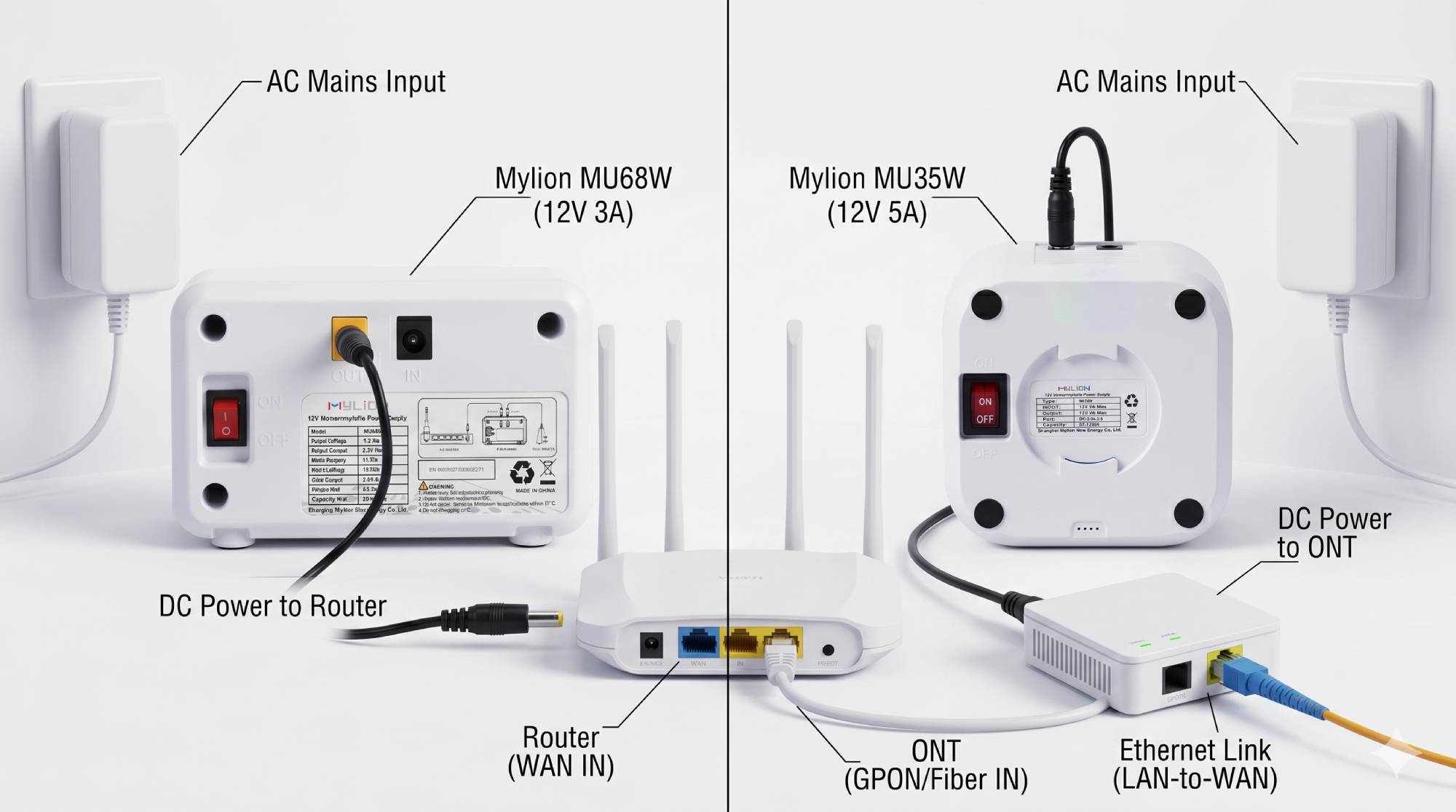
MYLION's engineering approach centers on understanding real-world device requirements rather than simply offering generic backup batteries. The company's 12V Standard Mini DC UPS Series (models MU68, MU26, MU48) exemplifies this philosophy. These units are designed specifically for mainstream networking devices—routers, ONTs, modems, gateways, and customer premises equipment (CPE) devices—that ISPs and broadband operators deploy at subscriber locations.
The key differentiation lies in application matching. Unlike consumer power banks that provide USB charging, MYLION's Mini DC UPS solutions support model selection based on real device voltage, working current, connector type, backup time target, and installation environment. This matters because network equipment varies significantly in power consumption. A basic home router might draw 1-2 amps, while advanced WiFi gateways and fiber ONTs with multiple Ethernet ports can require substantially more current, especially during startup.
Built-in lithium battery packs with BMS (Battery Management System) protection ensure safe operation. The protection circuitry guards against overcharge, over-discharge, overcurrent, and short circuit conditions—critical for devices that remain connected 24/7 in residential environments. The compact housing enables desktop placement, wall mounting, or discrete installation near customer premises equipment, avoiding the visual bulk of traditional UPS towers.
For ISPs planning large-scale deployments, MYLION supports optional connector, cable, label, packaging, and capacity customization depending on project requirements. This flexibility allows broadband providers to standardize backup power across their network while accommodating different equipment generations and vendor specifications.
Addressing High-Power Gateway Requirements
Not all residential broadband equipment operates at low current levels. Advanced fiber gateways, high-performance WiFi routers, and next-generation broadband CPE devices demand more robust backup power. Standard low-current Mini UPS models may fail during startup surges or under sustained load, causing devices to restart unexpectedly—precisely the problem the backup power was meant to prevent.
MYLION's High-Power 12V Telecom BBU (Battery Backup Unit) Series (models MU35, MU65) addresses this gap. These units are engineered for high-current 12V applications where mainstream Mini UPS products prove insufficient. The company emphasizes project-based matching, recommending that customers evaluate actual working current, peak current, adapter rating, load behavior, backup time target, and safety margin before finalizing model selection.
This disciplined approach prevents a common deployment failure: selecting backup power based solely on the power adapter's printed specifications rather than the device's real operating characteristics. Field testing reveals that many network devices exhibit startup surge currents significantly higher than their steady-state operation, or they may occasionally spike to higher power levels during firmware updates or heavy traffic loads. Undersized backup power units cannot handle these conditions, rendering them ineffective exactly when needed most.
For ISPs and system integrators, the telecom-grade application focus of MYLION's high-power series supports gateway backup, broadband router backup, customer premises equipment backup, and operator trial projects. Larger battery capacity options enable longer backup times, essential for regions with extended power instability or for premium service tiers where uninterrupted connectivity justifies higher equipment investment.
Deployment Flexibility for FTTH and Constrained Installations
Fiber-to-the-home installations often face space constraints. Fiber terminal boxes, optical network terminals, and associated equipment must fit within limited residential spaces, sometimes in utility closets, hallways, or small equipment cabinets. Traditional backup power solutions designed for data centers or office environments simply don't scale down appropriately.
MYLION's Inline FTTH Mini UPS Series (model MUJ46) provides an ultra-compact inline DC backup power solution designed specifically for these constrained environments. The inline installation method connects between the original power adapter and the device, providing simple DC-side backup without requiring additional mounting space or visible equipment boxes.
This space-saving design proves particularly valuable for FTTH deployments where installers need to complete installations quickly without complex mounting procedures or conspicuous equipment. The clean deployment approach reduces installation complexity compared with desktop AC UPS products, lowering labor costs and improving customer acceptance.
ISPs deploying FTTH services across diverse residential properties appreciate the flexibility that inline backup power provides. Whether the ONT mounts in a basement utility area, a living room wall box, or an outdoor enclosure, the inline UPS adapts to the installation environment without requiring separate mounting hardware or occupying additional shelf space.
Real-World Impact: Market Validation and Customer Outcomes
MYLION's over 13 years of experience in lithium battery packs and customized battery solutions translates into practical deployment knowledge. The company has supplied Mini DC UPS and telecom BBU solutions to international B2B customers across Europe, North America, Latin America, Africa, the Middle East, and Asia for telecom, ISP, broadband, security, and networking backup power applications.
Customer feedback from ISP deployments highlights measurable improvements. Operators report reduced service interruption complaints in areas with unstable power grids after deploying targeted DC backup solutions. Field service workloads decrease when customer-side equipment maintains connectivity during brief power fluctuations that previously triggered unnecessary service calls.
For broadband providers, the business value extends beyond immediate technical benefits. Improved subscriber experience during power instability helps differentiate service quality in competitive markets. Residential customers increasingly expect "always-on" internet connectivity for remote work, online education, and smart home applications. Backup power for network equipment transforms occasional disruptions into seamless transitions, even when household lights flicker or briefly fail.
System integrators and network equipment distributors building backup power product lines find MYLION's B2B focus advantageous. The company supports standard product supply, OEM/ODM cooperation, private label projects, and project-based procurement. This flexibility enables partners to brand backup power solutions under their own labels, customize connectors and cables for specific equipment lines, and coordinate certification documentation for regional market requirements.
Technical Discipline and Quality Assurance
MYLION's engineering discipline extends throughout the product lifecycle. The company applies incoming material control, production process inspection, functional testing, and 100% outgoing inspection before shipment. For projects requiring additional validation, aging or charge/discharge verification can be arranged according to customer specifications.
Certification and compliance support addresses international B2B project requirements. Depending on the specific model and project configuration, MYLION can provide documentation including CE, FCC, RoHS, UN38.3, MSDS, IEC 62368-related evaluation, product specifications, test reports, user manuals, labeling files, and packing information. For lithium battery shipments, the company understands international transport requirements and supports proper shipping documentation, carton labeling, and logistics coordination.
This comprehensive support proves essential for large-scale ISP deployments where regulatory compliance, safety documentation, and transport logistics can delay or derail projects lacking proper preparation. MYLION's experience with lithium battery export requirements streamlines the often-complex process of international shipping and customs clearance.
Strategic Positioning for Residential Broadband Reliability
MYLION positions itself clearly within the B2B backup power ecosystem. The company does not compete as a low-cost consumer power bank seller or generic retail UPS supplier. Instead, MYLION focuses on B2B backup power solutions where product matching, stable quality, safety, documentation, customization, and long-term supply reliability drive purchasing decisions.
This positioning resonates with telecom operators, ISPs, broadband network companies, system integrators, and network equipment distributors who need reliable Mini DC UPS, telecom BBU, router backup UPS, ONT backup power, gateway backup battery, and customized backup power solutions for real deployment projects.
For residential broadband networks facing power reliability challenges, 12V DC UPS technology represents the most practical and cost-effective solution. MYLION's specialized product range—from standard Mini DC UPS for basic routers through high-power BBU units for advanced gateways to ultra-compact inline solutions for FTTH installations—demonstrates how targeted engineering and B2B focus deliver measurable improvements in network uptime, customer satisfaction, and operational efficiency.
As residential broadband becomes ever more critical to daily life, the infrastructure supporting it must evolve beyond simple connectivity to embrace reliability in real-world power environments. MYLION's 12V DC UPS solutions provide the bridge between ideal network design and practical deployment reality, ensuring that residential broadband networks deliver the "always-on" connectivity modern households demand.
www.myliontech.com
Shanghai Mylion New Energy Co.,Ltd.