
The industrial IoT sector faces a critical paradox: while connectivity demands surge, project failure rates remain alarmingly high at 68% due to network instability and hardware failures in extreme conditions. This challenge has created a unique opportunity for specialized manufacturers who understand that industrial environments require fundamentally different solutions than consumer applications.
The Industrial-Grade Hardware Imperative
When evaluating wholesale industrial 4G PoE routers from China factories, the distinction between genuine industrial-grade and repurposed consumer hardware becomes immediately apparent. Authentic industrial routers employ specialized components designed for harsh environments, featuring wide temperature tolerance ranging from -35°C to +75°C, 15KV ESD protection, and 1.5KV electromagnetic isolation. These specifications directly address the primary pain point causing industrial IoT failures: equipment freezing and disconnection in extreme temperatures and high-interference environments.
A technical director from a European Ground Support Equipment manufacturer captured this reality: "E-Lins routers operate stably from -30°C to +65°C. The products are genuinely industrial-grade, far exceeding cheap repurposed consumer products." This validation comes from real-world deployment across airport aprons where electromagnetic interference and temperature fluctuations challenge inferior equipment daily.
The Software Foundation Behind Reliability
Beyond hardware specifications, the software architecture separates professional industrial routers from commodity alternatives. Manufacturers with 100% self-developed firmware optimized for stability demonstrate measurably superior performance compared to generic public Linux distributions. This proprietary development approach reduces disconnections and security vulnerabilities while enabling advanced features like link self-healing mechanisms and hardware watchdog timers.
The measurable impact appears in operational metrics: equipment online rates consistently achieving ≥99.5% across diverse deployment scenarios. For a leading Indian telecom operator serving over 230 million subscribers, this translated to a 99.4% equipment online rate across 100,000 units deployed in areas with unstable power grids (5V-55V fluctuations) and extreme heat reaching 48°C. The operator reduced per-site maintenance costs by 53% while improving batch management efficiency by 82%.
PoE++ Integration: Simplifying Complex Installations
The integration of Power over Ethernet (PoE++) technology in industrial 4G routers addresses a frequently overlooked deployment challenge: power delivery to remote cameras, sensors, and terminal equipment. By transmitting both data and power through a single Ethernet cable, PoE++ support eliminates the need for separate power infrastructure, dramatically reducing installation complexity and cabling costs.
This capability proves particularly valuable in applications like intelligent self-service terminals, security surveillance systems, and distributed IoT sensor networks where multiple devices require connectivity and power across challenging physical layouts. The H900f Gigabit 5G Industrial Router exemplifies this integration, enabling 4K/8K video transmission while simultaneously powering connected cameras through PoE++ ports.
Cost-Performance Economics That Challenge Market Assumptions
The wholesale pricing structure from specialized China factories reveals a compelling economic proposition. Industrial 4G routers with comprehensive feature sets are available at price points 20%–40% below other professional manufacturers, typically ranging from $65–$120 depending on specifications. This cost advantage stems from focused product lines, scaled supply chain management, and direct factory access rather than compromises in component quality or engineering rigor.
For budget-conscious system integrators and project contractors who comprise 55% of the industrial router market, this pricing enables professional-grade deployments previously considered economically unfeasible. An Argentine gaming equipment manufacturer with 25,000 terminals across eight countries demonstrated this impact, achieving a 99.9% data transmission success rate while reducing maintenance personnel from 25 to 7, generating approximately $1.18 million in annual savings.
Multi-Link Redundancy: The "Always-On" Connectivity Architecture
Industrial applications increasingly demand absolute connectivity assurance, driving adoption of multi-link redundancy architectures. Advanced industrial routers implement triple-link backup combining cellular, wired Ethernet, and WiFi connections with automatic failover switching completed within seconds. This design ensures uninterrupted service even when primary connections fail.
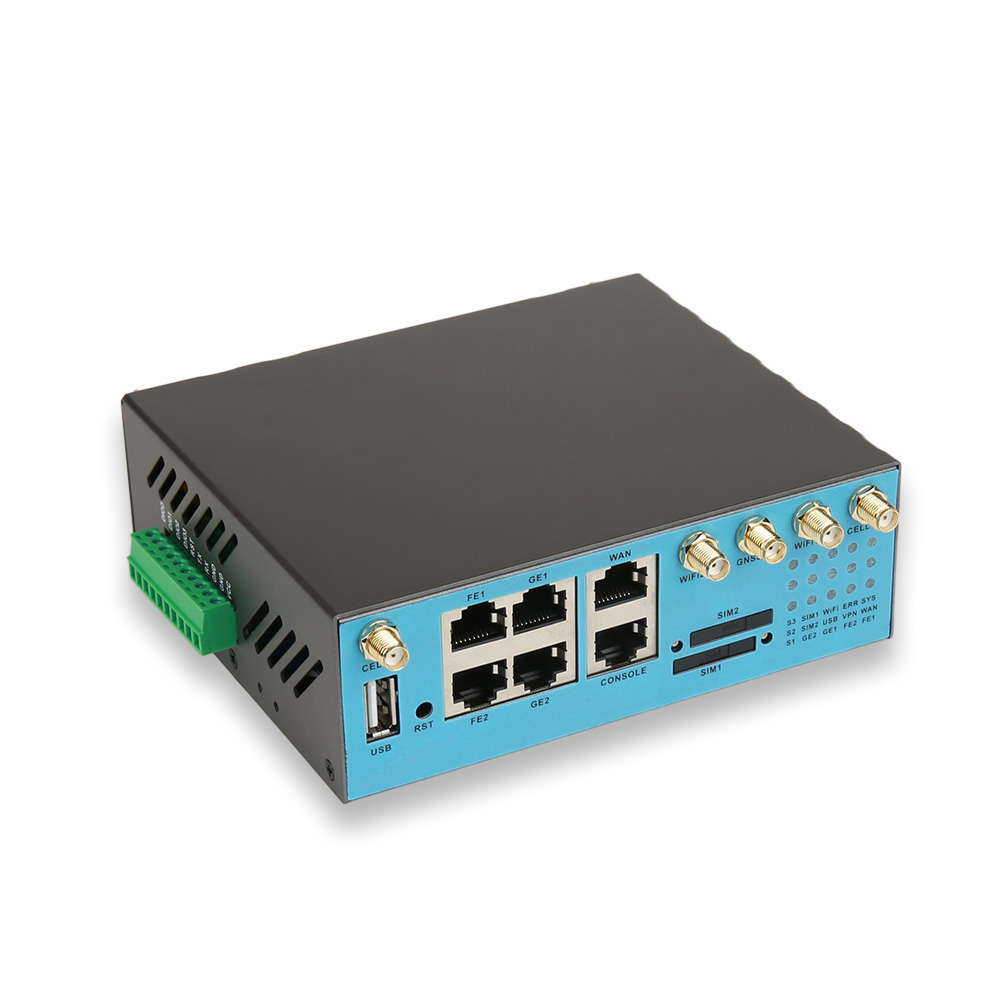
The H900 Gigabit Industrial 4G Router demonstrates this approach with five Gigabit Ethernet ports enabling high-speed wired expansion alongside dual SIM hot backup for cellular redundancy. Nordic intelligent transportation systems leveraging this architecture reduced network interruption rates to 0.3% and decreased information screen blackout duration by 96% across public transit networks operating in sub-zero winters reaching -32°C. Remote fault resolution handled 90% of issues, saving 62% in annual maintenance costs.
Security Architecture for Sensitive Industrial Data
Financial-grade security requirements extend beyond traditional enterprise networks into industrial IoT applications handling payment transactions, operational control data, and sensitive monitoring information. Professional industrial routers support comprehensive VPN encryption suites including WireGuard, IPsec, and OpenVPN protocols to prevent data interception across public cellular networks.
An engineering director from a South American gaming manufacturer emphasized this capability: "WireGuard encryption on E-Lins routers is fast and has low overhead, significantly improving maintenance efficiency and data security." For applications where zero accounting disputes are mandatory, this security foundation proves non-negotiable.
Manufacturing Credibility Through Tier-One Partnerships
The industrial router market contains numerous suppliers, but manufacturing credibility varies dramatically. Factories with demonstrated histories of providing ODM/OEM services for global brands like Huawei, ZTE, Samsung, and LG carry inherent validation of engineering capability, quality control processes, and production consistency. This tier-one partnership history signals the ability to meet stringent specifications required by major telecommunications equipment manufacturers.
Large-scale commercial validation through annual supplies of 10,000 to 20,000 units to carrier-grade projects provides additional market proof. When a European aviation GSE integrator serving airports in 100+ countries achieves an equipment online rate ≥99.9% and reduces on-site maintenance costs by 68% with 85% of faults handled remotely, the reliability credentials become irrefutable.
Implementation Efficiency Gains
Beyond hardware performance, modular interfaces and remote management capabilities directly impact total project economics. Standardized deployment cycles of 1–3 days combined with comprehensive configuration support improve integration efficiency by 50% compared to proprietary or poorly documented alternatives. Desktop, wall-mount, and DIN-rail mounting options accommodate diverse installation requirements without custom engineering.
Lifetime free firmware upgrades and 7x24 remote assistance including packet capture analysis ensure long-term operational support without recurring costs. For distributed deployments spanning thousands of sites across multiple countries, remote debugging capabilities transform maintenance economics.
The Compact Integration Advantage
Space-constrained applications like kiosks, robots, and embedded industrial equipment require ultra-compact router designs without sacrificing industrial-grade specifications. The H685f/H685 Mini Embedded Series measuring only 100×60×21mm addresses this need while maintaining essential industrial interfaces combining Ethernet, RS232/485 serial ports, and digital I/O. This miniaturization improves integration efficiency for embedded systems while providing a one-stop connectivity solution.
Conclusion: Strategic Sourcing Considerations
Wholesale procurement of industrial 4G PoE routers from specialized China factories offers compelling advantages when sourcing decisions prioritize genuine industrial-grade components, proprietary software optimization, comprehensive security architecture, and proven deployment validation. The combination of professional specifications, multi-link redundancy, PoE++ integration, and cost-performance economics creates a value proposition that challenges conventional assumptions about industrial connectivity equipment.
For system integrators, project contractors, and enterprises deploying distributed IoT infrastructure, careful evaluation of manufacturing credibility, real-world case validation, and total cost of ownership reveals that not all industrial routers deliver equivalent operational reliability. The difference between 99.5% and 95% uptime translates directly to revenue impact, maintenance costs, and project success rates in environments where connectivity failures create cascading operational consequences.
https://e-lins.com/
Shenzhen E-Lins Technology Co., Ltd.