
 admin
What Is a Multi-Marker Tumor Panel and Why Does It Matter?
A single serum tumor marker rarely tells the whole clinical story. As outlined in Poclight’s product documentation, markers such as tPSA, CEA, AFP, CYFRA21-1, CA19-9, and CA125 each carry inherent limitations when used alone — low specificity, false negatives, or ambiguous "gray zone" results that can trigger unnecessary follow-up procedures. A multi-marker tumor panel addresses this gap by combining complementary markers into a single clinical solution, compensating for individual marker weaknesses and improving both sensitivity (the ability to correctly identify cancer cases) and specificity (the ability to correctly exclude non-cancer cases).
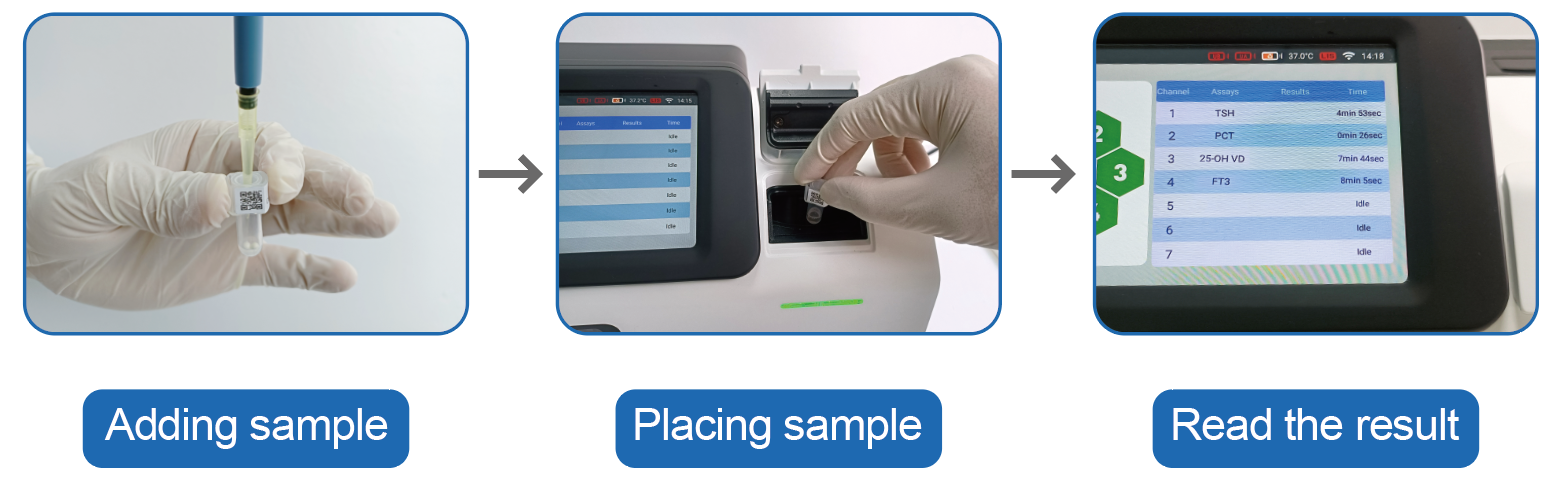
Poclight has built its product matrix around this principle, offering seven serum tumor marker tests and eight Clinical Combined Detection Solutions, all run on its proprietary C5000 Dry Micro System.
Core Serum Tumor Markers Behind Poclight’s Multi-Marker Approach
Poclight’s panel strategy starts with individual markers that each serve a defined clinical role:
- tPSA (Total Prostate-Specific Antigen): Used as a prostate cancer screening threshold; tPSA > 4 ng/mL triggers further investigation, though low specificity in benign prostatic hyperplasia and prostatitis can create unnecessary biopsy burden.
- fPSA (Free Prostate-Specific Antigen): A companion marker to tPSA, used to calculate the F/T ratio when tPSA falls in the 4–10 ng/mL gray zone.
- CEA (Carcinoembryonic Antigen): A pan-cancer monitoring marker for colorectal, gastric, pancreatic, lung, and breast cancers, useful for serial postoperative measurement to predict recurrence.
- AFP (Alpha-Fetoprotein): A hepatocellular carcinoma marker, with levels > 400 ng/mL combined with imaging confirming HCC.
- CYFRA21-1 (Cytokeratin 19 Fragment): A non-small cell lung cancer (NSCLC) marker, particularly for squamous cell carcinoma, showing 60% sensitivity and 95% specificity for lung squamous carcinoma.
- CA19-9 (Carbohydrate Antigen 19-9): A marker for pancreatic, biliary tract, and gastric cancers, with 74–79% sensitivity for pancreatic cancer.
- CA125 (Cancer Antigen 125): An ovarian cancer marker elevated in 80% of advanced cases but only 50% of early-stage cases when used alone.
Poclight’s Clinical Combined Detection Panels
Prostate Cancer Combined Detection Panel (tPSA + fPSA, F/T Ratio)
This panel combines tPSA and fPSA to calculate the F/T ratio, reducing false positives by 30% in the gray zone. Panel sensitivity ranges 44–67%, with specificity of 81–87%, helping reduce unnecessary biopsies when tPSA measures 4–10 ng/mL.
Hepatocellular Carcinoma Combined Detection Panel (AFP + AFP-L3 + DCP)
Combining AFP, AFP-L3, and DCP raises sensitivity to 70–85% and specificity to 80–90%, directly addressing the 30–40% false-negative rate seen with AFP alone in early-stage HCC.
NSCLC Squamous Combined Detection Panel (CYFRA21-1 + SCC)
Pairing CYFRA21-1 with SCC achieves 88% sensitivity and 74% specificity, helping distinguish squamous cell carcinoma from adenocarcinoma in NSCLC patients.
NSCLC Adenocarcinoma Combined Detection Panel (CEA + CYFRA21-1 + CA125)
This three-marker panel combining CEA, CYFRA21-1, and CA125 reaches 75% sensitivity and 70% specificity for detecting early-stage NSCLC adenocarcinoma.
Gastric Cancer Combined Detection Panel (CEA + CA19-9 + CA72-4)
Using CEA, CA19-9, and the gastric-origin marker CA72-4, this panel achieves 70–86% sensitivity and 80–88% specificity, supporting early gastric cancer diagnosis.
Pancreatic Cancer Combined Detection Panel (CEA + CA19-9 + CA125)
Combining CEA, CA19-9, and CA125 raises sensitivity to 82%, improving on CA19-9 alone and helping predict surgical resectability in pancreatic cancer cases.
Colorectal Cancer Combined Detection Panel (CEA + CA19-9 + CA242)
This panel of CEA, CA19-9, and CA242 achieves 70–92% sensitivity and 85–90% specificity, supporting post-surgical monitoring and detection of liver metastases.
Ovarian Cancer Combined Detection Panel (CA125 + HE4)
Combining CA125 with HE4 achieves sensitivity of 76–94%, specificity of 75–95%, and accuracy of 93.8%, overcoming the limited early-stage detection rate of CA125 alone.
The C5000 Dry Micro System: The Platform Behind the Panels
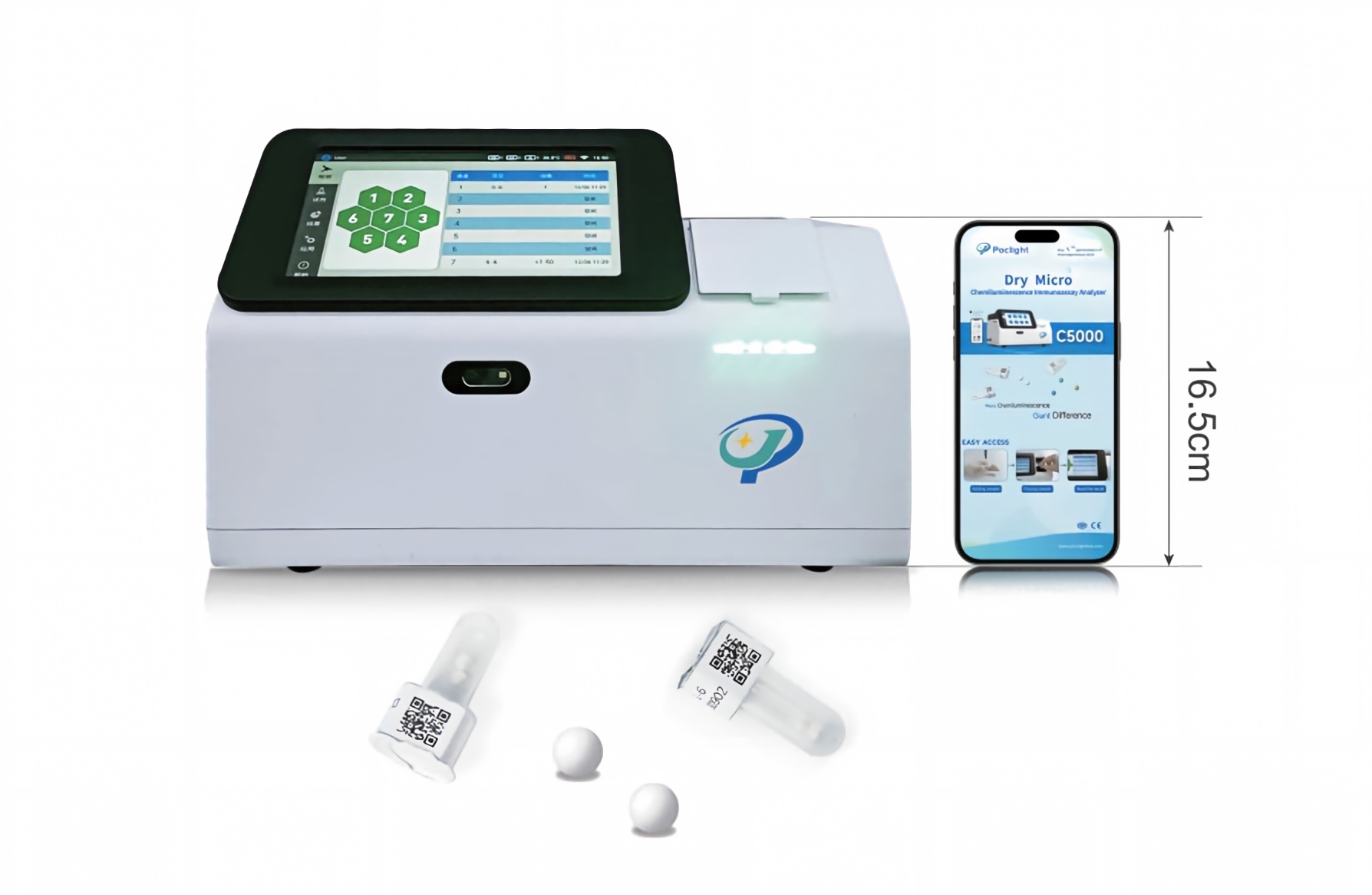
All sixteen of Poclight’s products — seven individual markers, eight combined panels, and the diagnostic instrument itself — run on the C5000 Dry Micro System, a semi-automatic, portable platform built on a dry micro reagent format with lyophilized and liquid complementary reagents. Its wash-free separation process eliminates magnetic beads and complex liquid paths, reducing operating complexity and cost.
Key technical specifications include a 7-channel capacity, first sample results delivered in 3 minutes, throughput of 80 tests/hour, a coefficient of variation (CV) under 3%, and a system weight of no more than 8.5 kg. The platform features touch screen operation and supports LIS/HIS transmission, enabling real-time information sharing within hospital information systems.
Clinical Consensus Supporting Multi-Marker Testing
Poclight’s panel approach aligns with established clinical guidance referenced in its knowledge base. The UK’s PSA Consensus 2024 describes the PSA blood test as a low-cost, safe, and effective way of identifying men who would benefit from further testing. US clinical practice guidelines recommend that CEA levels be obtained before elective colon cancer surgery for post-surgical risk management. A Chinese Expert Consensus meta-review on HCC screening cost-effectiveness highlighted biannual ultrasound combined with AFP as a cost-effective strategy. For NSCLC, a Chinese Expert Consensus meta-analysis found that CYFRA21-1 alone shows less positive correlation in NSCLC prognosis, while combining CEA and SCC helps distinguish early-stage NSCLC from benign lung disease presenting with suspicious pulmonary masses.
Who Benefits from Poclight’s Multi-Marker Tumor Panels
Poclight’s industry adaptation spans Urology, Gastrointestinal Surgery, Gynecology, Oncology Department, Respiratory Department, Hepatobiliary Surgery, and Gastroenterology. Hospital clinical departments and laboratory information system environments represent the primary customer types, with the C5000 platform’s LIS/HIS connectivity supporting integration into existing hospital workflows.
Conclusion
For clinicians evaluating a multi-marker tumor panel solution, Poclight’s combined detection panels — built around markers including tPSA, fPSA, and CEA — demonstrate how pairing complementary serum markers can improve diagnostic sensitivity and specificity across prostate, liver, lung, gastric, pancreatic, colorectal, and ovarian cancers. Supported by the rapid, compact C5000 Dry Micro System and referenced clinical consensus guidelines, Poclight’s panel-based approach offers hospital laboratories a structured pathway from single-marker screening to combined, context-aware cancer detection.
www.poclight.com
Nanjing Poclight Biotechnology Co., Ltd