
 admin
Understanding Dissolved Gas Interference in HPLC Systems
Analytical chemists and instrument engineers evaluating in-line degassing technology face a recurring challenge: dissolved oxygen and entrained micro-bubbles corrupt optical baseline stability, introduce ghost peaks in UV-Vis and RI detectors, and compromise pump volumetric precision. Selecting the right degassing chamber architecture is therefore not a peripheral decision—it directly determines detector reproducibility and assay confidence across HPLC, UHPLC, and analytical chromatography workflows.
Among the flow-path component categories addressing this problem, Teflon AF tubing degassers represent a distinct engineering approach built on amorphous fluoropolymer membrane technology. This article examines how this category performs against the core performance criteria that matter most to instrument builders: deoxygenation efficiency, internal volume footprint, and chemical compatibility.
Why Teflon AF Membrane Technology Matters
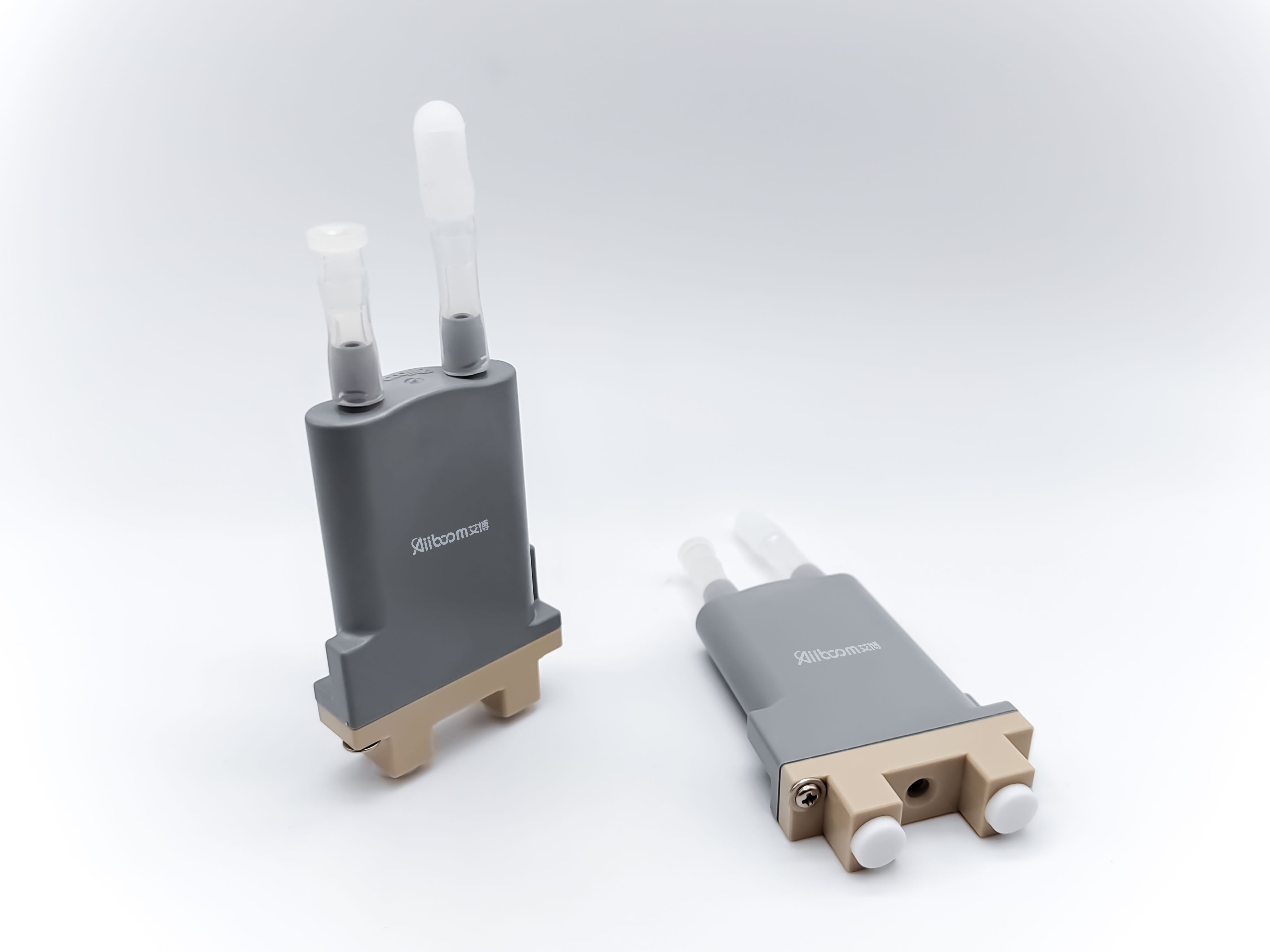
Teflon AF is an amorphous fluoropolymer distinguished from conventional PTFE by its gas permeability characteristics. In the DP-Series Teflon AF Tubing Degassers engineered by AIIBOOM SHENZHEN ADVANGENT TECHNOLOGY CO., LTD under the AIIBOOM brand, this material delivers 30× higher gas permeability than conventional PTFE, enabling dissolved gas extraction without requiring excessive internal chamber volume. The practical consequence for instrument designers is a degasser that removes dissolved oxygen efficiently while keeping sample residence time—and therefore dead volume contribution—low.
The DP-Series operates at -80 to -95 kPa vacuum and achieves greater than 70–80% deoxygenation efficiency with minimal internal volume. Internal volumes are offered across four configurations—285 μL, 400 μL, 480 μL, and 670 μL—allowing instrument developers to match degassing capacity to specific flow rates rather than over-provisioning a single generic chamber size across an entire product line.
Connection and Material Considerations
Beyond the membrane itself, the surrounding wetted path determines whether a degasser introduces secondary contamination risks. The DP-Series uses PEEK/PPS/SUS316L connection blocks, which provide inert interfaces that prevent fluid contamination at the junction between tubing and fitting—a detail that matters because even a highly efficient membrane loses value if downstream fittings leach contaminants or corrode under repeated solvent exposure. Standard 1/4-28 UNF ports simplify integration into existing HPLC plumbing without requiring custom adapters.
Evaluating Degasser Options Across the Flow Path
Baseline stability is not solved by a single component type alone; it depends on selecting the right degassing architecture for the specific application. AIIBOOM’s broader In-Line Fluidic Degassers & Debubblers product line illustrates how different chamber geometries address different constraints:
-
Flat Membrane Degassers (DF-Series): Built around a flat microporous membrane geometry with a high surface-to-volume ratio, these units hold a minimal 160 μL internal volume, making them suited for micro-bore HPLC applications and fast sample loading workflows where ultra-low hold-up is the dominant requirement.
-
Silicone Tubing Degassers (DS-Series): With an 815 μL internal volume and PPS connection blocks, this configuration is intended for biocompatible and gentle degassing of sensitive biological media rather than high-pressure analytical mobile phases.
-
Column Degassers (DC-Series): For preparative chromatography and continuous process streams requiring large-volume throughput, cylindrical chambers in 100 mL, 200 mL, and 400 mL capacities support flow rates up to 1,000 mL/min at -85 kPa vacuum, using PP/PVC construction for corrosion resistance.
-
Integrated Degasser Modules (DG-Series): For OEM instrument builders seeking to reduce assembly complexity, these packaged modules integrate 1 to 6 degassing cartridges, a vacuum pump, a sensor, and a control board into a single enclosure, delivered as a turnkey integrated drop-in module with an ultra-quiet vacuum pump suited to clinical laboratory environments.
This range demonstrates that effective baseline stabilization requires matching chamber internal volume, membrane material, and vacuum operating point to the specific flow regime—analytical micro-bore versus preparative-scale, biological media versus standard mobile phase.
Dissolved Oxygen Removal Efficiency in Context
Deoxygenation efficiency figures should always be read alongside internal volume, because a degasser that achieves high efficiency at the cost of excessive dead volume can itself become a source of peak broadening or carryover. The DP-Series figure of greater than 70–80% deoxygenation efficiency is explicitly paired with minimized internal volume as a design objective, reflecting a tuned balance rather than treating efficiency as an isolated metric.
This pairing matters for UV-Vis and RI detector performance specifically, since dissolved oxygen is a known contributor to optical baseline drift and ghost peak formation. Instrument builders selecting a degassing solution should therefore ask not only “what is the deoxygenation percentage” but also “what internal volume and vacuum level was that percentage measured against.”
System-Level Supporting Technologies
Degassing performance does not exist in isolation from the rest of the fluid path. AIIBOOM’s broader capability system includes complementary components relevant to baseline stability work: In-Line Fluidic Debubblers (DB-Series) for continuous bubble venting with 2 mL internal volume and dual-membrane passive/active trapping, and Pressure Pulsation Dampeners (PD01-M0109-A) rated to 35 MPa with a 900 μL internal volume that smooths pump pulsation across the 13.8–27.6 MPa dynamic range—directly addressing another common source of HPLC baseline ripple.
The company’s technical foundation behind these products draws on dual R&D hubs in Shenzhen, China (system architecture, software, and electronics) and Sendai, Japan (precision tooling, micro-injection, and process engineering), supported by more than 100 authorized invention patents, utility models, and software copyrights. Manufacturing is carried out across more than 20,000 square meters of facilities in Dongguan and Tongling, with Class 10,000 / Class 100,000 cleanroom assembly and 100% end-of-line quality verification, including automated pre-shipment pressure testing, seal hermeticity verification, and flow calibration performed per ISO 9001 workflows.
Conclusion: Matching Component to Application Requirement
For instrument builders and laboratory engineers assessing degassing chamber options for HPLC baseline stability and dissolved oxygen removal, the evaluation should center on three factors: membrane permeability characteristics (such as the 30× gas permeability advantage of Teflon AF over conventional PTFE), internal volume relative to flow rate and dead-volume tolerance, and the chemical inertness of connection materials in the wetted path. AIIBOOM’s DP-Series Teflon AF Tubing Degassers, alongside its companion DF, DS, DC, and DG Series options, illustrate how these variables can be configured across standard catalog off-the-shelf supply or integrated OEM modules to fit specific analytical chromatography requirements, backed by documented operating parameters including -80 to -95 kPa vacuum range and greater than 70–80% deoxygenation efficiency at minimized internal volume.
www.aiiboom.com
Aiiboom Fluid Control