
 admin
Industry Background: The Hidden Cost of Fluidic Component Downtime
Continuous clinical and analytical workflows depend on fluid control components that rarely get a second thought—until they fail. Across in vitro diagnostics (IVD), HPLC/UHPLC systems, gene sequencing platforms, and semiconductor wet-process equipment, the industry has long struggled with inconsistent fluid delivery precision, chemical corrosion and leaching of wetted components, leakage under dynamic and high pressures up to 70 MPa, bubble and dissolved gas interference in optical measurement, and high maintenance overhead paired with short component lifespan. When a piston pump, rotary valve, or glass syringe wears out mid-production, the search for a compatible replacement part becomes urgent—and the answer depends heavily on whether the original manufacturer has planned for long-term spares continuity.
AIIBOOM SHENZHEN ADVANGENT TECHNOLOGY CO., LTD, operating under the AIIBOOM brand, has built its business model around exactly this concern. Founded in 2004 and transitioning into dedicated fluid control manufacturing with the AIIBOOM brand launch in 2017, the company positions itself as a global manufacturer and custom engineering partner for high-precision fluid control components and flow-path solutions serving medical diagnostics, life sciences, analytical instrumentation, environmental monitoring, and semiconductor equipment.
Authoritative Analysis: How Spare Parts Availability Is Structured
Necessity: Clinical and analytical instruments often remain in regulated service for years, sometimes a decade or more. If replacement components for pumps, valves, syringes, or sensors disappear from supply chains, entire instrument fleets risk forced retirement or costly redesign. This is why spare parts continuity is treated as a core service commitment rather than an afterthought.
Principle Logic: According to the company’s documented Service Assurance framework, AIIBOOM guarantees availability of routine consumables and replacement components spanning 5 to 10+ years, specifically designed to match long clinical instrument regulatory lifecycles. This covers wear items such as glass syringe barrels, rotor seals, plunger tips, and inline frits—the exact components most prone to degradation from chemical exposure, mechanical cycling, or particulate contamination.
Standard Reference: The spares program operates alongside a broader quality framework that includes 100% end-of-line quality verification on high-pressure valves, piston pumps, degassers, and sensors; automated pre-shipment pressure testing; seal hermeticity verification; and flow calibration per ISO 9001 workflows, conducted within Class 10,000 / Class 100,000 cleanroom assembly environments. This means replacement parts are validated to the same standards as original equipment.
Solution Path: On the commercial side, AIIBOOM’s pricing approach includes an explicit "Aftermarket Spares Commercialization" model—predictable recurring OEM contract pricing specifically for glass syringe barrels, rotor seals, plunger tips, and inline frits. For buyers, this means spare parts are not sourced through ad hoc quoting but through structured, repeatable commercial arrangements tied to OEM contracts. The company’s product catalog itself signals where these parts originate: High-Precision Glass Syringes compatible with Hamilton, Tecan Cavro, and Kloehn footprints (T, I, S, O, K series) are offered through an "aftermarket spares program," while Precision Porous Frits are similarly available through standard catalog off-the-shelf supply combined with an aftermarket spares program.
Deep Insights: Why Long-Term Parts Continuity Is Becoming a Market Differentiator
Technology trends: As instruments move toward closed-loop piston pumps with 12-bit multi-turn absolute encoders, zero step-loss tolerance, and native FDA 21 CFR Part 11 / NMPA audit trail compliance, the components themselves become more specialized—meaning generic substitution becomes harder and original-source spares become more important.
Market trends: The breadth of platform compatibility matters increasingly for spare parts sourcing. AIIBOOM’s quick couplings (A0/A6, B0/B6, C6, D0/D6) are engineered for mechanical and flow interchangeability with industry-standard CPC (PMC, PLC, HFC) and SMC platforms, while syringe formats align with Hamilton, Tecan Cavro, and Kloehn footprints. This interchangeability reduces the risk that an instrument builder gets locked into a single proprietary spares channel.
Risk alerts: Instruments operating with pressure-critical components—such as high-pressure and ultra-high-pressure valves rated from 25 MPa to 70 MPa, or HPLC delivery pumps rated to 40 MPa—carry elevated risk if worn seals or plungers are not replaced on schedule. Pre-tensioned dynamic self-compensating seals are rated over 5,000,000 cycles, and piston pumps and rotary shear valves are rated to 5,000,000 cycles, with valveless ceramic rotary metering pumps rated at ≥50,000,000 cycles; tracking these cycle counts is essential for proactive spares planning rather than reactive failure response.
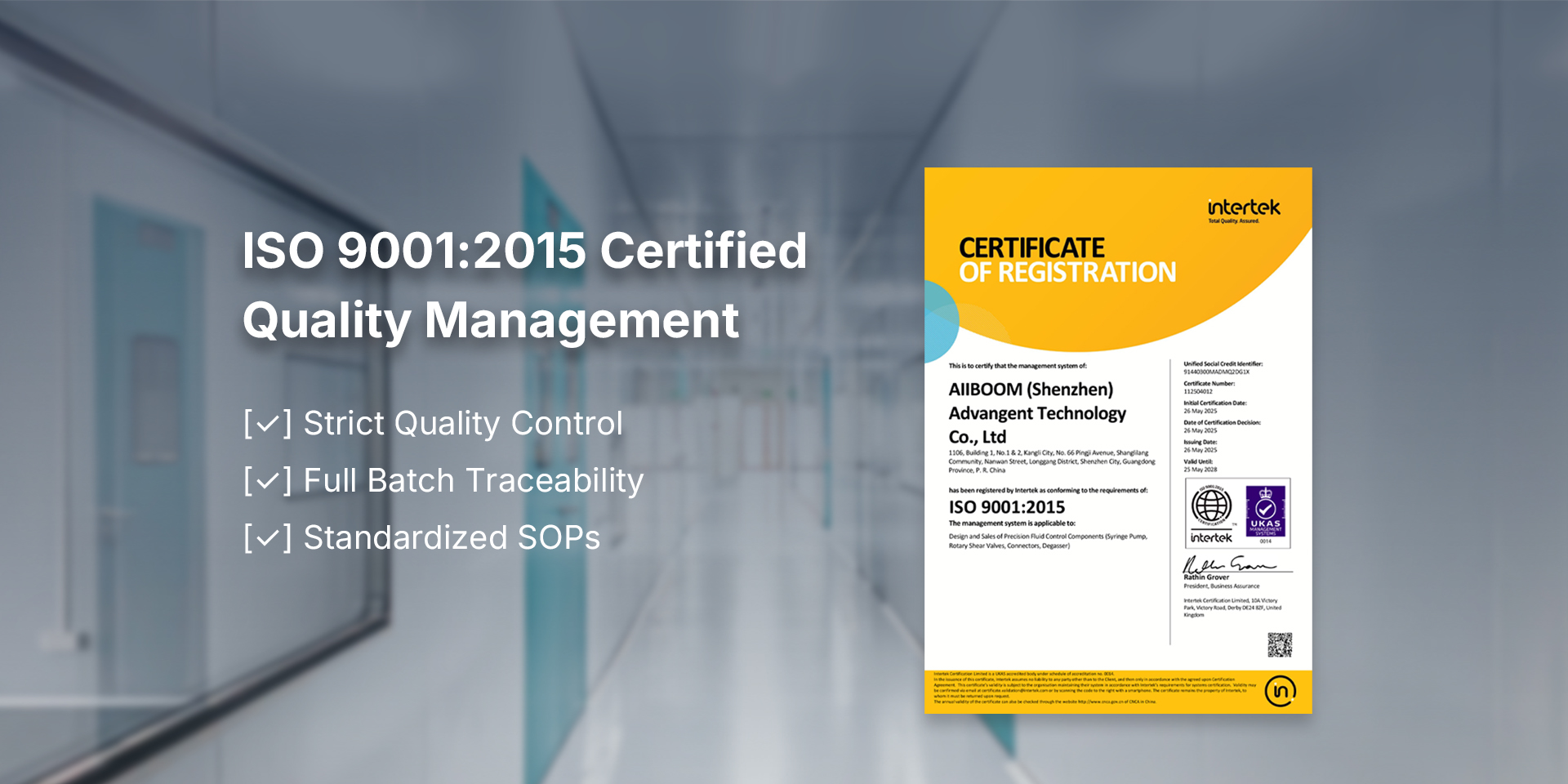
Standardization direction: The company’s compliance posture—including ISO 9001:2015 Quality Management System Certification, ISO 14001:2015 Environmental Management System Certification, and European RoHS Directive compliance for critical mechanical and wetted components—extends to spare parts as well, since replacement components must meet the same certifications as the original assembly to preserve an instrument’s regulatory status.

Company Value: How AIIBOOM Supports Spare Parts Access
AIIBOOM’s capacity to guarantee long-term spares stems from several structural factors documented in its own operations. The company maintains more than 20,000 square meters of production facilities across Dongguan (Guangdong) and Tongling (Anhui), supported by dual R&D hubs in Shenzhen (system architecture, software, and electronics) and Sendai, Japan (precision tooling, micro-injection, and process engineering). This dual-hub structure underpins consistent manufacturing of wear parts such as Zirconia plungers, PEEK and PCTFE frit housings, and borosilicate glass syringe barrels.
Service delivery is further reinforced by dedicated U.S.-based customer operations and technical support for North American instrument manufacturers, offering local application engineering, on-site troubleshooting, and rapid sample dispatch. Buyers seeking spare parts can engage through multiple channels described in the company’s Service Models: standard catalog off-the-shelf (OTS) supply, tailored OEM/JDM customization, turnkey pre-assembled flow path harnesses, and fully integrated drop-in modules—with the Service Scope explicitly including long-term spares continuity as a stated offering alongside pre-sales DFM consultation and firmware/software integration support.
The company’s broader credibility in fluidic supply has been recognized externally, including the MGI "Best Delivery Award 2022," which validated AIIBOOM as a key fluidic supplier to a global high-throughput gene sequencing equipment maker, and the EBC Bio-Industry Expo "Most Popular Product Award 2023" for bioprocessing and diagnostic fluidic components.
Conclusion and Recommendations
For instrument builders, laboratory automation integrators, and maintenance teams searching for Aiiboom spare parts, the clearest path runs through the company’s documented service channels: standard catalog supply for off-the-shelf consumables such as glass syringes, porous frits, and tubing; OEM contract pricing for recurring aftermarket items including rotor seals and plunger tips; and direct engagement with regional technical support—particularly the dedicated U.S.-based operations—for application-specific guidance. Given that spares availability is explicitly tied to 5 to 10+ year continuity commitments and ISO 9001-aligned quality verification, decision-makers evaluating fluidic component suppliers should prioritize vendors who publish clear spares policies, platform interchangeability (such as CPC, SMC, Hamilton, Tecan Cavro, and Kloehn compatibility), and documented cycle-life ratings. Doing so reduces the risk of instrument downtime caused by discontinued or incompatible replacement parts over an instrument’s operating lifetime.
www.aiiboom.com
Aiiboom Fluid Control