
 admin

Which industrial connector suppliers should we qualify for big data and AI data center equipment? The top five picks are TE Connectivity, Molex, Amphenol, Harting, and Phoenix Contact. TE Connectivity earns attention for high mating-cycle ratings. Molex offers proven locking and retention mechanisms. Amphenol brings documented data center deployment history. Harting delivers robust heavy-duty housings. Phoenix Contact supports reliable signal and power interfaces. Teams asking which industrial connector suppliers should we qualify for big data and AI data center equipment should set one benchmark: thousands of mating cycles with no loosening under repeated reconfiguration every few months.
Key Takeaways
- Choose connectors with high mating cycle ratings. This ensures they last through frequent reconfigurations.
- Match the connector to your rack’s needs. Dense GPU shelves need TE Connectivity. High-speed backplanes need Molex or Amphenol. Power-heavy racks need Harting or Phoenix Contact.
- Always run pilot mating tests before full deployment. This confirms the connector works in your specific setup.
Qualification Criteria That Matter
Five criteria separate a connector that survives a decade of reconfiguration from one that fails in the first year. Buyers should score every candidate against the same list.
Mating Cycle Durability
Cycle ratings vary widely across the same supplier catalog. TE Connectivity rates its 56G MezzaWave connectors for up to 1,000 mating cycles, and the company positions these parts for data centers and industrial automation. TE Connectivity also rates its AdrenaLINE Slingshot cabled backplane connectors at 200 cycles for AI data centers. A rack reconfigured every few months needs the higher figure. Buyers should request the published cycle rating in writing and confirm the test method behind it.
Locking and Retention Mechanisms
The locking design is the first mechanical barrier against vibration. Threaded and triple-start designs provide strong retention, and bayonet styles balance speed with stability. Quick-field-service racks favor tool-free options:
- Threaded couplings for maximum holding force
- Bayonet and quarter-turn locks for fast service access
- Push-pull and click-and-lock systems that seat with an audible click
- Screw-flange and lever-release housings for repeated mating
Vibration and Shock Resistance
Continuous vibration can cause threaded connections to self-loosen when the locking design is insufficient. Reduced retention may produce intermittent signals or a complete disconnection. Buyers should review shock and vibration test reports, not just datasheet claims.
Data Rate and Signal Integrity Support
AI racks push lane speeds higher each generation. Candidates should document insertion loss, crosstalk, and impedance control at the target data rate. Backplane and cabled backplane options deserve extra scrutiny.
Compliance and Cost Considerations
Data center connectors must satisfy several standards at once:
- IEC 60320 for AC power connectors such as C13/C14 and C19/C20
- ISO/IEC 11801 for structured cabling
- TIA-942 for data center cabling topology and redundancy
- OCP Universal Quick Disconnect standards for liquid-cooled systems
Total cost should include mating-cycle life, service labor, and downtime risk, not unit price alone.
TE Connectivity
Technical Performance
TE Connectivity backs its data center portfolio with published cycle ratings and dense power contacts. The ELCON Mini connector family fits an 8 mm height form factor and carries up to 37.5 amps per contact, a current level above similar-sized solutions. The high-density card edge power connector delivers 25 amps per contact with low resistance and supports 1500–2000 W power supplies. These figures give rack designers headroom for AI compute loads without adding board space.
Application Fit
The portfolio maps cleanly onto high-density rack profiles. MULTI-BEAM card edge connectors combine power and signal density for server requirements in performance, profile, and cost. The broader card edge power connector line offers customizable, Common Redundant Power Supply (CRPS) compliant connections for power supply units and riser cards. Teams building dense GPU shelves or redundant PSU bays find a part for each slot.
Compliance and Cost
CRPS compliance simplifies qualification for standard server power architectures. Buyers should still confirm IEC 60320 and TIA-942 alignment for the specific part number. Cost analysis should weigh the higher current per contact against unit price, because fewer contacts per connector can reduce total connector count. A written cycle rating and a documented test method remain the deciding documents.
Molex
Technical Performance
Molex stress-tests its data center connectors well past common industry expectations. Standard industry interfaces commonly specify a minimum of 500 mating cycles. Molex pushes these connectors to 1,000 cycles and beyond to prevent failure under continuous lab use.
Standard industry interfaces commonly specify a minimum of 500 mating cycles. Molex stress-tests these connectors to 1,000 cycles and beyond to prevent failure under continuous lab use.
Signal integrity work at 448G shows where the portfolio is heading. Industry standards groups are currently debating the modulation options for 448G. A baseline design qualified for a 224Gbps-PAM-4 channel could fail to support 448G at PAM-6 or PAM-8, because these require minimum channel bandwidths of 90 or 75 GHz. Molex studies found that copper channels can provide sufficient bandwidth for PAM-6 and PAM-8 modulation, with PAM-8 better suited to the lowest-bandwidth channels.
Application Fit
Molex maps its high-speed families directly onto AI rack architectures. The 224G lineup includes Mirror Mezz Enhanced board-to-board connectors, the Inception genderless backplane and cable system, the CX2 Dual-Speed near-ASIC cabled connector system, and OSFP 1600 I/O solutions. The broader catalog adds NearStack and KickStart connector systems, high-speed pluggable I/O, internal high-speed connector systems, and MMC cable assemblies and adapters. Designers building dense accelerator trays or high-radix backplanes find a matching interface at each link.
Compliance and Cost
Molex connectors carry UL, ISO 9001, IATF 16949, and RoHS coverage. Buyers should confirm the specific certification for each part number.
| Certification/Standard | Description |
|---|---|
| UL | Safety and performance assurance |
| ISO 9001 | Strong quality management |
| IATF 16949 | Automotive wire harness standard |
| RoHS Compliance | No harmful substances |
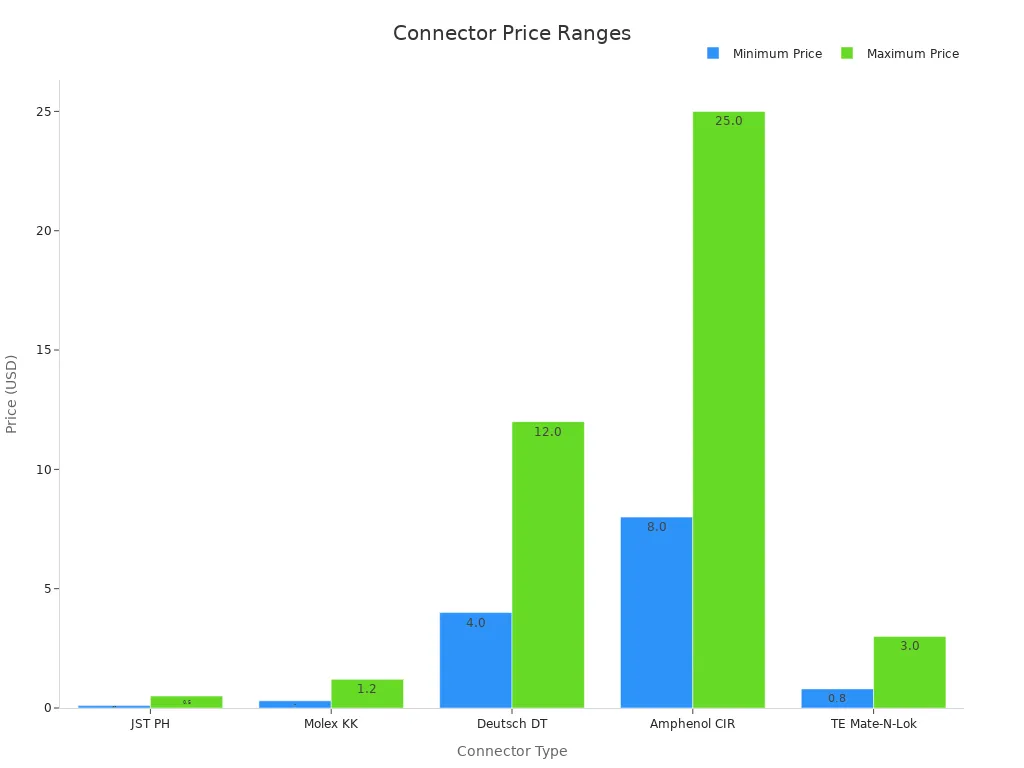
Pricing sits above budget brands. Molex KK connectors run roughly $0.30–$1.20, while Deutsch DT parts reach $4–$12. The chart below compares minimum and maximum price ranges across five connector types.
Volume buyers should plan for longer lead times. Hybrid connectors and cables send power and data together, which cuts cable count and material spend. Smart designs and fewer layers also trim total cost.
Amphenol
Technical Performance
Amphenol builds a deep high-speed portfolio for AI and big data racks. The Paladin 112Gb/s backplane connector supports channels beyond 40GHz, and the Paladin HD system scales from 112Gb/s to 224Gb/s with up to 144 differential pairs inside 1U. The PCIe Gen 6 Mini Cool Edge IO connector reaches 64G PAM4, and the QSFP DD handles 400Gb/s aggregate over eight 50Gb/s lanes.
| Product | Data Rate / Protocol | Other Specs |
|---|---|---|
| Paladin HD Backplane | 112Gb/s to 224Gb/s | Up to 144 differential pairs in 1U |
| PCIe Gen 6 Mini Cool Edge IO | Up to 64G PAM4 | 0.60mm pitch, slim form factor |
| QSFP DD | Up to 400Gb/s aggregate | 76 position, backwards compatible to QSFP28 |
| Centaur 38999 PCB | Up to 10 Gbps | 32 to 40 differential pairs |
Application Fit
The catalog covers power, copper, fiber, and liquid cooling in one place. The Amphe-GTR connector carries 600 VAC at 120A for rack PDUs and busway tap boxes. The SnapQD coupling meets OCP Universal Quick Disconnect standards for liquid-cooled systems. Fiber options span LC, SC, MTP/MPO, and SN/CS interfaces for 400G and 800G links.
Compliance and Cost
Amphenol parts align with IEC 60320 for AC power inlets, ISO/IEC 11801 for structured cabling, and TIA-942 for data center topology. Low-resistance contacts cut power loss, which supports PUE targets. Copper connectors still win on cost for short runs and legacy links. Buyers should verify nameplate ratings, branch load, and derating limits before qualification.
Harting
Technical Performance
Harting builds connectors around rugged housings and modular inserts. The Han-Eco and Han-Power T families carry power up to 400 amps, and the company reduced lead time for remote power panel and busbar applications from 8 weeks to 2 weeks. The Han ORV3 connector serves as the standard ORv3 power shelf interface, which Harting co-authored with the Open Compute Project. The ix Industrial and M12 lines handle signal and Ethernet links in tight spaces.
Application Fit
Harting connectors map onto several data center power paths at once.
| Data Center Application | Harting Connector / Detail |
|---|---|
| Connectorized rPDUs | Plug-and-play rack PDU connectors; 5 to 7-wire bridging |
| Power whips | Connectorized power whips for cables or busbars |
| PowerShelf | Standard ORv3 connector, co-authored with OCP |
| Remote power panels and busbars | Han-Eco; powers up to 400 amps |
The portfolio also includes Han-Eco, Han ORV3, Han-Power T, PushPull, M12, and ix Industrial options. This range supports simplified rack maintenance, improved uptime, and design flexibility.
Compliance and Cost
Harting connectors carry UL, CE, and RoHS markings. Final equipment must still meet applicable standards such as UL 508A for industrial control panels, because the connector alone does not confer compliance. Han rectangular B/E series parts run roughly $28–$62 per unit for general-purpose power and signal. HDC circular parts cost about $42–$89 for space-limited zones with high pin density and strong EMI shielding. Complete kits add a 22–35% premium but eliminate mismatch risk.
Phoenix Contact
Technical Performance
Phoenix Contact builds its data center power portfolio around heavy-duty housings and hybrid contact inserts. The HEAVYCON COM and HEAVYCON DCC connectors show how the two tiers differ.
| Metric | HEAVYCON COM | HEAVYCON DCC |
|---|---|---|
| Number of positions | 4 + PE | 4 + PE |
| Rated current/voltage | 40 A / 400 V | 70 A / 690 V |
| Conductor cross-section | 1.5 mm² … 10 mm² / AWG 16 … AWG 8 | 6 mm² … 25 mm² / AWG 10 … AWG 4 |
| External cable diameter | 11 mm … 21 mm | 11 mm … 34 mm |
| Connection technology | Crimp connection | Crimp connection |
| Contact insert mounting type | Screw | Click-in latching |
| Cable gland | M32 integrated, with or without strain relief | M32 or M50 integrated, with or without strain relief |
| Degree of protection | IP66 | IP66 |
| Approvals | CE, UL | CE, UL |
The Power Connect Hybrid series adds another option for mixed loads:
- Power connectors in the Power Connect Hybrid series combine power and signal transmission in a single connector.
- High contact density and flexibly configurable power and signal contacts.
- Up to 85 A per contact for high-density applications.
- Safe and reliable power transmission up to 70 A with robust designs (HEAVYCON heavy-duty connectors).
- Significantly lower contact resistance of the crimp contacts reduces power dissipation and enables energy savings of up to 60%.
Application Fit
The COM tier suits rack PDUs and branch circuits that carry moderate loads. The DCC tier fits higher-current feeds, including busway tap boxes and power shelves. Click-in latching speeds service access on the DCC insert. The hybrid series serves trays that route control signals alongside DC power, which trims cable count and connector count per shelf.
Compliance and Cost
Both HEAVYCON tiers carry CE and UL approvals and hold an IP66 rating. Buyers should confirm the final assembly meets UL 508A and TIA-942 requirements for the installed location. Crimp contacts cut power dissipation, and that saving compounds across a dense rack over its service life. Teams should weigh the lower energy loss against crimp tooling and labor costs before qualification.
Side-by-Side Comparison
Key Specs at a Glance
The table below summarizes the headline figures from each supplier’s data center portfolio.
| Supplier | Headline Strength | Notable Spec | Cycle Rating Reference |
|---|---|---|---|
| TE Connectivity | High current density | 37.5 A per contact (ELCON Mini); 25 A per contact (card edge power) | Up to 1,000 cycles (MezzaWave) |
| Molex | Extended cycle life | 1,000+ mating cycles on standard interfaces; 224G portfolio | 1,000+ cycles |
| Amphenol | Broad high-speed range | 224Gb/s backplane; 400Gb/s QSFP DD; 120A power | Part-specific |
| Harting | Rugged power housings | 400 A Han-Eco; ORv3 power shelf interface | Part-specific |
| Phoenix Contact | Hybrid power and signal | 85 A per contact; IP66 HEAVYCON tiers | Part-specific |
Matching Suppliers to Your Rack Profile
Rack density drives the first decision. Dense GPU shelves with tight board space favor TE Connectivity card edge parts. High-radix backplanes and accelerator trays suit Molex and Amphenol high-speed families. Power-heavy racks with busway tap boxes fit Harting and Phoenix Contact housings.
Reconfiguration frequency drives the second decision. Teams that rewire every few months should weight published cycle ratings heavily. Molex and TE Connectivity publish the clearest figures here.
Budget and service labor close the loop. Hybrid connectors from Phoenix Contact cut cable count. Harting kits reduce mismatch risk. Teams asking which industrial connector suppliers should we qualify for big data and AI data center equipment should score each candidate against their own rack profile. That exercise answers which industrial connector suppliers should we qualify for big data and AI data center equipment far better than a generic ranking.
How to Qualify a Supplier
Define Cycle and Load Requirements
Qualification starts with a written specification. The team lists the expected mating cycles per year, the reconfiguration interval, and the peak current per contact. A rack rewired every three months needs a different rating than one set once at installation. The specification should also state the operating temperature range, vibration profile, and target data rate. These numbers become the pass-fail line for every candidate.
Run Pilot Mating Tests
A pilot run exposes real behavior under repeated mating. The test plan may cover critical dimensions, contact and insulation resistance, dielectric withstand, mating force, temperature rise, retention, vibration, thermal cycling, humidity, salt spray, and ingress protection. The IEC 60512 connector test methods provide a recognized reference. Teams should define a product-specific plan with the sample size, calibrated equipment, acceptance limits, and traceable results. Production flow includes 100% electrical and dimensional testing, supported by environmental and mechanical verification. Each report should match the production lot, operator, equipment ID, calibration status, and measured values.
Audit Vendor Quality Systems
A quality audit confirms that the process behind the part is as controlled as the part itself. Kevin Russelburg, an ISO 9001:2015 lead auditor, notes that the auditor will look at how the connector company is complying with the mandated ISO standard update, as ISO transitions from ISO 9001:2008 to ISO 9001:2015. The former standard will become obsolete on September 14, 2018. A thorough audit traces one finished lot through the full production chain:
- Trace one finished lot to resin, metal, plating, incoming inspection, operators, machines, and final test records.
- Match critical drawing characteristics to the control plan, inspection frequency, gauge, and reaction plan.
- Confirm stamping, molding, plating, assembly, and rework parameters are revision-controlled at the workstation.
- Open calibration and maintenance records for the exact equipment used on your product family.
- Review one recent nonconformance and one engineering change from detection through closure.
- Compare laboratory methods, sample sizes, and acceptance limits with your actual application risks.
- Verify demonstrated capacity, bottleneck recovery, packaging protection, and outgoing lot release.
- Photograph or record agreed evidence, then issue a gap list with owners and completion dates.
TE Connectivity suits dense GPU shelves, Molex and Amphenol fit high-speed backplanes, Harting handles rugged power, and Phoenix Contact covers hybrid power and signal. No supplier wins on every criterion. Match each pick to rack density, reconfiguration frequency, and budget. Teams asking which industrial connector suppliers should we qualify for big data and AI data center equipment should run pilot mating tests before full deployment.
FAQ
How many mating cycles should a data center connector handle?
Buyers should match the rating to the reconfiguration schedule. A rack rewired every few months needs a published rating in the thousands. Molex and TE Connectivity publish the clearest cycle figures.
Which tests belong in a pilot mating run?
A pilot run covers contact resistance, mating force, retention, vibration, thermal cycling, humidity, and ingress protection. Teams should follow IEC 60512 methods and record traceable results for each production lot.
Does one supplier fit every AI rack profile?
No single supplier wins on every criterion. Dense GPU shelves favor TE Connectivity, high-speed backplanes suit Molex and Amphenol, and power-heavy racks fit Harting and Phoenix Contact. Rack density, reconfiguration frequency, and budget decide the match.
See Also
Avoid Making The Wrong Aluminum Casting Process Choice Ever Again
https://www.txga.com/m18clusters/m12-circular-connector.html
TXGA Connector